Deep Dive · Robotics
What Are Robot Actuators? Motors, Gears, Costs, and Companies
A practical guide to the systems that make robots move, including motors, reducers, sensors, brakes, drives, actuator types, supplier economics, joint counts, public prices, failure modes, and buyer tradeoffs.
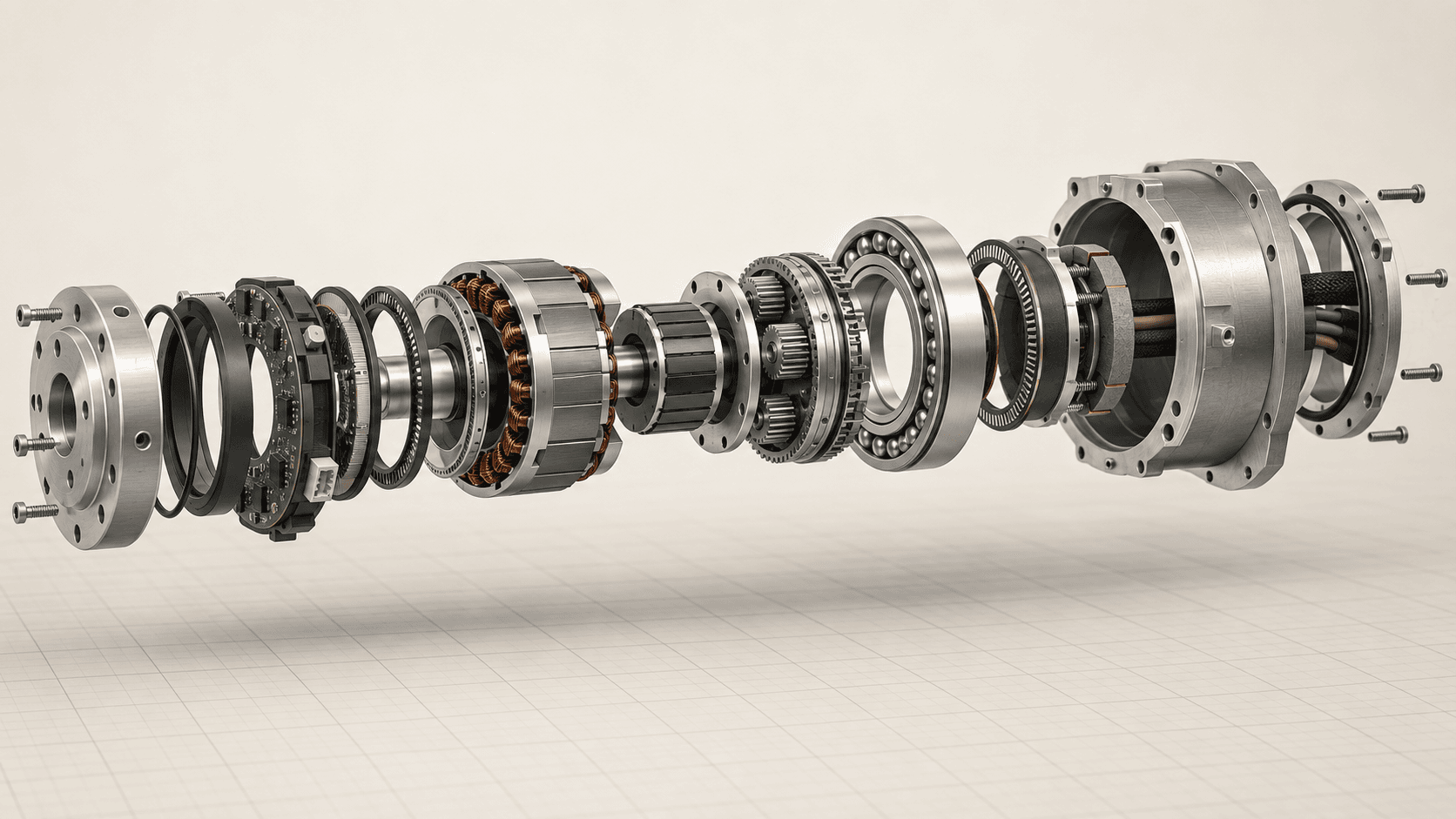
A robot actuator is the part of a machine that turns energy into controlled physical motion. It rotates an arm, bends a knee, closes a gripper, drives a wheel, extends a cylinder, or tensions a cable. Software may decide where the robot should go, but actuators create the force that makes the decision real.
The simplest mental model is muscle. The better engineering model is an entire joint organ. A modern electric rotary actuator can combine a motor, precision reducer, bearings, encoders, torque sensing, brake, power electronics, communications, thermal path, seals, lubrication, and structural housing. Calling that assembly a motor is like calling a car an engine.
This guide explains what sits inside an actuator, why different robots need different architectures, how many actuators common robot types use, which companies supply the stack, and what public prices can and cannot tell a buyer. It also explains why the actuator line in a robot budget is much larger than the catalog price of its motor.
The Short Answer
What is an actuator?
Practical Answer
A device or integrated system that converts electrical, hydraulic, or pneumatic energy into controlled motion.
Is an actuator the same as a motor?
Practical Answer
No. A motor can be one component inside an actuator. The complete joint may also need gearing, sensing, bearings, a brake, electronics, and a housing.
How many go into a robot?
Practical Answer
A simple mobile base may use two drive actuators. A six axis arm normally uses six. A quadruped commonly uses twelve. A humanoid can use roughly 23 to more than 40 joint motors, with dexterous hands adding many more degrees of freedom.
What do they cost?
Practical Answer
Public integrated modules span from about $57 for a small educational unit to more than $3,500 for a larger smart servo. Commercial robot makers usually buy or manufacture custom systems at confidential volume economics.
What matters most?
Practical Answer
Continuous torque, speed, thermal performance, efficiency, shock tolerance, sensing, life, safety, serviceability, and cost at the required production volume.
| Question | Practical Answer |
|---|---|
| What is an actuator? | A device or integrated system that converts electrical, hydraulic, or pneumatic energy into controlled motion. |
| Is an actuator the same as a motor? | No. A motor can be one component inside an actuator. The complete joint may also need gearing, sensing, bearings, a brake, electronics, and a housing. |
| How many go into a robot? | A simple mobile base may use two drive actuators. A six axis arm normally uses six. A quadruped commonly uses twelve. A humanoid can use roughly 23 to more than 40 joint motors, with dexterous hands adding many more degrees of freedom. |
| What do they cost? | Public integrated modules span from about $57 for a small educational unit to more than $3,500 for a larger smart servo. Commercial robot makers usually buy or manufacture custom systems at confidential volume economics. |
| What matters most? | Continuous torque, speed, thermal performance, efficiency, shock tolerance, sensing, life, safety, serviceability, and cost at the required production volume. |
Public prices are snapshots from supplier stores reviewed on September 15, 2026. They are not quotations for a production robot.
The Joint Is More Than the Motor
An electric motor creates torque at its rotor. Many robots need more output torque and less speed than a compact motor naturally provides, so a transmission changes the relationship. Bearings carry the robot structure and payload. An encoder measures position. A servo drive regulates motor current. A controller closes motion loops. A brake can hold a vertical axis when power is removed. The housing aligns these parts while carrying heat into the robot frame.
Every layer changes the behavior of the others. A high reduction ratio multiplies motor torque, but it also reflects inertia, friction, and transmission error back into the joint. A compact housing saves space, but it may trap heat. A hollow shaft makes cable routing cleaner, but it consumes valuable diameter. A stronger output bearing can improve stiffness while adding mass that the next joint must move.
This is why actuator development is a systems problem. The best motor on a bench can become a poor robot joint after it is paired with the wrong reducer, poorly supported by bearings, measured by a noisy encoder, or placed inside a housing that cannot reject heat.
Inside a Typical Electric Rotary Actuator
Motor
Job
Converts electrical power into rotor torque and speed
What Can Go Wrong
Copper heating, magnet temperature, insulation damage, cogging, weak torque density
Reducer
Job
Trades motor speed for higher output torque
What Can Go Wrong
Wear, backlash, lost motion, friction, tooth damage, poor shock life
Bearings
Job
Carry radial, axial, and overturning loads
What Can Go Wrong
Brinelling, contamination, preload loss, misalignment, fatigue
Encoders
Job
Measure rotor and output position
What Can Go Wrong
Drift, electrical noise, damaged code ring, calibration error
Torque sensing
Job
Measures or estimates joint load
What Can Go Wrong
Bias drift, overload, hysteresis, poor current calibration
Servo drive
Job
Switches power and controls motor current
What Can Go Wrong
Power device heat, current sensor error, bus faults, software defects
Brake
Job
Holds or stops an axis under defined conditions
What Can Go Wrong
Wear, release failure, insufficient holding torque, added drag
Housing and seals
Job
Align parts, carry load, reject heat, and exclude contaminants
What Can Go Wrong
Distortion, leakage, blocked heat flow, difficult repair
Connectors and harness
Job
Deliver power, data, grounding, and sensor signals
What Can Go Wrong
Flex fatigue, fretting, abrasion, loose contacts, electromagnetic interference
| Layer | Job | What Can Go Wrong |
|---|---|---|
| Motor | Converts electrical power into rotor torque and speed | Copper heating, magnet temperature, insulation damage, cogging, weak torque density |
| Reducer | Trades motor speed for higher output torque | Wear, backlash, lost motion, friction, tooth damage, poor shock life |
| Bearings | Carry radial, axial, and overturning loads | Brinelling, contamination, preload loss, misalignment, fatigue |
| Encoders | Measure rotor and output position | Drift, electrical noise, damaged code ring, calibration error |
| Torque sensing | Measures or estimates joint load | Bias drift, overload, hysteresis, poor current calibration |
| Servo drive | Switches power and controls motor current | Power device heat, current sensor error, bus faults, software defects |
| Brake | Holds or stops an axis under defined conditions | Wear, release failure, insufficient holding torque, added drag |
| Housing and seals | Align parts, carry load, reject heat, and exclude contaminants | Distortion, leakage, blocked heat flow, difficult repair |
| Connectors and harness | Deliver power, data, grounding, and sensor signals | Flex fatigue, fretting, abrasion, loose contacts, electromagnetic interference |
Black Scarab Weekly
Get the next Black Scarab deep dive
Keep reading now, then get every new deep dive and news report in Thursday's briefing.
How Motion Travels Through the Stack
A higher level computer asks for a joint position, velocity, or torque. The local controller compares that request with encoder measurements. The servo drive adjusts current through the motor windings. Magnetic fields create rotor torque. The transmission converts that motion into the speed and torque available at the output. Bearings deliver the load into the robot structure, while sensors report what actually happened.
These loops operate at different rates. Perception and task planning can tolerate more delay than joint current control. A robot can therefore run a sophisticated model on a central computer while closing fast current and position loops near the actuator. Local control also reduces the amount of time critical traffic moving across the robot network.
Force control requires more than a command labeled torque. The machine needs a credible estimate of output force, known transmission behavior, enough control bandwidth, and a mechanical structure that does not hide impacts behind friction. Some systems use a dedicated torque sensor. Others estimate output torque from motor current and a calibrated transmission model. Both approaches have error sources.
From Command to Contact
Task planner
Input
Desired robot action
Output
Joint or tool trajectory
Key Constraint
World uncertainty and timing
Motion controller
Input
Trajectory and robot state
Output
Position, velocity, or torque commands
Key Constraint
Coordination across axes
Servo drive
Input
Command and encoder feedback
Output
Controlled phase current
Key Constraint
Loop speed, efficiency, and electrical limits
Motor
Input
Electrical current
Output
Rotor torque and speed
Key Constraint
Temperature and magnetic limits
Transmission
Input
Rotor motion
Output
Joint torque and speed
Key Constraint
Ratio, efficiency, stiffness, backlash, and shock
Output structure
Input
Joint motion
Output
Movement of the robot and payload
Key Constraint
Bearing load, link stiffness, and contact forces
| Stage | Input | Output | Key Constraint |
|---|---|---|---|
| Task planner | Desired robot action | Joint or tool trajectory | World uncertainty and timing |
| Motion controller | Trajectory and robot state | Position, velocity, or torque commands | Coordination across axes |
| Servo drive | Command and encoder feedback | Controlled phase current | Loop speed, efficiency, and electrical limits |
| Motor | Electrical current | Rotor torque and speed | Temperature and magnetic limits |
| Transmission | Rotor motion | Joint torque and speed | Ratio, efficiency, stiffness, backlash, and shock |
| Output structure | Joint motion | Movement of the robot and payload | Bearing load, link stiffness, and contact forces |
The Main Actuator Families
Electric actuation dominates many contemporary robots because batteries, motors, drives, and digital control can be packaged into compact modules. It is not the only answer. Hydraulic systems remain attractive when force density and impact tolerance outweigh plumbing complexity. Pneumatic systems can be fast, inexpensive, and clean at the point of use when a facility already supplies compressed air. Cable, tendon, screw, and belt mechanisms often relocate or reshape the output of another actuator.
The visible motion and the energy source are separate classifications. A rotary electric motor can create linear motion through a ball screw. A hydraulic cylinder creates linear motion directly. A rotary pneumatic vane can turn a fixture. The buyer should describe the required output before selecting the energy source.
Actuator Types and Their Natural Homes
Electric rotary
Strength
Precise digital control, compact integration, broad supplier base
Tradeoff
Heat, gearing losses, and shock sensitivity can limit performance
Common Uses
Robot arms, mobile platforms, humanoids, quadrupeds, surgical systems
Electric linear
Strength
Clean and controllable straight line motion
Tradeoff
Screws, belts, or guides add length, wear, and packaging constraints
Common Uses
Grippers, lifts, mobile robot mechanisms, factory axes
Hydraulic
Strength
Very high force density and robust load handling
Tradeoff
Pumps, valves, fluid, leaks, noise, and maintenance increase system complexity
Common Uses
Heavy field robots, construction systems, high force research platforms
Pneumatic
Strength
Fast, simple, low component cost, tolerant of dirty factory work
Tradeoff
Compressed air is inefficient and precise force or position control can be difficult
Common Uses
Clamps, pick and place units, grippers, end tooling, packaging automation
Direct drive
Strength
No reduction stage, minimal backlash, excellent transparency
Tradeoff
Large motor size or limited output torque for a given package
Common Uses
Precision stages, gimbals, wheels, selected robot joints
Quasi direct drive
Strength
Low ratio gearing preserves speed and backdrivability while multiplying torque
Tradeoff
Needs a high torque density motor and careful thermal design
Common Uses
Dynamic quadrupeds, exoskeletons, humanoid limbs
Series elastic
Strength
A deliberate spring improves impact tolerance and provides a path to force measurement
Tradeoff
Compliance reduces stiffness and changes control bandwidth
Common Uses
Human interaction, legged robots, research arms, prosthetics
Tendon or cable driven
Strength
Moves motor mass away from distal joints and enables compact fingers
Tradeoff
Stretch, friction, routing, wear, and calibration complicate control
Common Uses
Robot hands, wrists, soft covers, humanlike limbs
| Type | Strength | Tradeoff | Common Uses |
|---|---|---|---|
| Electric rotary | Precise digital control, compact integration, broad supplier base | Heat, gearing losses, and shock sensitivity can limit performance | Robot arms, mobile platforms, humanoids, quadrupeds, surgical systems |
| Electric linear | Clean and controllable straight line motion | Screws, belts, or guides add length, wear, and packaging constraints | Grippers, lifts, mobile robot mechanisms, factory axes |
| Hydraulic | Very high force density and robust load handling | Pumps, valves, fluid, leaks, noise, and maintenance increase system complexity | Heavy field robots, construction systems, high force research platforms |
| Pneumatic | Fast, simple, low component cost, tolerant of dirty factory work | Compressed air is inefficient and precise force or position control can be difficult | Clamps, pick and place units, grippers, end tooling, packaging automation |
| Direct drive | No reduction stage, minimal backlash, excellent transparency | Large motor size or limited output torque for a given package | Precision stages, gimbals, wheels, selected robot joints |
| Quasi direct drive | Low ratio gearing preserves speed and backdrivability while multiplying torque | Needs a high torque density motor and careful thermal design | Dynamic quadrupeds, exoskeletons, humanoid limbs |
| Series elastic | A deliberate spring improves impact tolerance and provides a path to force measurement | Compliance reduces stiffness and changes control bandwidth | Human interaction, legged robots, research arms, prosthetics |
| Tendon or cable driven | Moves motor mass away from distal joints and enables compact fingers | Stretch, friction, routing, wear, and calibration complicate control | Robot hands, wrists, soft covers, humanlike limbs |
The categories overlap. A tendon driven joint can be electric and series elastic at the same time.
Why Robots Use Precision Reducers
A reduction stage lets a relatively small, fast motor produce useful joint torque. The ratio is not free leverage. Higher ratios can increase reflected inertia and friction, reduce backdrivability, magnify transmission imperfections, and restrict output speed. The correct reducer is the one that fits the complete motion and load cycle.
Strain wave reducers are compact, precise, and commonly associated with robot wrists, compact arms, and collaborative systems. Cycloidal reducers are valued for rigidity, load capacity, and shock tolerance in larger industrial axes. Planetary gearsets can deliver efficient, compact reduction across many size and ratio classes. Screws convert rotation to linear motion, while belts and cables can relocate mass or isolate geometry.
Harmonic Drive Systems says a vertically articulated robot typically uses six precision reducers and that compact or collaborative robots commonly use five to six. Nabtesco estimates that its precision reducers hold about 60 percent of the market for joints in medium and large industrial robots. Both statements come from the suppliers and should be read as company disclosures, not independent market audits.
Transmission Choices
Strain wave
Why Designers Use It
Compact high ratio reduction, low backlash, hollow options
Main Watch Item
Flex element fatigue, efficiency, torsional compliance, shock loading
Representative Suppliers
Harmonic Drive Systems, Nidec, Schaeffler, Leaderdrive
Cycloidal
Why Designers Use It
High rigidity, high load capacity, durability, overload resistance
Main Watch Item
Mass, manufacturing precision, vibration, package size
Representative Suppliers
Nabtesco, Sumitomo Drive Technologies, Spinea
Planetary
Why Designers Use It
Efficient, scalable, familiar manufacturing, useful low and medium ratios
Main Watch Item
Backlash, bearing support, gear noise, load sharing
Representative Suppliers
maxon, Wittenstein, Neugart, Schaeffler, Nidec
Ball or roller screw
Why Designers Use It
Efficient conversion from rotary to linear motion
Main Watch Item
Buckling, lubrication, contamination, nut life, impact
Representative Suppliers
Schaeffler, THK, Bosch Rexroth, Ewellix, HIWIN
Belt, cable, or tendon
Why Designers Use It
Remote motor placement, low distal mass, flexible routing
Main Watch Item
Stretch, creep, tension maintenance, pulley wear, friction
Representative Suppliers
Robot maker design plus broad cable and belt suppliers
| Mechanism | Why Designers Use It | Main Watch Item | Representative Suppliers |
|---|---|---|---|
| Strain wave | Compact high ratio reduction, low backlash, hollow options | Flex element fatigue, efficiency, torsional compliance, shock loading | Harmonic Drive Systems, Nidec, Schaeffler, Leaderdrive |
| Cycloidal | High rigidity, high load capacity, durability, overload resistance | Mass, manufacturing precision, vibration, package size | Nabtesco, Sumitomo Drive Technologies, Spinea |
| Planetary | Efficient, scalable, familiar manufacturing, useful low and medium ratios | Backlash, bearing support, gear noise, load sharing | maxon, Wittenstein, Neugart, Schaeffler, Nidec |
| Ball or roller screw | Efficient conversion from rotary to linear motion | Buckling, lubrication, contamination, nut life, impact | Schaeffler, THK, Bosch Rexroth, Ewellix, HIWIN |
| Belt, cable, or tendon | Remote motor placement, low distal mass, flexible routing | Stretch, creep, tension maintenance, pulley wear, friction | Robot maker design plus broad cable and belt suppliers |
How Many Actuators Does a Robot Need?
A degree of freedom is an independently controlled motion. A dedicated actuator often controls one degree of freedom, but the relationship is not always one to one. One actuator can drive several coupled joints. Several actuators can cooperate around one joint. Passive springs, differentials, linkages, and underactuated fingers can add motion without adding an equal number of motors.
For a conventional articulated arm, the count is straightforward. Universal Robots describes its current arms as six rotating joints, which means six servo joints in the arm before any gripper, external rail, turntable, or tool changer is added. A quadruped with three controlled joints per leg uses twelve leg actuators. A mobile base can use two wheel motors, four independent wheel drives, or more elaborate steering and suspension actuation.
Humanoids show why configuration matters. Unitree publishes 23 joint motors for the base G1 and a range of 23 to 43 degrees of freedom for G1 EDU configurations. Schaeffler says an average humanoid uses 25 to 30 actuators in major body joints. Hands can change the total dramatically. Harmonic Drive Systems notes that a humanlike hand with three reducer equipped joints per finger would use 15 reducers per hand, or 30 across two hands.
Typical Actuator Counts by Robot Form
Differential drive mobile base
Typical Count
2
What Is Included
Left and right wheel drive
What Can Add More
Steering, suspension, lift, conveyor, manipulator
Four wheel mobile platform
Typical Count
4 to 8
What Is Included
Wheel drives, sometimes independent steering
What Can Add More
Active suspension and onboard handling
Six axis robot arm
Typical Count
6
What Is Included
Base, shoulder, elbow, and three wrist axes
What Can Add More
Gripper, seventh axis, track, positioner, tool changer
Quadruped
Typical Count
12
What Is Included
Three joints per leg
What Can Add More
Active spine, neck, gripper, arm, wheels
Basic humanoid
Typical Count
About 20 to 30
What Is Included
Legs, arms, waist, and sometimes neck
What Can Add More
Wrists, richer torso, ankles, hands, face
Dexterous humanoid
Typical Count
30 to more than 50
What Is Included
Body plus additional wrist and hand motion
What Can Add More
Independently actuated fingers can expand the count quickly
Industrial gripper
Typical Count
1 to 3
What Is Included
Open, close, and sometimes rotate or change stroke
What Can Add More
Independent fingers, compliance, tool changing
| Robot | Typical Count | What Is Included | What Can Add More |
|---|---|---|---|
| Differential drive mobile base | 2 | Left and right wheel drive | Steering, suspension, lift, conveyor, manipulator |
| Four wheel mobile platform | 4 to 8 | Wheel drives, sometimes independent steering | Active suspension and onboard handling |
| Six axis robot arm | 6 | Base, shoulder, elbow, and three wrist axes | Gripper, seventh axis, track, positioner, tool changer |
| Quadruped | 12 | Three joints per leg | Active spine, neck, gripper, arm, wheels |
| Basic humanoid | About 20 to 30 | Legs, arms, waist, and sometimes neck | Wrists, richer torso, ankles, hands, face |
| Dexterous humanoid | 30 to more than 50 | Body plus additional wrist and hand motion | Independently actuated fingers can expand the count quickly |
| Industrial gripper | 1 to 3 | Open, close, and sometimes rotate or change stroke | Independent fingers, compliance, tool changing |
Counts are architectural ranges, not universal rules. Published robot specifications may count powered joints, degrees of freedom, and hand motion differently.
What Robot Actuators Cost
There is no single actuator price because the category stretches from a small educational smart servo to a custom industrial joint qualified for years of high duty operation. Torque class, volume, integration, sensing, precision, safety, environmental protection, documentation, and service support all change the number.
Public stores provide useful reference points. ROBOTIS listed its AX 12A smart actuator at $57.39, several X series units around $103 to $632, and larger DYNAMIXEL P models from about $1,092 to $3,542 when reviewed. CubeMars listed compact robotic actuation modules from about $135.90 and larger AK modules from roughly $299 to $990. These are retail snapshots before shipping, taxes, brackets, cables, power supplies, controllers, spares, and integration.
The public range does not reveal the cost inside a mass produced commercial robot. An original equipment manufacturer may buy components under confidential contracts, manufacture key elements internally, amortize tooling over volume, and use several actuator sizes across one body. Retail multiplication can illustrate sensitivity, but it cannot reconstruct a private bill of materials.
Public Price Evidence Reviewed September 15, 2026
ROBOTIS DYNAMIXEL AX 12A
Published Price
$57.39
What It Demonstrates
A small integrated smart servo can combine motor, reduction, control, sensing, and networking at hobby and education scale
Important Limitation
Not a leg or industrial arm actuator
ROBOTIS DYNAMIXEL X family
Published Price
About $103 to $632 across listed models
What It Demonstrates
Integration and performance create a wide price ladder inside one product family
Important Limitation
Models differ substantially and are not interchangeable
ROBOTIS DYNAMIXEL P family
Published Price
About $1,092 to $3,542 across listed models
What It Demonstrates
Larger professional smart servos can cost thousands each at retail
Important Limitation
Lead times and accessories vary
CubeMars AK40 family
Published Price
About $135.90 to $185.90 for listed V3 models
What It Demonstrates
Compact integrated modules aimed at robot joints can reach low retail price points
Important Limitation
Published specifications and durability still require application validation
CubeMars AK60, AK70, and AK80 family
Published Price
About $299 to $990 across reviewed listings
What It Demonstrates
Torque class, ratio, encoder, and drive configuration change cost materially
Important Limitation
Store prices can change and do not represent volume contracts
| Supplier and Product | Published Price | What It Demonstrates | Important Limitation |
|---|---|---|---|
| ROBOTIS DYNAMIXEL AX 12A | $57.39 | A small integrated smart servo can combine motor, reduction, control, sensing, and networking at hobby and education scale | Not a leg or industrial arm actuator |
| ROBOTIS DYNAMIXEL X family | About $103 to $632 across listed models | Integration and performance create a wide price ladder inside one product family | Models differ substantially and are not interchangeable |
| ROBOTIS DYNAMIXEL P family | About $1,092 to $3,542 across listed models | Larger professional smart servos can cost thousands each at retail | Lead times and accessories vary |
| CubeMars AK40 family | About $135.90 to $185.90 for listed V3 models | Compact integrated modules aimed at robot joints can reach low retail price points | Published specifications and durability still require application validation |
| CubeMars AK60, AK70, and AK80 family | About $299 to $990 across reviewed listings | Torque class, ratio, encoder, and drive configuration change cost materially | Store prices can change and do not represent volume contracts |
Prices are supplier listed retail observations, not endorsements, production quotes, or like for like performance comparisons.
Illustrative Module Multiplication
Six axis arm
Count
6
Low Module Assumption
$300
High Module Assumption
$1,500
Arithmetic Only
$1,800 to $9,000
Twelve actuator quadruped
Count
12
Low Module Assumption
$300
High Module Assumption
$990
Arithmetic Only
$3,600 to $11,880
Twenty three actuator humanoid
Count
23
Low Module Assumption
$136
High Module Assumption
$1,500
Arithmetic Only
$3,128 to $34,500
Forty three actuator humanoid
Count
43
Low Module Assumption
$136
High Module Assumption
$1,500
Arithmetic Only
$5,848 to $64,500
| Architecture | Count | Low Module Assumption | High Module Assumption | Arithmetic Only |
|---|---|---|---|---|
| Six axis arm | 6 | $300 | $1,500 | $1,800 to $9,000 |
| Twelve actuator quadruped | 12 | $300 | $990 | $3,600 to $11,880 |
| Twenty three actuator humanoid | 23 | $136 | $1,500 | $3,128 to $34,500 |
| Forty three actuator humanoid | 43 | $136 | $1,500 | $5,848 to $64,500 |
Black Scarab illustration only. A real robot mixes actuator sizes, uses negotiated or internal costs, and requires the rest of the machine. The same module would rarely suit every joint.
The Cost You Do Not See in the Catalog
The actuator purchase price is only the beginning. Engineers must size the joint, model loads, design housings, route cables, tune controls, validate thermals, manage suppliers, build fixtures, inspect parts, and test life. Certification and safety engineering can be substantial for machines that share space with people or operate in regulated environments.
A cheap module can become expensive if it needs a custom adapter, separate output bearing, external drive, fragile connector, complex calibration, or frequent replacement. A more expensive integrated joint may lower development time and field service. The correct comparison is cost per dependable operating hour at the required performance, not dollars per newton meter on a product page.
Production volume changes the answer again. A research team values availability, documentation, flexible software, and the ability to buy one replacement. A robot maker building thousands of units values repeatability, supplier capacity, test automation, second sources, tooling control, and a cost curve that improves without quality drifting.
The Complete Actuator Cost Basket
Components
Included Work
Motor, reducer, bearings, encoders, drive, brake, connectors, seals
Why It Matters
Sets the physical baseline but not the finished joint cost
Mechanical integration
Included Work
Housing, shafts, fasteners, tolerances, cable path, lubrication
Why It Matters
Poor alignment can erase the quality of premium components
Electronics and software
Included Work
Control loops, firmware, communications, diagnostics, update path
Why It Matters
Determines whether hardware can be controlled and serviced reliably
Thermal engineering
Included Work
Heat paths, sensors, cooling, derating, duty cycle validation
Why It Matters
Peak specifications are meaningless if the joint overheats in the real cycle
Manufacturing
Included Work
Tooling, fixtures, winding, machining, assembly, balancing, end testing
Why It Matters
Repeatability becomes a product feature at scale
Qualification
Included Work
Shock, vibration, ingress, temperature, electromagnetic, life, safety
Why It Matters
Separates a prototype from deployable hardware
Operations
Included Work
Spares, repair labor, calibration, grease, firmware support, inventory
Why It Matters
Field cost can exceed purchase savings
| Cost Layer | Included Work | Why It Matters |
|---|---|---|
| Components | Motor, reducer, bearings, encoders, drive, brake, connectors, seals | Sets the physical baseline but not the finished joint cost |
| Mechanical integration | Housing, shafts, fasteners, tolerances, cable path, lubrication | Poor alignment can erase the quality of premium components |
| Electronics and software | Control loops, firmware, communications, diagnostics, update path | Determines whether hardware can be controlled and serviced reliably |
| Thermal engineering | Heat paths, sensors, cooling, derating, duty cycle validation | Peak specifications are meaningless if the joint overheats in the real cycle |
| Manufacturing | Tooling, fixtures, winding, machining, assembly, balancing, end testing | Repeatability becomes a product feature at scale |
| Qualification | Shock, vibration, ingress, temperature, electromagnetic, life, safety | Separates a prototype from deployable hardware |
| Operations | Spares, repair labor, calibration, grease, firmware support, inventory | Field cost can exceed purchase savings |
The Companies Behind Robotic Motion
The actuator supply chain is layered. Some companies sell one critical element, such as a frameless motor or precision reducer. Others sell integrated modules. Large robot manufacturers may design the joint internally while purchasing magnets, bearings, semiconductors, sensors, and production equipment from outside suppliers. Product availability does not prove that a component is installed in a named robot.
The established industrial leaders and the newer legged robot ecosystem are converging. Harmonic Drive Systems and Nabtesco bring decades of precision reduction experience. maxon and Kollmorgen supply motors and motion systems. Schaeffler and Nidec are packaging motors, gearing, sensing, and control around humanoid requirements. ROBOTIS and CubeMars make integrated modules accessible to researchers and smaller builders. Moog brings hydraulic and electromechanical experience to demanding robotic motion.
Robot Actuator Supplier Map
Precision reducers
Representative Companies
Harmonic Drive Systems, Nabtesco, Nidec, Schaeffler, Sumitomo Drive Technologies, Spinea, Leaderdrive
What They Supply
Strain wave, cycloidal, planetary, and integrated reduction products
Evidence Boundary
A suitable product is not proof of a named robot customer
Motors
Representative Companies
maxon, Kollmorgen, TQ RoboDrive, Moog, Nidec, Schaeffler, FAULHABER
What They Supply
Frameless torque motors, brushless motors, geared motors, custom electromagnetics
Evidence Boundary
Exact winding and customer programs are often confidential
Integrated electric joints
Representative Companies
maxon, Schaeffler, CubeMars, ROBOTIS, HEBI Robotics, MyActuator
What They Supply
Motor, transmission, sensing, drive, and mechanical package in varying combinations
Evidence Boundary
Integration level and qualification differ widely
Servo drives and controls
Representative Companies
Elmo Motion Control, Synapticon, Copley Controls, Kollmorgen, Bosch Rexroth, Yaskawa
What They Supply
Current control, feedback, communications, safety functions
Evidence Boundary
The drive may be joint mounted or centralized
Bearings and linear motion
Representative Companies
Schaeffler, SKF, NSK, THK, IKO, HIWIN, Ewellix
What They Supply
Crossed roller bearings, angular contact bearings, guides, ball and roller screws
Evidence Boundary
Robot makers rarely disclose every bearing source
Hydraulic actuation
Representative Companies
Moog, Bosch Rexroth, Parker Hannifin, Eaton
What They Supply
Pumps, valves, cylinders, controls, integrated hydraulic systems
Evidence Boundary
Most battery humanoids and cobots use electric joints instead
Pneumatic actuation
Representative Companies
Festo, SMC, Parker Hannifin, Emerson Aventics
What They Supply
Cylinders, rotary drives, grippers, valves, air preparation
Evidence Boundary
Often used in end tooling and factory automation rather than dynamic mobile bodies
| Layer | Representative Companies | What They Supply | Evidence Boundary |
|---|---|---|---|
| Precision reducers | Harmonic Drive Systems, Nabtesco, Nidec, Schaeffler, Sumitomo Drive Technologies, Spinea, Leaderdrive | Strain wave, cycloidal, planetary, and integrated reduction products | A suitable product is not proof of a named robot customer |
| Motors | maxon, Kollmorgen, TQ RoboDrive, Moog, Nidec, Schaeffler, FAULHABER | Frameless torque motors, brushless motors, geared motors, custom electromagnetics | Exact winding and customer programs are often confidential |
| Integrated electric joints | maxon, Schaeffler, CubeMars, ROBOTIS, HEBI Robotics, MyActuator | Motor, transmission, sensing, drive, and mechanical package in varying combinations | Integration level and qualification differ widely |
| Servo drives and controls | Elmo Motion Control, Synapticon, Copley Controls, Kollmorgen, Bosch Rexroth, Yaskawa | Current control, feedback, communications, safety functions | The drive may be joint mounted or centralized |
| Bearings and linear motion | Schaeffler, SKF, NSK, THK, IKO, HIWIN, Ewellix | Crossed roller bearings, angular contact bearings, guides, ball and roller screws | Robot makers rarely disclose every bearing source |
| Hydraulic actuation | Moog, Bosch Rexroth, Parker Hannifin, Eaton | Pumps, valves, cylinders, controls, integrated hydraulic systems | Most battery humanoids and cobots use electric joints instead |
| Pneumatic actuation | Festo, SMC, Parker Hannifin, Emerson Aventics | Cylinders, rotary drives, grippers, valves, air preparation | Often used in end tooling and factory automation rather than dynamic mobile bodies |
How the Supplier Strategies Differ
Nabtesco is strongest where large robot joints need rigid, durable reduction. The company says its RV precision reducers hold an estimated 60 percent share in medium and large industrial robot joints. Its product catalog spans components, gearheads, actuators, positioners, and mobile drive units.
Harmonic Drive Systems is closely associated with compact strain wave reduction. Its 2025 report describes five to six reducers in compact and collaborative robots, six in vertically articulated robots, and many more potential units in dexterous hands and humanoid bodies. The strategic attraction is clear: greater robot dexterity expands content per machine.
Schaeffler is approaching the humanoid joint as an integrated motion platform. Its planetary unit combines a two stage gearbox, electric motor, encoder, and controller, with a published torque range of 60 to 250 newton meters. Nidec is presenting a broader component basket that includes planetary and strain wave reducers, frameless motors, thermal products, and sensor integrated gearing.
maxon combines motors, gearheads, sensors, controllers, and increasingly complete robotic joints. Its published Reachy 2 case identifies EC flat and ECX torque motors, GPX gearboxes, and encoders inside compact multiaxis joints. Kollmorgen focuses heavily on frameless motor kits that let robot makers build the motor directly into their own structure. That gives the original equipment manufacturer packaging control while leaving bearings, housing, sensing, and transmission integration to the joint designer.
Why Humanoid Actuators Are a Special Challenge
A humanoid needs enough torque to support and accelerate its own body while keeping limb mass low. Weight added at the hand raises the burden on the wrist, elbow, shoulder, torso, hips, knees, and ankles. Every gram has a downstream cost in torque, battery use, structure, and impact energy.
The joint must also tolerate contact. A factory arm can operate behind guarding with a stiff transmission and carefully managed path. A humanoid is expected to walk, recover balance, touch objects, and sometimes work near people. Backdrivability, torque sensing, compliance, fast control, and predictable stopping become more important.
Heat is the quiet constraint. A humanoid can show an impressive peak motion for seconds, yet productive work demands repeated cycles. Closely packed joints heat one another. Covers restrict airflow. Battery voltage limits current. The meaningful question is not maximum torque in isolation. It is the motion the whole body can repeat for an hour without overheating or exhausting its energy reserve.
Hands multiply the problem. Tiny actuators must fit inside fingers or send force through tendons from the palm and forearm. More independent motion can improve manipulation, but it adds motors, reducers, sensors, wires, calibration, and failure points. A simple gripper may be commercially superior for a bounded task even when a five finger hand looks more versatile.
What Changes Across the Humanoid Body
Hip and knee
Primary Need
High continuous and peak torque, impact tolerance
Common Architecture Pressure
Large motor and reducer, strong bearings, excellent heat path
Ankle
Primary Need
Fast balance correction and contact control
Common Architecture Pressure
Compact package, multidirectional loads, sensing, shock tolerance
Shoulder
Primary Need
Wide motion range with low arm mass
Common Architecture Pressure
Hollow routing, compact multiaxis geometry, moderate torque
Elbow
Primary Need
Efficient repeated lifting
Common Architecture Pressure
Low distal mass, cable routing, thermal endurance
Wrist
Primary Need
Compact dexterity and force transparency
Common Architecture Pressure
Small precise reducers, sensing, hollow path, limited cooling
Hand
Primary Need
Many small motions and delicate contact
Common Architecture Pressure
Tendons, underactuation, miniature drives, tactile sensing
Waist and neck
Primary Need
Orientation and reach with low bulk
Common Architecture Pressure
Cable management, quiet motion, limited available volume
| Region | Primary Need | Common Architecture Pressure |
|---|---|---|
| Hip and knee | High continuous and peak torque, impact tolerance | Large motor and reducer, strong bearings, excellent heat path |
| Ankle | Fast balance correction and contact control | Compact package, multidirectional loads, sensing, shock tolerance |
| Shoulder | Wide motion range with low arm mass | Hollow routing, compact multiaxis geometry, moderate torque |
| Elbow | Efficient repeated lifting | Low distal mass, cable routing, thermal endurance |
| Wrist | Compact dexterity and force transparency | Small precise reducers, sensing, hollow path, limited cooling |
| Hand | Many small motions and delicate contact | Tendons, underactuation, miniature drives, tactile sensing |
| Waist and neck | Orientation and reach with low bulk | Cable management, quiet motion, limited available volume |
How to Read an Actuator Specification
Peak torque is the most abused number in actuator marketing. It describes a short event under stated conditions, not the load a joint can sustain all day. Continuous torque depends on temperature limits and cooling. Rated speed may fall as torque rises. A meaningful operating point needs both torque and speed at the same time.
Output torque also needs context. Is the figure measured before or after the reducer? Is it rated, peak, stall, or theoretical? Does the published mass include the drive, output bearing, housing, cables, and brake? Is efficiency measured at the relevant speed and load? Does the actuator survive the shock load created by a foot strike or collision?
Accuracy, repeatability, resolution, and backlash are different. A fine encoder can report tiny increments even when the transmission has compliance or lost motion. A highly repeatable joint can return to the same location while still having absolute error. Buyers should ask for complete system measurements at the output, under load, after thermal stabilization.
The Specification Questions That Matter
Continuous torque
Ask This
At what ambient temperature, winding temperature, speed, and cooling condition?
Common Trap
Comparing one supplier's continuous value with another supplier's peak value
Peak torque
Ask This
For how many seconds and how often can it repeat?
Common Trap
Designing the normal duty cycle around a temporary limit
Speed
Ask This
What torque remains available at that output speed?
Common Trap
Treating maximum speed and maximum torque as simultaneous
Mass
Ask This
Does it include housing, drive, bearing, sensors, brake, and cables?
Common Trap
Comparing a bare motor with a complete joint module
Efficiency
Ask This
At which torque, speed, temperature, and direction?
Common Trap
Using one best point as the complete operating map
Backlash and stiffness
Ask This
How do they change with load, wear, and temperature?
Common Trap
Assuming encoder resolution equals output accuracy
Shock load
Ask This
What event can the output survive and how was it tested?
Common Trap
Using static torque capacity as a fall or impact rating
Life
Ask This
What duty cycle, load spectrum, lubrication, and confidence level support the claim?
Common Trap
Treating laboratory hours as universal field life
Safety
Ask This
Which functions, architecture, and certification evidence are included?
Common Trap
Assuming a communications stop is a certified safe stop
| Metric | Ask This | Common Trap |
|---|---|---|
| Continuous torque | At what ambient temperature, winding temperature, speed, and cooling condition? | Comparing one supplier's continuous value with another supplier's peak value |
| Peak torque | For how many seconds and how often can it repeat? | Designing the normal duty cycle around a temporary limit |
| Speed | What torque remains available at that output speed? | Treating maximum speed and maximum torque as simultaneous |
| Mass | Does it include housing, drive, bearing, sensors, brake, and cables? | Comparing a bare motor with a complete joint module |
| Efficiency | At which torque, speed, temperature, and direction? | Using one best point as the complete operating map |
| Backlash and stiffness | How do they change with load, wear, and temperature? | Assuming encoder resolution equals output accuracy |
| Shock load | What event can the output survive and how was it tested? | Using static torque capacity as a fall or impact rating |
| Life | What duty cycle, load spectrum, lubrication, and confidence level support the claim? | Treating laboratory hours as universal field life |
| Safety | Which functions, architecture, and certification evidence are included? | Assuming a communications stop is a certified safe stop |
Common Failure Modes
Actuator failures often begin as interactions rather than single broken parts. A bearing loses preload, which changes gear alignment, which increases vibration and encoder error. A seal adds drag, which raises current, which increases heat, which ages insulation and grease. A cable intermittently opens at one pose, so the problem appears to be software until flex testing reveals the conductor failure.
Wear is not always visible as catastrophic breakage. Backlash can grow gradually. Torque sensing can drift. Lubricant can migrate. A brake can release more slowly. Connector resistance can rise. The robot may remain operational while control quality, energy use, noise, and accuracy deteriorate.
Good diagnostics compare several signals. Rising current for the same motion can indicate friction or payload change. Temperature rise can reveal cooling degradation. Encoder disagreement can expose looseness or calibration drift. Vibration signatures can identify bearing or gear damage. The value is not a dashboard full of data. It is a maintenance decision early enough to avoid an unsafe event or expensive secondary damage.
Actuator Failure Map
Joint runs hotter
Possible Cause
Higher friction, cooling blockage, load change, drive loss
Useful Evidence
Current, temperature, speed, ambient, comparison with healthy joint
Response
Inspect load and mechanics before changing software limits
Position oscillation
Possible Cause
Control tuning, backlash, compliance, loose encoder, structural mode
Useful Evidence
Command and feedback traces, frequency response, mechanical inspection
Response
Separate control instability from physical looseness
New clicking or vibration
Possible Cause
Gear or bearing damage, fastener movement, contamination
Useful Evidence
Acoustic and vibration trend, oil or grease inspection
Response
Remove from demanding duty and inspect
Torque bias changes
Possible Cause
Sensor drift, thermal effect, cable fault, transmission friction
Useful Evidence
Zero checks across temperature, current comparison, external reference load
Response
Recalibrate only after ruling out physical damage
Intermittent bus fault
Possible Cause
Connector fretting, flex fatigue, grounding, electromagnetic noise
Useful Evidence
Pose correlated logs, harness flex test, signal integrity
Response
Repair the path, not just the communication timeout
Brake release delay
Possible Cause
Wear, contamination, voltage drop, temperature
Useful Evidence
Release current, timing, holding test
Response
Treat as a safety and availability issue
| Symptom | Possible Cause | Useful Evidence | Response |
|---|---|---|---|
| Joint runs hotter | Higher friction, cooling blockage, load change, drive loss | Current, temperature, speed, ambient, comparison with healthy joint | Inspect load and mechanics before changing software limits |
| Position oscillation | Control tuning, backlash, compliance, loose encoder, structural mode | Command and feedback traces, frequency response, mechanical inspection | Separate control instability from physical looseness |
| New clicking or vibration | Gear or bearing damage, fastener movement, contamination | Acoustic and vibration trend, oil or grease inspection | Remove from demanding duty and inspect |
| Torque bias changes | Sensor drift, thermal effect, cable fault, transmission friction | Zero checks across temperature, current comparison, external reference load | Recalibrate only after ruling out physical damage |
| Intermittent bus fault | Connector fretting, flex fatigue, grounding, electromagnetic noise | Pose correlated logs, harness flex test, signal integrity | Repair the path, not just the communication timeout |
| Brake release delay | Wear, contamination, voltage drop, temperature | Release current, timing, holding test | Treat as a safety and availability issue |
An Illustrative Buyer Case
Consider Meridian Robotics, a fictional team designing a twelve actuator inspection quadruped. The robot must walk for two hours, carry sensors, climb stairs, tolerate occasional foot impacts, and remain serviceable by a small field team. This is an example, not a quotation or a description of any supplier's customer.
The team first considers a $300 integrated module. Twelve units equal $3,600 at list price. That number is attractive, but the module basket is not the leg system. The robot also needs mechanical links, feet, cables, power distribution, compute, battery, structure, sensors, protective covers, assembly fixtures, spares, software, testing, and a support plan.
Suppose the team budgets two spare actuators, $800 of joint brackets and cables, $1,500 for battery and power hardware, $2,500 for compute and sensing, $1,600 for structure and covers, and $2,000 for prototype machining and assembly. The direct prototype basket reaches $12,600 before engineering labor, failed iterations, shipping, taxes, tools, and life testing.
A $470 module would raise the twelve installed units plus two spares from $4,200 to $6,580, a $2,380 difference. That premium could be excellent value if it avoids redesign and improves field life. It could also be wasted if the higher priced unit is heavier, thermally mismatched, difficult to control, or no more durable in the real load cycle. The pilot must measure the intended work.
Fictional Quadruped Prototype Basket
Installed actuators
Assumption
12 at $300
Illustrative Cost
$3,600
Spare actuators
Assumption
2 at $300
Illustrative Cost
$600
Joint brackets and cables
Assumption
Prototype quantity
Illustrative Cost
$800
Battery and power distribution
Assumption
One working set
Illustrative Cost
$1,500
Compute and sensing
Assumption
Development configuration
Illustrative Cost
$2,500
Structure, links, feet, and covers
Assumption
Prototype materials
Illustrative Cost
$1,600
Machining and assembly
Assumption
Early build allowance
Illustrative Cost
$2,000
Direct basket
Assumption
Before labor and validation
Illustrative Cost
$12,600
| Item | Assumption | Illustrative Cost |
|---|---|---|
| Installed actuators | 12 at $300 | $3,600 |
| Spare actuators | 2 at $300 | $600 |
| Joint brackets and cables | Prototype quantity | $800 |
| Battery and power distribution | One working set | $1,500 |
| Compute and sensing | Development configuration | $2,500 |
| Structure, links, feet, and covers | Prototype materials | $1,600 |
| Machining and assembly | Early build allowance | $2,000 |
| Direct basket | Before labor and validation | $12,600 |
Black Scarab hypothetical example. Replace every figure with quotations, measured loads, and a validated design. The example excludes engineering labor, tooling, software, test equipment, failures, certification, freight, tax, and margin.
Build the Joint or Buy the Module?
Buying an integrated module can shorten the path to a working prototype. The supplier has already combined several difficult layers and may provide firmware, communication tools, drawings, and replacement inventory. The compromise is less control over package geometry, thermal paths, sensing, cost structure, and future supply.
Building the joint provides architectural control and a path to differentiated performance. It also transfers integration risk to the robot maker. Frameless motors, bare reducers, bearings, encoders, drives, housings, lubrication, assembly tolerances, and end testing must all work as one product. The first custom joint is almost never cheaper than the first purchased module.
A common path is staged. Research begins with catalog modules. The team measures the real torque, speed, impact, temperature, and duty cycle. A custom joint appears only where the evidence shows that size, mass, performance, supply, or cost prevents the product from scaling. Other axes can remain on standard hardware.
Buy Versus Build
Volume
Favor a Module
Low volume, research, pilot fleets
Favor a Custom Joint
Large credible production volume
Schedule
Favor a Module
Fast prototype and integration
Favor a Custom Joint
Time exists for design, fixtures, tuning, and qualification
Performance
Favor a Module
Catalog envelope meets the duty cycle
Favor a Custom Joint
Mass, torque density, geometry, or thermal needs are differentiating
Team
Favor a Module
Limited motor, gearing, drive, and manufacturing expertise
Favor a Custom Joint
Strong multidisciplinary motion and production engineering
Service
Favor a Module
Supplier replacements and documentation are valuable
Favor a Custom Joint
Internal repair strategy and long term configuration control are essential
Supply risk
Favor a Module
Standard product has stable availability
Favor a Custom Joint
Supplier concentration or lifecycle creates unacceptable dependence
Economics
Favor a Module
Engineering cost dominates component savings
Favor a Custom Joint
Recurring unit savings can repay development and tooling
| Question | Favor a Module | Favor a Custom Joint |
|---|---|---|
| Volume | Low volume, research, pilot fleets | Large credible production volume |
| Schedule | Fast prototype and integration | Time exists for design, fixtures, tuning, and qualification |
| Performance | Catalog envelope meets the duty cycle | Mass, torque density, geometry, or thermal needs are differentiating |
| Team | Limited motor, gearing, drive, and manufacturing expertise | Strong multidisciplinary motion and production engineering |
| Service | Supplier replacements and documentation are valuable | Internal repair strategy and long term configuration control are essential |
| Supply risk | Standard product has stable availability | Supplier concentration or lifecycle creates unacceptable dependence |
| Economics | Engineering cost dominates component savings | Recurring unit savings can repay development and tooling |
A Practical Evaluation Plan
Begin with the motion, not a preferred actuator. Define the payload, geometry, acceleration, speed, duty cycle, contact events, ambient conditions, and life target. Convert those requirements into joint torque and speed over time. Include the mass of the actuator and every structure it forces the upstream joints to carry.
Then test the operating map. A short no load demonstration proves very little. Run representative cycles until temperatures stabilize. Measure electrical energy, output motion, current, temperature, noise, and control error. Add realistic cables, covers, mounting stiffness, payload, and ambient temperature. Test impact and recovery within a safe fixture.
Finally, inspect the commercial system. Ask who owns firmware, how field updates work, which parts have lifecycle commitments, what test data accompanies each unit, and how a failed actuator is diagnosed. The actuator becomes a fleet problem the moment more than one robot leaves the lab.
Actuator Selection Checklist
Load model
Evidence to Produce
Torque and speed traces across normal and fault cases
Decision
Required operating envelope and safety margin
Thermal test
Evidence to Produce
Temperature stabilized representative cycle
Decision
Continuous capability and cooling requirement
Control test
Evidence to Produce
Tracking, force response, disturbance, and network timing
Decision
Usable bandwidth and tuning burden
Mechanical test
Evidence to Produce
Backlash, stiffness, shock, vibration, and wear
Decision
Structural suitability and life risk
Energy test
Evidence to Produce
Battery energy per completed task
Decision
Mission duration and power system impact
Integration review
Evidence to Produce
Mass, geometry, mounting, cable, software, and safety interface
Decision
Total engineering burden
Commercial review
Evidence to Produce
Quote, lead time, minimum order, support, lifecycle, second source
Decision
Scalability and supply risk
Service trial
Evidence to Produce
Swap time, calibration, fault isolation, spare procedure
Decision
Fleet availability and field cost
| Step | Evidence to Produce | Decision |
|---|---|---|
| Load model | Torque and speed traces across normal and fault cases | Required operating envelope and safety margin |
| Thermal test | Temperature stabilized representative cycle | Continuous capability and cooling requirement |
| Control test | Tracking, force response, disturbance, and network timing | Usable bandwidth and tuning burden |
| Mechanical test | Backlash, stiffness, shock, vibration, and wear | Structural suitability and life risk |
| Energy test | Battery energy per completed task | Mission duration and power system impact |
| Integration review | Mass, geometry, mounting, cable, software, and safety interface | Total engineering burden |
| Commercial review | Quote, lead time, minimum order, support, lifecycle, second source | Scalability and supply risk |
| Service trial | Swap time, calibration, fault isolation, spare procedure | Fleet availability and field cost |
Benefits and Limitations
Better actuators can make a robot lighter, stronger, more efficient, more precise, safer in contact, and easier to service. Integrated modules can compress development schedules. Standardized joint families can reduce spare inventory and simplify control. Rich sensing can turn the actuator into a source of machine health data.
The same integration creates concentration risk. One compact module may contain several single source elements. A controller failure can require replacement of the entire joint. Proprietary firmware can limit tuning or repair. A beautiful specification can hide a narrow thermal envelope. Greater sensor count can create calibration and data quality burdens.
Actuators also cannot rescue a poor robot architecture. Excess reach, heavy distal links, weak cable routing, unrealistic payload targets, and badly chosen duty cycles will consume any gain from a better motor or gearbox. Mechanical design, controls, energy, and application scope must improve together.
The Black Scarab Verdict
Actuators are where a robot's intelligence meets physics. They are not commodity motors attached to clever software. They are compact motion systems whose electromagnetic, mechanical, electronic, thermal, and manufacturing choices determine whether the robot can do useful work repeatedly.
For buyers, the most important distinction is between peak capability and productive capability. A robot needs enough joint performance after heat, wear, payload, impact, and service constraints are included. The winning actuator is not the one with the largest torque number. It is the one that completes the required task with acceptable energy, accuracy, life, safety, availability, and total cost.
For investors and operators, actuator economics reveal why robot cost does not fall as quickly as compute cost. More dexterity means more joints. More joints mean more precision components, assembly steps, calibration, potential failures, and replacement inventory. Scale can lower prices, but quality must scale with it. The companies that combine repeatable manufacturing with validated motion performance will capture a disproportionate share of the physical AI value chain.
For robot builders, the sensible path is measurement before customization. Use available modules to learn the real operating envelope. Build custom hardware only where the application proves that catalog products block performance, packaging, supply, or unit economics. Motion is too central to optimize from a spreadsheet alone.
Humanoid Robot Components and Suppliers
Continue into the complete hardware anatomy of a humanoid body, including joints, hands, batteries, compute, sensing, safety, and service.
Universal Robots UR Series Guide
See how six servo joints fit into a complete collaborative robot and installed automation cell.
Unitree G1 Guide
Examine a current humanoid platform with 23 to 43 published degrees of freedom and public entry pricing.

About the author
Rodolfo Garcia Calderoni, CFA
Rodolfo is the founder of Black Scarab, where he covers the technologies and commercial signals shaping physical AI adoption.
Meet RodolfoBlack Scarab Weekly
Catch up on physical AI in one email
Every new Black Scarab deep dive and news report, collected into one clear Thursday briefing.
Related Insights
Manufacturing
Types of Manufacturing Machines: A Beginner's Guide to Factory Equipment
A visual machine atlas covering how factory equipment removes, forms, adds, molds, casts, joins, assembles, inspects, moves, and packages material.
Read related insight
Manufacturing
Learn to See a Factory: What Every Room, Process, and Production Flow Actually Does
A practical tour of the modern manufacturing plant, from receiving and fabrication to assembly, quality, shipping, maintenance, and the production flows that connect them.
Read related insight
Manufacturing
How Modern Manufacturing Works: A Beginner's Guide to Factories and Physical AI
A first principles map of the modern factory, from materials, machines, and production flow to automation, industrial software, company roles, and the emerging place of physical AI.
Read related insight
Next Step
Explore a commercial opportunity in Mexico
If you are exploring how a physical AI technology could fit the Mexican market, Black Scarab can help assess the opportunity, map relevant stakeholders, and define a credible commercial next step.