
Robotics Series · Manufacturing
Universal Robots UR Series Deep Dive: Collaborative Robot Arms, Machine Tending, Packaging, Assembly, Pricing, ROI, and Deployment Strategy
A business-focused deep dive on the Universal Robots UR Series, covering collaborative robot arms, machine tending, palletizing, packaging, assembly, welding, inspection, pricing context, ROI logic, UR+ ecosystem, and what leaders should verify before deploying cobots.
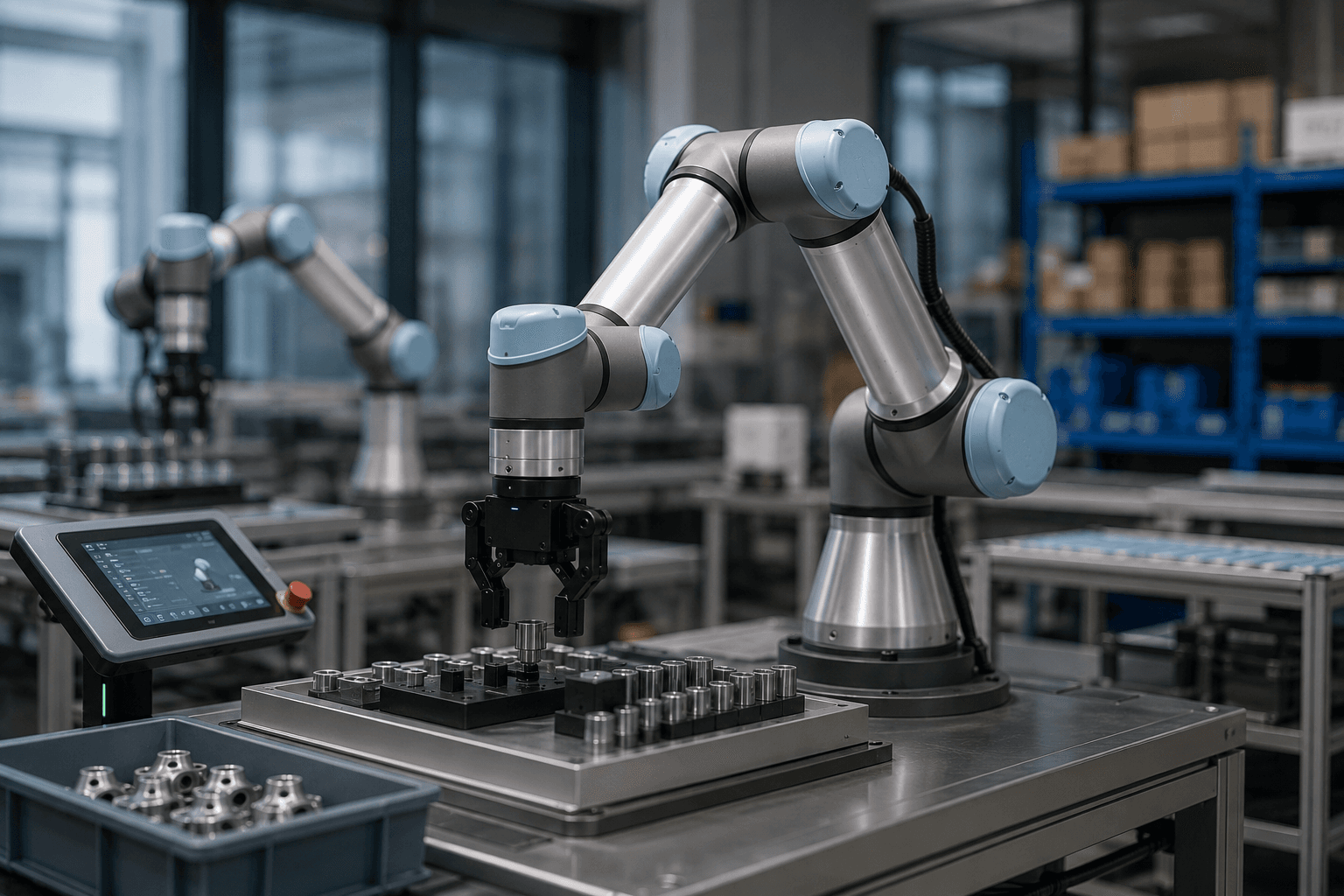
Universal Robots UR Series belongs in this robotics series because it represents the practical side of automation. Humanoids get attention because they look like the future. Cobots matter because they are already helping factories, machine shops, packaging lines, assembly cells, and small manufacturers automate real work without rebuilding the entire facility.
This is the eighth deep dive in Black Scarab's robotics series. Spot and ANYmal showed inspection. Digit, Figure, Atlas, Optimus, and G1 showed different versions of the humanoid race. Universal Robots is different: the UR Series is not trying to imitate a whole person. It focuses on one of the most useful pieces of industrial labor, the repeatable arm task.
This article belongs to the Top 10 Robots Transforming the World in 2026 series. Read it beside Viam's robotics software platform, Roboflow's computer vision platform, Edge Impulse's embedded AI deployment layer, and FORT Robotics' safety and control layer to understand how cobots connect to robotics software, machine vision, embedded AI, and safety controls.
The executive question is not whether cobots are exciting enough. The question is whether they can automate a specific bottleneck with less risk, lower integration complexity, and faster payback than a large traditional industrial robot cell.
Executive Summary
Universal Robots is one of the defining companies in collaborative robot arms. The company says it has sold more than 100,000 cobots worldwide, and its current portfolio includes smaller e-Series models and newer UR Series arms built for heavier payloads, longer reach, and industrial-grade performance.
Universal Robots positions its cobots for practical applications including palletizing, machine tending, welding, quality inspection, assembly, dispensing, finishing, material handling, and material removal. Its current public materials list payloads up to 35 kg and reach up to 1750 mm, with UR+ offering more than 500 certified kits, components, grippers, software tools, and safety accessories.
For industry leaders, the UR Series should be treated as one of the clearest automation options before jumping to humanoids. If the work is repetitive, reachable by a fixed or semi-fixed arm, and can be solved with a gripper, tool, fixture, or vision system, a cobot may be the more mature answer.
UR Series at a Glance
What is it?
Practical Answer
A family of collaborative robotic arms designed for accessible industrial automation.
Who is it for?
Practical Answer
Manufacturers, machine shops, packaging operations, logistics teams, electronics producers, metal fabricators, educators, and integrators.
What makes it different?
Practical Answer
Ease of programming, broad ecosystem support, collaborative-capable safety architecture, and a large installed base.
What is proven?
Practical Answer
Universal Robots reports over 100,000 cobots sold worldwide and many deployed applications across manufacturing industries.
How should leaders evaluate it?
Practical Answer
By task fit, payload, reach, cycle time, fixture needs, end-of-arm tooling, safety assessment, integration cost, and payback period.
| Question | Practical Answer |
|---|---|
| What is it? | A family of collaborative robotic arms designed for accessible industrial automation. |
| Who is it for? | Manufacturers, machine shops, packaging operations, logistics teams, electronics producers, metal fabricators, educators, and integrators. |
| What makes it different? | Ease of programming, broad ecosystem support, collaborative-capable safety architecture, and a large installed base. |
| What is proven? | Universal Robots reports over 100,000 cobots sold worldwide and many deployed applications across manufacturing industries. |
| How should leaders evaluate it? | By task fit, payload, reach, cycle time, fixture needs, end-of-arm tooling, safety assessment, integration cost, and payback period. |
Black Scarab Weekly
Follow the physical AI economy
Get Black Scarab news, deep research, and practical analysis in one clear Thursday briefing.
What the UR Series Actually Does
A Universal Robots cobot is a 6-axis robotic arm that can be programmed to move tools, parts, grippers, sensors, dispensers, welders, cameras, and other end-of-arm equipment through a repeatable workflow. The robot arm is only one part of the system; the full application usually includes tooling, fixtures, safety, software, and integration.
The current lineup covers small arms for light assembly and electronics work, mid-sized arms for packaging and machine tending, and heavier-payload models for palletizing and material handling. Universal Robots' public product materials list examples such as UR3e, UR7e, UR12e, UR16e, UR8 Long, UR15, UR18, UR20, and UR30, with payloads ranging from 3 kg to 35 kg depending on model.
The practical point is that cobots are not general-purpose humanoids. They are constrained, and that is part of their strength. If a business can define the object, the motion, the tool, the station, and the safety envelope, a cobot can often do useful work sooner than more flexible but less mature robots.
Why Cobots Matter
Cobots matter because many automation opportunities are not science fiction. They are repetitive arm tasks: loading CNC machines, unloading parts, stacking boxes, tending presses, applying adhesive, inspecting components, driving screws, sanding, polishing, welding, or moving material between nearby process steps.
Traditional industrial robots can be powerful and fast, but they often require larger guarded cells, specialized programming, and higher integration overhead. Cobots are designed to lower some of that friction. They can still require guarding or safety hardware depending on the risk assessment, but the buying logic is accessibility: smaller footprint, easier programming, easier redeployment, and a stronger fit for high-mix, lower-volume environments.
That makes Universal Robots especially relevant for small and mid-sized manufacturers. These companies may not need a full custom automation line. They may need one reliable arm that can cover a labor bottleneck, protect operators from repetitive strain, and keep machines running longer.
Why UR Cobots Are Business-Relevant
Labor shortage
Cobot Logic
A cobot can cover repetitive tasks when skilled operators are scarce.
What Still Needs Work
The company still needs someone to own programming, setup, and troubleshooting.
Machine downtime
Cobot Logic
Machine tending can extend spindle uptime and reduce idle equipment.
What Still Needs Work
Parts, fixtures, doors, trays, and exceptions must be engineered well.
Ergonomic strain
Cobot Logic
Cobots can take over repetitive lifting, reaching, screwdriving, sanding, or loading.
What Still Needs Work
Safety assessment and operator workflow design remain mandatory.
High-mix production
Cobot Logic
Cobots can be reprogrammed and redeployed more easily than many fixed systems.
What Still Needs Work
Changeovers still need fixtures, grippers, recipes, and trained operators.
Quality variation
Cobot Logic
Repeatable motion and inspection tools can reduce variation.
What Still Needs Work
Process control must include sensors, calibration, and clear acceptance criteria.
| Business Problem | Cobot Logic | What Still Needs Work |
|---|---|---|
| Labor shortage | A cobot can cover repetitive tasks when skilled operators are scarce. | The company still needs someone to own programming, setup, and troubleshooting. |
| Machine downtime | Machine tending can extend spindle uptime and reduce idle equipment. | Parts, fixtures, doors, trays, and exceptions must be engineered well. |
| Ergonomic strain | Cobots can take over repetitive lifting, reaching, screwdriving, sanding, or loading. | Safety assessment and operator workflow design remain mandatory. |
| High-mix production | Cobots can be reprogrammed and redeployed more easily than many fixed systems. | Changeovers still need fixtures, grippers, recipes, and trained operators. |
| Quality variation | Repeatable motion and inspection tools can reduce variation. | Process control must include sensors, calibration, and clear acceptance criteria. |
Where UR Cobots Are Used
The best UR use cases are narrow enough to engineer and repetitive enough to matter. Machine tending is a classic example: the robot loads and unloads CNC machines, presses, inspection stations, or other equipment so human operators can manage more valuable work.
Packaging and palletizing are also strong fits, especially when the work involves repetitive box movement, end-of-line handling, or predictable product flow. Assembly can be attractive when the task is precise, repetitive, and toolable, such as screwdriving, insertion, dispensing, or small-part handling.
Welding, quality inspection, finishing, material removal, and dispensing all work when the process can be defined around tooling. In every case, the important phrase is not 'buy a robot.' It is 'build an application.'
Likely UR Series Use-Case Zones
Machine tending
Typical Task
Load and unload CNC machines, injection molding machines, presses, CMMs, or laser marking stations.
Why It Matters
Keeps equipment running and frees skilled workers from repetitive loading.
Packaging and palletizing
Typical Task
Pick boxes, stack cartons, case pack, depalletize, or handle end-of-line product movement.
Why It Matters
Targets common labor and ergonomic bottlenecks.
Assembly
Typical Task
Screwdriving, insertion, part placement, adhesive dispensing, component handling.
Why It Matters
Improves repeatability in high-mix or repetitive workstations.
Welding and finishing
Typical Task
Cobot welding, sanding, polishing, grinding, deburring, surface finishing.
Why It Matters
Helps with skilled-labor constraints and consistency.
Quality inspection
Typical Task
Camera positioning, gauge handling, part presentation, repeatable inspection motions.
Why It Matters
Turns inspection into a repeatable process with less operator fatigue.
| Use-Case Zone | Typical Task | Why It Matters |
|---|---|---|
| Machine tending | Load and unload CNC machines, injection molding machines, presses, CMMs, or laser marking stations. | Keeps equipment running and frees skilled workers from repetitive loading. |
| Packaging and palletizing | Pick boxes, stack cartons, case pack, depalletize, or handle end-of-line product movement. | Targets common labor and ergonomic bottlenecks. |
| Assembly | Screwdriving, insertion, part placement, adhesive dispensing, component handling. | Improves repeatability in high-mix or repetitive workstations. |
| Welding and finishing | Cobot welding, sanding, polishing, grinding, deburring, surface finishing. | Helps with skilled-labor constraints and consistency. |
| Quality inspection | Camera positioning, gauge handling, part presentation, repeatable inspection motions. | Turns inspection into a repeatable process with less operator fatigue. |
Pricing and Total Cost
Universal Robots does not publish simple official checkout pricing for every cobot application. Buyers usually work through Universal Robots, distributors, certified partners, or integrators. Public reseller and industry price guides can be useful directional references, but they should not be treated as official quotes.
The robot arm is only part of the cost. A real deployment may include the cobot, controller, teach pendant, gripper, tool changer, vision system, sensors, fixtures, trays, safety scanner, guarding, pedestal, 7th axis, software, installation, programming, training, spare parts, maintenance, and production downtime during commissioning.
For executives, the correct budget question is not, 'What does the arm cost?' It is, 'What does the complete cell cost, and how quickly does it remove a measurable bottleneck?' A cheaper arm with poor tooling can become expensive. A more expensive system with clean fixtures, good training, and a narrow task can pay back faster.
UR Cobot Cost Areas to Budget For
Robot arm
What It Covers
UR model selection based on payload, reach, speed, footprint, and precision needs.
Buyer Note
Match the arm to the real payload, including gripper, part, center of gravity, and safety limits.
End-of-arm tooling
What It Covers
Gripper, welder, screwdriver, dispenser, sander, camera, force tool, or custom tool.
Buyer Note
The tool often determines whether the application works.
Fixtures and part presentation
What It Covers
Trays, nests, feeders, conveyors, machine-door interfaces, part orientation.
Buyer Note
Many cobot failures are really part-presentation failures.
Safety and compliance
What It Covers
Risk assessment, scanners, guarding, speed limits, stops, procedures, operator training.
Buyer Note
Collaborative-capable does not mean automatically safe in every application.
Integration and training
What It Covers
Programming, installation, URCaps, MES or machine communication, staff training.
Buyer Note
Small manufacturers should budget for learning, not only hardware.
| Cost Area | What It Covers | Buyer Note |
|---|---|---|
| Robot arm | UR model selection based on payload, reach, speed, footprint, and precision needs. | Match the arm to the real payload, including gripper, part, center of gravity, and safety limits. |
| End-of-arm tooling | Gripper, welder, screwdriver, dispenser, sander, camera, force tool, or custom tool. | The tool often determines whether the application works. |
| Fixtures and part presentation | Trays, nests, feeders, conveyors, machine-door interfaces, part orientation. | Many cobot failures are really part-presentation failures. |
| Safety and compliance | Risk assessment, scanners, guarding, speed limits, stops, procedures, operator training. | Collaborative-capable does not mean automatically safe in every application. |
| Integration and training | Programming, installation, URCaps, MES or machine communication, staff training. | Small manufacturers should budget for learning, not only hardware. |
Treat public price references as directional only. Verify final pricing and support terms with Universal Robots, a distributor, or a certified integrator.
The UR+ Ecosystem
One of Universal Robots' biggest advantages is ecosystem. UR+ brings together certified grippers, vision systems, tool changers, software, safety accessories, application kits, and complete solutions designed to work with UR arms.
This matters because many buyers do not fail because the robot cannot move. They fail because the application is incomplete. The robot needs a gripper that fits the part, a fixture that presents the part, software that handles the process, and safety hardware that matches the workcell.
For Black Scarab's catalog vision, UR+ is a useful model. A buyer does not need only the robot arm. They need the basket: arm, gripper, camera, pedestal, safety scanner, tooling, software, cables, training, and support. That is the same direction Black Scarab is building toward across AI and robotics infrastructure.
What UR+ Adds Around the Robot Arm
Grippers and tools
Examples
Vacuum grippers, finger grippers, welders, screwdrivers, sanding tools, dispensers.
Business Value
Turns robot motion into a real application.
Vision and sensing
Examples
Cameras, barcode readers, force sensors, inspection tools, safety scanners.
Business Value
Lets the system find, inspect, verify, and operate around variation.
Application kits
Examples
Palletizing kits, welding kits, finishing kits, machine tending kits.
Business Value
Reduces integration time for common use cases.
Software
Examples
URCaps, machine interfaces, remote access, calibration, simulation, workflow tools.
Business Value
Makes the cell easier to program, monitor, and improve.
Complete solutions
Examples
Pre-integrated cells or packages for common manufacturing tasks.
Business Value
Helps non-expert buyers avoid starting from a blank page.
| Layer | Examples | Business Value |
|---|---|---|
| Grippers and tools | Vacuum grippers, finger grippers, welders, screwdrivers, sanding tools, dispensers. | Turns robot motion into a real application. |
| Vision and sensing | Cameras, barcode readers, force sensors, inspection tools, safety scanners. | Lets the system find, inspect, verify, and operate around variation. |
| Application kits | Palletizing kits, welding kits, finishing kits, machine tending kits. | Reduces integration time for common use cases. |
| Software | URCaps, machine interfaces, remote access, calibration, simulation, workflow tools. | Makes the cell easier to program, monitor, and improve. |
| Complete solutions | Pre-integrated cells or packages for common manufacturing tasks. | Helps non-expert buyers avoid starting from a blank page. |
Why Companies Would Integrate UR Cobots
The strongest reason to integrate a UR cobot is not novelty. It is a clear operational bottleneck. A machine sits idle because nobody can load it. A packaging station struggles with staffing. A worker repeats the same ergonomic motion all day. A quality step needs consistent presentation. A small manufacturer wants automation but cannot justify a huge fixed line.
Universal Robots' value proposition is especially strong when the company wants a flexible first step into automation. UR Academy, PolyScope, URCaps, certified partners, and the UR+ marketplace all reduce the distance between 'we should automate this' and 'we have a working cell.'
That does not mean cobots are magic. They are usually slower than large traditional industrial robots when running in collaborative modes. They still need application engineering. They still need safety assessment. But they are often much easier to start with than a full custom automation project.
The ROI Logic
UR cobot ROI is strongest when the task is repetitive, measurable, and tied to real production economics. Machine tending can add unattended hours. Packaging can reduce ergonomic strain and stabilize throughput. Assembly can improve consistency. Inspection can reduce rework. Palletizing can remove a physically difficult task.
Universal Robots' own machine tending materials cite examples such as Go Fast Campers using UR5 cobots to achieve 22 hours of daily machine time, including six unmanned hours, and EMI adding more than 1,200 production hours per machine annually with ROI in 12 to 18 months. These are case examples, not guarantees, but they show the right way to think: measure the bottleneck, then measure the improvement.
The wrong ROI case is vague automation enthusiasm. If the part is hard to present, the gripper cannot reliably pick it, the machine interface is messy, or the operator has to rescue the cell constantly, ROI will suffer no matter how approachable the robot is.
UR Cobot ROI Checklist
Is the task repetitive enough?
Why It Matters
Cobots need enough volume or frequency to justify hardware, tooling, and integration.
Can the part be presented consistently?
Why It Matters
Good trays, fixtures, feeders, and conveyors often determine success.
Is payload calculated correctly?
Why It Matters
Payload must include the part, gripper, tool, center of gravity, and motion profile.
Will cycle time meet production needs?
Why It Matters
Collaborative operation may require speed limits depending on the safety assessment.
Is there a trained owner?
Why It Matters
The best cobot deployments have a local champion who can adjust, maintain, and improve the cell.
| Question | Why It Matters |
|---|---|
| Is the task repetitive enough? | Cobots need enough volume or frequency to justify hardware, tooling, and integration. |
| Can the part be presented consistently? | Good trays, fixtures, feeders, and conveyors often determine success. |
| Is payload calculated correctly? | Payload must include the part, gripper, tool, center of gravity, and motion profile. |
| Will cycle time meet production needs? | Collaborative operation may require speed limits depending on the safety assessment. |
| Is there a trained owner? | The best cobot deployments have a local champion who can adjust, maintain, and improve the cell. |
The Edge AI Stack Behind UR Cobots
A UR deployment is not usually an AI-heavy humanoid system, but it still fits Black Scarab's edge AI lens. Modern cobot cells increasingly include cameras, force sensors, barcode readers, safety scanners, local control software, machine interfaces, and sometimes AI-based vision or quality inspection.
Universal Robots has also been positioning around physical AI, with a platform for developing, deploying, and scaling physical AI in production. For buyers, this means cobots may become more capable as perception, simulation, AI-assisted programming, and adaptive tooling improve.
The important point is practical: AI does not replace the need for good process engineering. A camera can help find parts, but it cannot fix a bad fixture. A model can classify defects, but it still needs lighting, calibration, and reject logic. The robot stack works when compute, sensors, tooling, and process design are aligned.
What a UR Deployment Really Includes
Robot arm
Examples
UR3e, UR7e, UR12e, UR16e, UR8 Long, UR15, UR18, UR20, UR30.
Business Question
Which payload, reach, footprint, and speed are actually needed?
Tooling
Examples
Grippers, welders, dispensers, screwdrivers, sanders, tool changers.
Business Question
Can the robot interact with the product reliably?
Sensing
Examples
Vision, barcode, force, safety scanners, machine status, part detection.
Business Question
Can the cell detect variation, faults, and unsafe conditions?
Software
Examples
PolyScope, URCaps, machine interfaces, simulation, dashboards.
Business Question
Can operators adjust and maintain the workflow without excessive engineering support?
Operations
Examples
Risk assessment, training, maintenance, spare parts, changeover process.
Business Question
Can the cell survive daily production realities?
| Layer | Examples | Business Question |
|---|---|---|
| Robot arm | UR3e, UR7e, UR12e, UR16e, UR8 Long, UR15, UR18, UR20, UR30. | Which payload, reach, footprint, and speed are actually needed? |
| Tooling | Grippers, welders, dispensers, screwdrivers, sanders, tool changers. | Can the robot interact with the product reliably? |
| Sensing | Vision, barcode, force, safety scanners, machine status, part detection. | Can the cell detect variation, faults, and unsafe conditions? |
| Software | PolyScope, URCaps, machine interfaces, simulation, dashboards. | Can operators adjust and maintain the workflow without excessive engineering support? |
| Operations | Risk assessment, training, maintenance, spare parts, changeover process. | Can the cell survive daily production realities? |
Deployment Pattern: How to Pilot UR Cobots
A first UR pilot should be boring on purpose. Choose one task with clear volume, known parts, known cycle time, known labor pain, and a defined handoff between the robot and the human team. The goal is not to prove that the cobot can move. The goal is to prove that the cell can make production better.
The best first pilots are often machine tending, packaging, simple palletizing, screwdriving, inspection presentation, or repetitive dispensing. These tasks are easy to baseline and easy to explain to finance, operations, safety, and the shop floor.
The pilot should also include operator training from day one. Cobots become more valuable when the people closest to the process can recover from errors, adjust programs, handle changeovers, and suggest improvements.
First UR Cobot Pilot Plan
1
Action
Choose one repetitive bottleneck.
Success Signal
The task has clear labor minutes, ergonomic pain, machine downtime, or quality impact.
2
Action
Confirm payload and reach.
Success Signal
The selected UR model can handle the part, gripper, tool, center of gravity, and workspace.
3
Action
Engineer part presentation.
Success Signal
Fixtures, trays, feeders, conveyors, and machine interfaces are defined.
4
Action
Complete the safety assessment.
Success Signal
Speed, force, guarding, scanners, stops, and operator procedures match the application.
5
Action
Run production trials.
Success Signal
Cycle time, uptime, intervention rate, scrap, quality, and operator feedback are measured.
6
Action
Train local ownership.
Success Signal
Operators and technicians can recover, adjust, and improve the cell.
| Step | Action | Success Signal |
|---|---|---|
| 1 | Choose one repetitive bottleneck. | The task has clear labor minutes, ergonomic pain, machine downtime, or quality impact. |
| 2 | Confirm payload and reach. | The selected UR model can handle the part, gripper, tool, center of gravity, and workspace. |
| 3 | Engineer part presentation. | Fixtures, trays, feeders, conveyors, and machine interfaces are defined. |
| 4 | Complete the safety assessment. | Speed, force, guarding, scanners, stops, and operator procedures match the application. |
| 5 | Run production trials. | Cycle time, uptime, intervention rate, scrap, quality, and operator feedback are measured. |
| 6 | Train local ownership. | Operators and technicians can recover, adjust, and improve the cell. |
When UR Cobots Are a Bad Fit
UR cobots are a bad fit when the application needs very high speed, very high payload, extreme reach, heavy-duty welding throughput, harsh environments outside the robot's ratings, or fully enclosed high-volume automation that a traditional industrial robot can handle better.
They are also a bad fit when the buyer thinks collaborative means no safety work. Collaborative-capable robots still require a risk assessment. Depending on speed, payload, tool, part geometry, pinch points, and surrounding equipment, guarding or safety scanners may still be required.
Finally, cobots are a bad fit when the process itself is unstable. If parts arrive randomly, fixtures are inconsistent, product variation is uncontrolled, and no one owns the process, the robot will inherit the chaos. Automation exposes weak process design.
Black Scarab Takeaway
Universal Robots UR Series belongs in this series because it is one of the best examples of accessible automation already creating value. It is less cinematic than a humanoid, but for many businesses it is more immediately useful.
For industry leaders, the right posture is practical evaluation. Before asking whether a humanoid can work in your facility, ask whether a cobot arm can solve the first bottleneck. Machine tending, packaging, palletizing, assembly, inspection, welding, and finishing are often closer to ROI than broad general-purpose robotics.
For Black Scarab's catalog vision, UR is a near-perfect example of basket logic. A buyer needs the arm, but also the gripper, fixture, safety scanner, vision system, software, pedestal, cables, training, and support. The catalog should help users source the whole working setup, not just the robot headline.
Sourcing & Verification
This guide was compiled using Universal Robots' official cobot product pages, UR Series materials, developer documentation on payload and working area, UR+ marketplace materials, machine tending and assembly application pages, and public reseller price guidance for pricing context. Current product availability, payload limits, pricing, certification, safety requirements, warranty, and support terms should be verified directly with Universal Robots, a distributor, or a certified integrator before procurement.
Black Scarab Weekly
Follow the physical AI economy
Get Black Scarab news, deep research, and practical analysis in one clear Thursday briefing.
Related Insights
Manufacturing
Vibe Manufacturing: The Next AI Opportunity Has a Shop Floor
As AI makes physical products easier to design, small manufacturers could inherit a wave of prototype orders.
Read related insight
Manufacturing
How to Build a Manufacturing Plant: Equipment, Employees, Costs, Installation, and First Production
A practical guide to the team, equipment purchases, facility work, acceptance testing, installation, commissioning, staffing, cash, and launch discipline required to turn an empty building into a working factory.
Read related insight
Manufacturing
Physical AI in Manufacturing: Robotics, Machine Vision, Digital Twins, and Smart Factories
A first principles guide to the factory applications, edge architecture, data, safety, validation, and economics that turn artificial intelligence into useful physical work.
Read related insight