
Deep Dive · Physical AI Infrastructure
What Are Digital Twins? How Living Models of the Physical World Actually Work
A practical guide to digital twin architecture, simulation, data, standards, companies, costs, implementation, risks, and the ways trustworthy twins could change industry, infrastructure, climate planning, healthcare research, and physical AI.
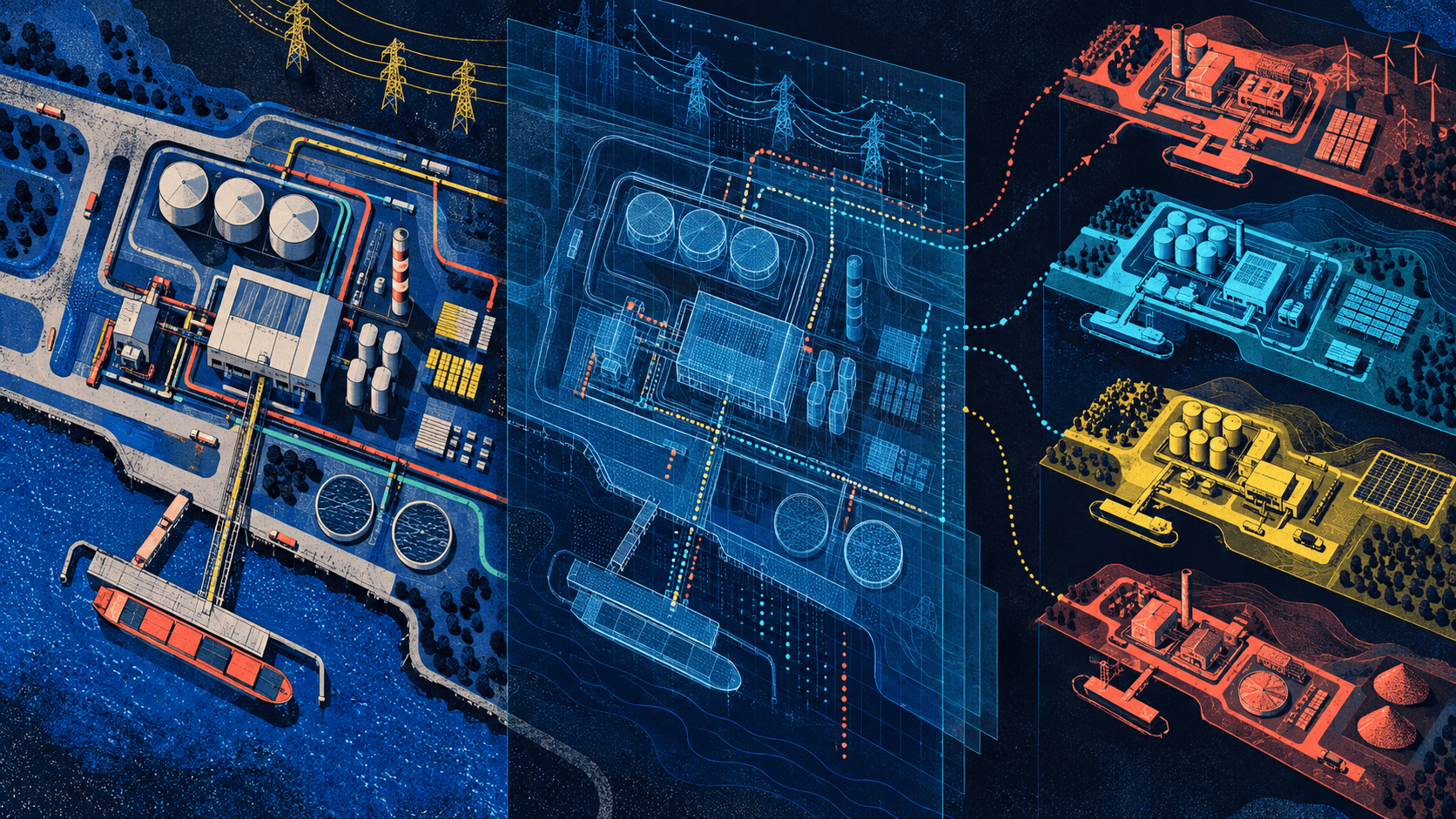
A digital twin is useful for the same reason a flight simulator is useful. It creates a place to observe, test, and learn about a physical system without making every mistake on the system itself. The difference is that a true twin does not remain an isolated model. It stays connected to evidence from a particular machine, product, process, building, network, person, or environment.
The Digital Twin Consortium defines a digital twin as a virtual representation of real world entities and processes, synchronized at a specified frequency and fidelity. The words frequency and fidelity do most of the work. A useful twin updates often enough, represents the details that matter, and supports a defined decision. It does not require a photorealistic three dimensional model, instant updates, artificial intelligence, or autonomous control.
That makes the category both powerful and easy to abuse. A computer aided design file can be an important input, but it is not automatically a twin. A dashboard can display live sensor data without modeling how a system behaves. A simulation can predict behavior without being connected to one operating asset. A twin brings selected models and data together around the state and decisions of a real subject.
This report explains that system from first principles. It covers the architecture, hardware, software, synchronization, simulation, standards, company landscape, pricing evidence, implementation process, security risks, and buyer economics. It also examines the larger question: what changes when societies can test more physical decisions in a credible virtual environment before committing money, material, machines, and human lives?
What Is Physical AI?
A companion guide to the machines and intelligent systems that can use digital twins to learn, plan, and act in the physical world.
Physical AI in Manufacturing
The manufacturing guide that places digital twins beside robotics, machine vision, predictive maintenance, and intelligent scheduling.
The Short Answer
A digital twin is a fit for purpose digital representation of a real entity or process that is kept meaningfully synchronized with evidence from that reality. It may describe current state, explain past behavior, predict possible futures, recommend an action, or help control a system. The more authority it has, the more evidence, security, and governance it needs.
The twin is not one file. It is a system of models, data, relationships, software, operating rules, and people. Geometry may show where things are. Time series data shows how measurements change. A physics model estimates forces, heat, flow, or wear. A process model represents queues and cycle times. A knowledge graph connects assets and dependencies. An interface makes those results usable. Validation establishes when any of it should be trusted.
Digital Twins at a Glance
What is being twinned?
Practical Answer
A specific product, asset, process, facility, network, person, or environment.
What makes it a twin?
Practical Answer
A real subject, meaningful synchronization, and a defined purpose.
Does it need three dimensional graphics?
Practical Answer
No. Equations, events, graphs, or process logic can be enough.
Does it need real time data?
Practical Answer
No. The update pace should match the decision.
Does it need artificial intelligence?
Practical Answer
No. Physics, rules, statistics, and conventional simulation may be sufficient.
Can it control the real system?
Practical Answer
Sometimes, with explicit authority and safeguards.
What is the value?
Practical Answer
Better decisions with less testing, downtime, waste, risk, or uncertainty.
| Question | Practical Answer |
|---|---|
| What is being twinned? | A specific product, asset, process, facility, network, person, or environment. |
| What makes it a twin? | A real subject, meaningful synchronization, and a defined purpose. |
| Does it need three dimensional graphics? | No. Equations, events, graphs, or process logic can be enough. |
| Does it need real time data? | No. The update pace should match the decision. |
| Does it need artificial intelligence? | No. Physics, rules, statistics, and conventional simulation may be sufficient. |
| Can it control the real system? | Sometimes, with explicit authority and safeguards. |
| What is the value? | Better decisions with less testing, downtime, waste, risk, or uncertainty. |
Black Scarab Weekly
Follow the physical AI economy
Get Black Scarab news, deep research, and practical analysis in one clear Thursday briefing.
A Model, a Shadow, and a Twin Are Not the Same Thing
The market uses digital twin as a flexible label, so buyers need a stricter test. The first question is not whether software looks realistic. It is how information moves between reality and the representation, how the representation is validated, and what decision it is allowed to influence.
The Twin Starts with a Decision
A team that begins by trying to copy everything usually builds an expensive archive. A team that begins with a decision can choose the evidence, model, update rate, and tolerance that decision requires. The purpose might be to detect pump degradation, balance a production line, test a robot release, reduce building energy use, schedule bridge maintenance, or compare flood defenses.
Fit for purpose is not an apology for low fidelity. It is a design principle. A maintenance twin may need vibration, load, temperature, lubricant condition, and service history while requiring only simple geometry. A collision planning twin may need accurate dimensions and motion envelopes but not a molecular model of the paint. A hospital wayfinding twin and a physiological heart twin should not share the same definition of fidelity.
The decision also sets the cost ceiling. If an avoided failure is worth thousands of dollars, a twin that requires millions to create is not economical. If the twin supports a spacecraft, power grid, semiconductor plant, or regional flood plan, the value of earlier evidence can be enormous. Digital twin economics are application economics.
Inside the Architecture
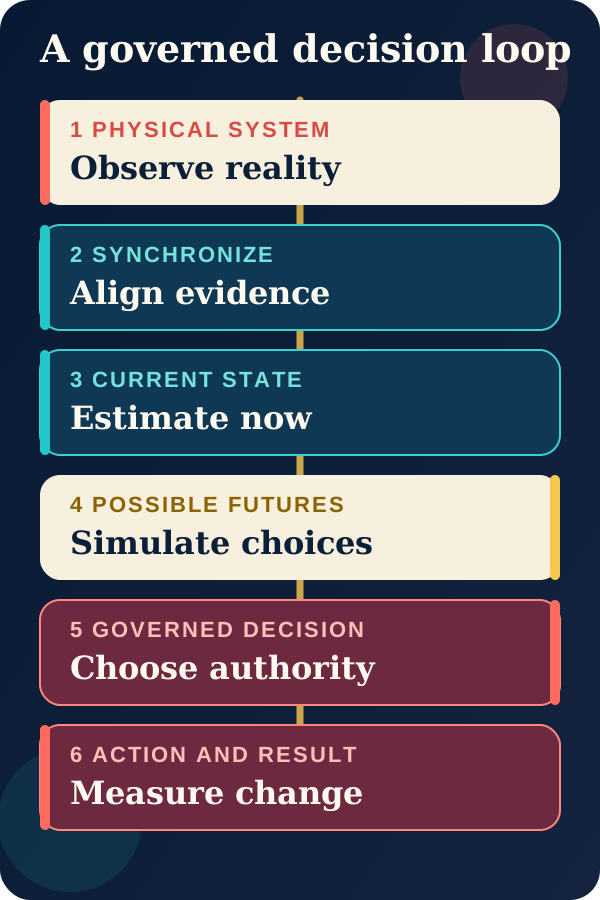
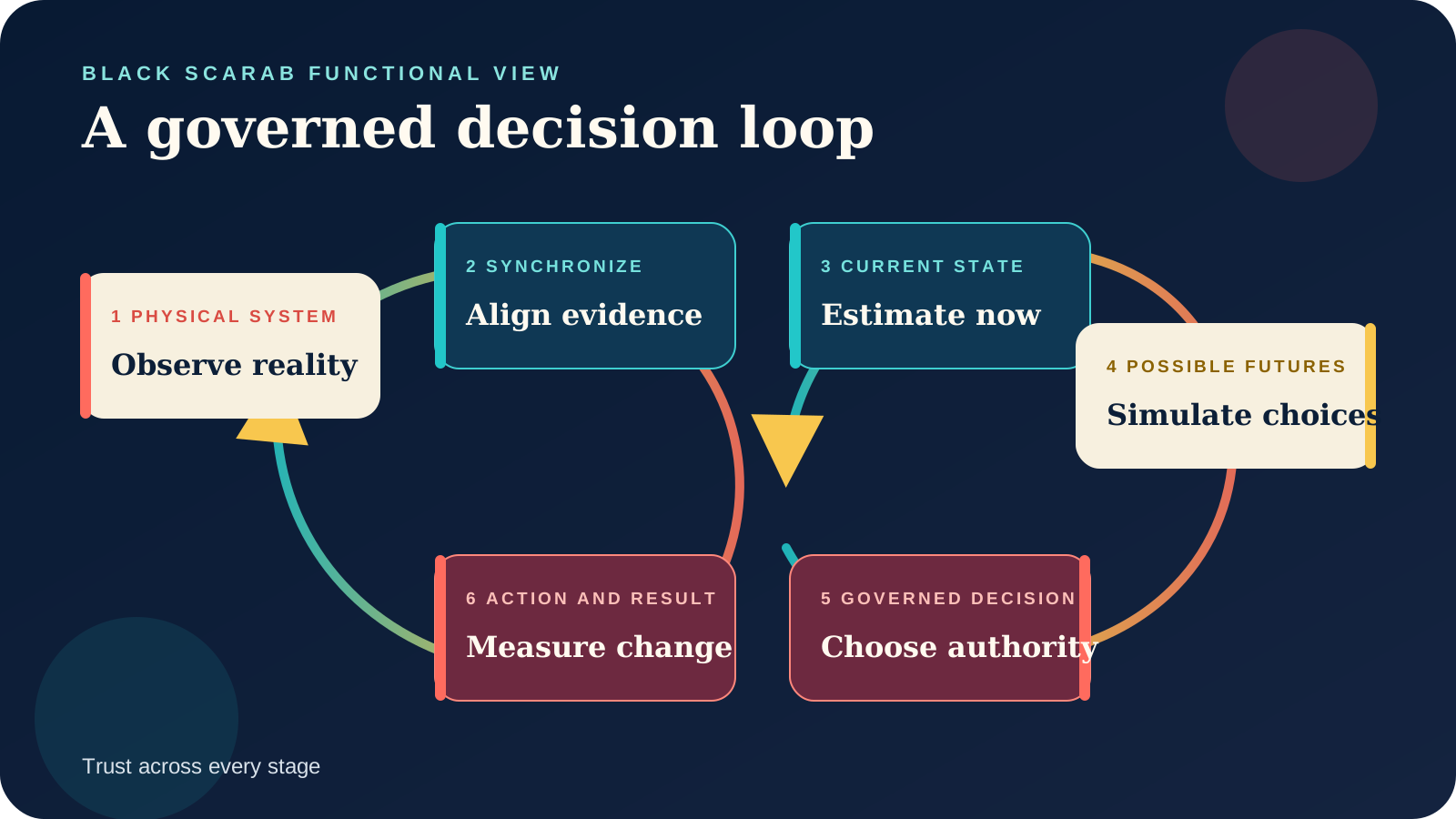
Every implementation is different, but the operating logic is consistent. Reality produces evidence. The twin maps that evidence to an identity and current state. Models evaluate what the state means and what may happen next. A person or authorized system chooses an intervention. New observations show whether the intervention worked.
The physical side includes the asset or process, sensors, controllers, maintenance actions, operating context, and people. The digital side includes data ingestion, time alignment, asset identity, geometry, state models, simulation, analytics, scenario management, interfaces, access control, and version history. The synchronization layer is the bridge between them.
Core Layers
Physical subject
Function
Defines what is represented.
Failure Mode
Reality moves outside the assumed boundary.
Observation
Function
Collects evidence from reality.
Failure Mode
Evidence is missing, biased, delayed, or misidentified.
Synchronization
Function
Aligns identity, time, version, and state.
Failure Mode
Stale or mismatched records look current.
Representation
Function
Stores structure, relationships, state, and history.
Failure Mode
Important dependencies or changes are missing.
Models and simulation
Function
Interprets state and tests possible futures.
Failure Mode
The model is used outside its valid range.
Decision layer
Function
Turns results into a recommendation or action.
Failure Mode
The wrong objective is optimized.
Action and feedback
Function
Acts on reality and measures the result.
Failure Mode
Authority is unclear or outcomes go unmeasured.
| Layer | Function | Failure Mode |
|---|---|---|
| Physical subject | Defines what is represented. | Reality moves outside the assumed boundary. |
| Observation | Collects evidence from reality. | Evidence is missing, biased, delayed, or misidentified. |
| Synchronization | Aligns identity, time, version, and state. | Stale or mismatched records look current. |
| Representation | Stores structure, relationships, state, and history. | Important dependencies or changes are missing. |
| Models and simulation | Interprets state and tests possible futures. | The model is used outside its valid range. |
| Decision layer | Turns results into a recommendation or action. | The wrong objective is optimized. |
| Action and feedback | Acts on reality and measures the result. | Authority is unclear or outcomes go unmeasured. |
Synchronization Is More Important Than Realism
A detailed rendering can be stale. A simple state estimate can be current and useful. Synchronization answers which physical subject the data describes, when the evidence was collected, which configuration was active, how the digital state was updated, and what uncertainty remains.
The Digital Twin Consortium deliberately allows different synchronization frequencies. A warehouse traffic twin may update positions many times per second. A facility space model may change only after construction work. A product twin may receive a new inspection record at each manufacturing step and a service record months later. The right cadence follows the rate at which the decision can become wrong.
Synchronization also moves in two directions. Observation causes the virtual representation to match reality more closely. Intervention causes reality to move toward a desired state represented in the twin. The second direction deserves a higher burden of proof. Recommending a valve setting is not the same as commanding the valve, and commanding a process setpoint is not the same as replacing an independent safety function.
Fidelity Is a Contract, Not a Compliment
A twin should state what it represents accurately, across which conditions, at what resolution, and within what tolerance. Geometry can be millimeter accurate while thermal behavior is approximate. A process model can predict average throughput while missing rare blockages. A learned model can fit historical data while failing after a supplier changes a material.
NIST argues that credibility requires verification, validation, and uncertainty quantification throughout the twin lifecycle. Verification asks whether the model was implemented correctly. Validation asks whether it represents reality well enough for the intended purpose. Uncertainty quantification expresses what is not known and how that uncertainty affects the result. These disciplines are a continuing obligation rather than a final project gate.
This is especially important when a twin uses artificial intelligence. A fast surrogate can approximate an expensive physics simulation and make interactive scenario testing possible. The speed is valuable only inside the conditions represented by its training and validation data. A prediction without a known operating boundary is a guess with better graphics.
The Digital Thread Connects Time
A twin represents a subject at one or more stages. A digital thread connects the information that explains how that subject reached its current state. Requirements lead to design. Design leads to manufacturing plans. Actual production records show which materials, settings, inspections, and deviations created one unit. Service history records how that unit was used, repaired, updated, and retired.
The emerging ISO 23247 Part 5 describes a digital thread as dependable and trustworthy information linking twins across structure, behavior, space, time, and lifecycle stages. The distinction matters. A live pump twin may estimate current condition. Its digital thread can show the exact configuration, supplier component, commissioning test, duty cycle, repair, and software version behind that condition.
Without the thread, teams spend time reconciling identifiers, drawings, spreadsheets, maintenance systems, and sensor tags before they can trust the analysis. With a governed thread, the twin can become a traceable operating record. That record can support quality investigations, service, product improvement, compliance, resale, remanufacturing, and recycling.
Types of Digital Twins
The categories overlap because real systems overlap. A product moves through a process inside a facility supported by equipment and people. The useful distinction is the question each twin answers.
Common Twin Scopes
Component twin
Primary Question
How is one critical part behaving?
Typical Evidence
Material, load, vibration, inspection, service history.
Product twin
Primary Question
What was built and how will it perform?
Typical Evidence
Design, configuration, test, usage, maintenance.
Asset twin
Primary Question
What is this operating asset's current state?
Typical Evidence
Telemetry, alarms, maintenance, environment.
Process twin
Primary Question
How does work or material move?
Typical Evidence
Cycle time, queues, recipes, quality, resources.
Production system twin
Primary Question
What will constrain production?
Typical Evidence
Layout, capacity, downtime, labor, demand, controls.
Facility twin
Primary Question
How is a building or site operating?
Typical Evidence
Models, scans, equipment, occupancy, energy, work orders.
Network twin
Primary Question
How will a network respond to change?
Typical Evidence
Topology, flows, constraints, demand, failures.
Human or biological twin
Primary Question
How might a body or biological system respond?
Typical Evidence
Imaging, physiology, biomarkers, treatment, population evidence.
Environmental twin
Primary Question
How could natural and human systems interact?
Typical Evidence
Earth observation, weather, hydrology, emissions, infrastructure.
| Scope | Primary Question | Typical Evidence |
|---|---|---|
| Component twin | How is one critical part behaving? | Material, load, vibration, inspection, service history. |
| Product twin | What was built and how will it perform? | Design, configuration, test, usage, maintenance. |
| Asset twin | What is this operating asset's current state? | Telemetry, alarms, maintenance, environment. |
| Process twin | How does work or material move? | Cycle time, queues, recipes, quality, resources. |
| Production system twin | What will constrain production? | Layout, capacity, downtime, labor, demand, controls. |
| Facility twin | How is a building or site operating? | Models, scans, equipment, occupancy, energy, work orders. |
| Network twin | How will a network respond to change? | Topology, flows, constraints, demand, failures. |
| Human or biological twin | How might a body or biological system respond? | Imaging, physiology, biomarkers, treatment, population evidence. |
| Environmental twin | How could natural and human systems interact? | Earth observation, weather, hydrology, emissions, infrastructure. |
Where Artificial Intelligence Fits
Digital twins existed before the current artificial intelligence wave and do not depend on it. Engineering equations, discrete event simulation, control models, statistical estimation, and rules remain essential because they encode known structure and can be inspected. Artificial intelligence adds value where state is difficult to observe, relationships are hard to specify, or a full simulation is too slow for the decision.
Machine learning can detect anomalies, estimate hidden condition, predict remaining useful life, approximate computationally expensive solvers, recognize objects in images, reconcile records, generate scenarios, and search large decision spaces. Generative systems can help users query the twin and draft explanations. None of those capabilities establishes physical truth on its own.
The connection to physical AI is direct. Robots and autonomous systems need environments in which they can learn, test, and rehearse. Operating robots can then update those environments with new observations. The twin becomes a memory and test surface around the machine, while the physical AI system supplies perception and action.
The Company and Platform Landscape
No company owns the complete digital twin category. The stack crosses engineering design, simulation, industrial data, cloud services, building information, geospatial systems, robotics, visualization, controls, and integration. A buyer may use several platforms around one decision.
Vendor language should be mapped to function. A physics model is different from an asset graph. A photorealistic environment is different from a maintenance application. A robotics observability platform is different from a factory planning suite. They may interoperate, compete at the edges, or become components of the same twin system.
Representative Companies by Role
Industrial lifecycle and automation
Representative Companies
Siemens, Dassault Systèmes, PTC, Rockwell Automation, Schneider Electric, and Hexagon
Function
Connect design, production, operations, and service.
Physics and system simulation
Representative Companies
Ansys, Siemens, Dassault Systèmes, MathWorks, Altair, and Modelon
Function
Model physical and system behavior.
Cloud twin services
Representative Companies
Microsoft Azure Digital Twins and AWS IoT TwinMaker
Function
Provide graphs, APIs, connectors, and application building blocks.
Buildings and infrastructure
Representative Companies
Bentley Systems, Autodesk, Esri, Hexagon, and Trimble
Function
Connect design, geospatial, asset, and maintenance data.
High fidelity spatial simulation
Representative Companies
NVIDIA Omniverse, Epic Games, Unity, and specialized industrial developers
Function
Create interactive environments for simulation and testing.
Robotics simulation and evaluation
Representative Companies
Antioch, NVIDIA, Applied Intuition, Parallel Domain, and internal engineering platforms
Function
Run scenarios and compare autonomy releases.
Robotics data and observability
Representative Companies
Foxglove and internal fleet data systems
Function
Synchronize, replay, and inspect robot data.
Mobile reality capture
Representative Companies
FieldAI, Caterpillar, Boston Dynamics partners, drone providers, and inspection robotics companies
Function
Refresh spatial and condition evidence from the field.
| Role | Representative Companies | Function |
|---|---|---|
| Industrial lifecycle and automation | Siemens, Dassault Systèmes, PTC, Rockwell Automation, Schneider Electric, and Hexagon | Connect design, production, operations, and service. |
| Physics and system simulation | Ansys, Siemens, Dassault Systèmes, MathWorks, Altair, and Modelon | Model physical and system behavior. |
| Cloud twin services | Microsoft Azure Digital Twins and AWS IoT TwinMaker | Provide graphs, APIs, connectors, and application building blocks. |
| Buildings and infrastructure | Bentley Systems, Autodesk, Esri, Hexagon, and Trimble | Connect design, geospatial, asset, and maintenance data. |
| High fidelity spatial simulation | NVIDIA Omniverse, Epic Games, Unity, and specialized industrial developers | Create interactive environments for simulation and testing. |
| Robotics simulation and evaluation | Antioch, NVIDIA, Applied Intuition, Parallel Domain, and internal engineering platforms | Run scenarios and compare autonomy releases. |
| Robotics data and observability | Foxglove and internal fleet data systems | Synchronize, replay, and inspect robot data. |
| Mobile reality capture | FieldAI, Caterpillar, Boston Dynamics partners, drone providers, and inspection robotics companies | Refresh spatial and condition evidence from the field. |
Illustrative, not a ranking. Most implementations combine platforms.
FieldAI Deep Dive
How mobile robots, edge autonomy, sensors, and digital twin workflows connect in changing industrial environments.
Foxglove Deep Dive
The data and observability layer that helps robotics teams synchronize, replay, search, and inspect physical system evidence.
Antioch Deep Dive
A focused examination of simulation, digital twin calibration, cloud evaluation, and the evidence required to trust virtual tests.
Caterpillar and FieldAI
Black Scarab reporting on autonomous inspection, changing site records, industrial robots, and live digital twin ambitions.
What the Major Platforms Actually Contribute
Siemens describes a comprehensive twin spanning product, machine, production, and plant lifecycles. Its strongest position is the connection between engineering software and industrial automation. The company says teams can use physics based simulation to test and optimize before acting in the real world. That is a broad suite strategy rather than one standalone twin product.
Ansys Twin Builder focuses on connected models of in service assets. It can combine system models with reduced order models derived from detailed physics simulation, then integrate third party models through standards such as the Functional Mockup Interface. The value is computational: preserve enough physical behavior to make a model useful at operating speed. Ansys publishes performance and maintenance benefit claims, but buyers should require evidence for their own asset.
AWS IoT TwinMaker and Azure Digital Twins sit closer to the application infrastructure layer. AWS supplies entity models, unified data access, knowledge graph queries, connectors, and visualization integration. Azure provides a managed model and graph service for environments such as factories, buildings, farms, railways, and cities. Neither service automatically supplies a validated physics model, clean source data, operating workflow, or business case.
Bentley iTwin and Autodesk Tandem address buildings and infrastructure from different entry points. Bentley emphasizes engineering information, reality data, infrastructure context, and applications built on its iTwin Platform. Autodesk Tandem turns building information models into an operational facility representation connected to assets, documents, and time series data.
NVIDIA Omniverse provides libraries and workflows for high fidelity spatial representation, OpenUSD data exchange, physics, sensor simulation, synthetic data, and robot development. Its relevance is strongest when visual and physical simulation of a facility or machine is part of the use case. It is not a replacement for product lifecycle management, maintenance records, industrial control, validation, or domain specific models.
PTC ThingWorx represents machines and data sources as connected software objects and supports applications such as asset monitoring, utilization, performance management, and work instructions. It illustrates an important category boundary: industrial IoT software can become part of a twin when it is connected to a fit for purpose representation and decision. Connectivity and dashboards alone do not settle the definition.
Standards Matter Because Twins Must Outlive Tools
The ISO 23247 series supplies manufacturing terminology, principles, a reference architecture, information attributes, and exchange requirements. The architecture is intentionally neutral about one data format or protocol. It gives organizations a common structure for discussing observable manufacturing elements, digital representations, and the services around them.
Other standards solve narrower pieces. STEP carries product model data. Building information standards such as IFC support facilities. OPC UA and MTConnect exchange industrial information. Functional Mockup Interface packages simulation models for exchange and combined execution. OpenUSD can connect complex three dimensional scene data. Asset Administration Shell provides a structured digital representation for industrial assets. No one standard makes the complete twin.
Interoperability has commercial consequences. A twin assembled from proprietary identifiers, undocumented transformations, and one vendor interface can become expensive to extend or leave. Buyers should negotiate model export, data ownership, schema access, version history, interface rights, and transition support before the twin becomes operationally critical.
Where Digital Twins Already Create Value
NASA provides unusually clear examples because physical access is difficult and failure is consequential. The agency describes twins used to test and monitor the James Webb Space Telescope, including thermal behavior and the sunshield deployment. NASA also uses software twins that emulate spacecraft hardware so flight software can be developed and validated before all physical hardware is available. These are engineering and mission tools, not decorative replicas.
Manufacturers use twins for virtual commissioning, line balancing, process optimization, quality investigation, asset monitoring, training, and maintenance. A controls team can test machine logic against a simulated line before installation. A production planner can explore buffers and schedules. A maintenance team can combine condition evidence with an asset model. The value comes from a shorter or safer path to a decision, not from the twin label.
Buildings and infrastructure create value through information continuity. A useful facility twin can connect rooms, equipment, documents, sensors, work orders, energy, inspections, and changes. A bridge or rail twin can connect geometry and condition evidence with maintenance planning. These applications often update more slowly than a robot twin, but their lifecycle can span decades.
Robotics makes the feedback loop visible. FieldAI and Caterpillar plan to use mobile robots for inspection and changing site records, while digital environments support testing and operational analysis. Foxglove helps teams inspect synchronized robot data. Antioch positions simulation as a continuous evaluation layer. Each company covers a different part of the system. The Caterpillar announcement does not disclose a customer rollout, price, or measured return, so its larger twin vision remains a development program rather than proven commercial evidence.
How Digital Twins Could Change the World
The deepest consequence is not that every object receives a virtual copy. It is that more decisions about the physical world can become testable, reversible, and evidence based before they consume scarce resources or create irreversible harm. That changes the cost of learning.
The following ramifications are Black Scarab analysis grounded in current programs and technical direction. They are possible outcomes, not forecasts with guaranteed dates or adoption rates.
A Digital Twin of the Earth Is No Longer Just a Metaphor
The European Commission's Destination Earth initiative combines Earth observation, environmental models, socioeconomic data, cloud services, high performance computing, and interactive applications. Initial twins address extreme events and climate adaptation. The program aims to help users test responses to floods, droughts, fires, resource stress, and policy choices at useful geographic scales.
This is a digital twin at system of systems scale. No single model captures Earth. Weather, oceans, land, infrastructure, population, and economic activity use different data and time horizons. The twin is therefore an organized environment in which multiple models and observations can interact, with reliability information attached to scenario results.
The world changing potential is better preparation. A region could compare where to strengthen a flood barrier, how an evacuation route performs, which power assets face heat stress, or how a water policy affects agriculture. The danger is false authority. A detailed map can make a conditional scenario look like a certain future. The public value depends on visible assumptions, competing scenarios, and decisions that remain accountable to people.
Human Digital Twins Require a Higher Standard
The National Heart, Lung, and Blood Institute describes research toward personalized models that could estimate disease risk, treatment response, or surgical outcomes. It also states that the technology is in its infancy. A 2026 systematic review found applications across diagnosis, therapy optimization, physiological monitoring, and health system modeling, while noting the need to distinguish conceptual proposals, prototypes, and patient level implementations.
A biological twin is harder than an industrial asset twin because the subject is adaptive, partly observed, socially situated, and ethically protected. The data may be incomplete or uneven across populations. A model can influence diagnosis or treatment even when its uncertainty is poorly understood. Privacy loss can be permanent because physiology and identity cannot simply be reset like a password.
The credible path is narrow and clinical. Define one decision, one population, one evidence standard, and one accountable professional workflow. Compare predictions with outcomes. Study bias and failure. Protect consent and data rights. A virtual human that claims to predict everything is marketing. A validated model that improves one decision can be medicine.
What Digital Twins Cost
There is no useful average price for a digital twin. A developer experiment with a managed graph service, a facility model connected to a few systems, a production line commissioning environment, and a national infrastructure twin have different labor, data, model, compute, security, and lifecycle burdens.
NIST warns that software application estimates do not necessarily include sensors, data standardization, modeling, integration, and implementation. A 2025 peer reviewed cost methodology similarly treats twin cost as a collection of data and model activities rather than one license.
The largest cost is often not the twin platform. It is making source information trustworthy, mapping asset identities, instrumenting the physical system, integrating operational technology and enterprise systems, validating models, changing workflows, and maintaining the result after equipment and software change.
Public Platform Pricing Evidence
AWS IoT TwinMaker
Published Evidence
$197.53 monthly standard example or $220 tier bundle for 800 entities and the stated workload.
Not Included
Source services, storage, Grafana, sensors, engineering, validation, and operations.
Bentley iTwin Platform
Published Evidence
$199 monthly Standard with 200 credits or $499 Premium with 500 credits.
Not Included
Data preparation, capture, processing, integration, and professional work.
Azure Digital Twins
Published Evidence
Consumption billing across operations, messages, and query units.
Not Included
Ingestion, storage, analytics, simulation, integration, and implementation.
Autodesk Tandem
Published Evidence
Free tier with capacity limits, then capacity based pricing.
Not Included
Model quality, sensors, integration, commissioning, and governance.
Enterprise industrial suites
Published Evidence
Product selection and commercial quotation required.
Not Included
Architecture, services, deployment, support, and exit terms.
| Platform | Published Evidence | Not Included |
|---|---|---|
| AWS IoT TwinMaker | $197.53 monthly standard example or $220 tier bundle for 800 entities and the stated workload. | Source services, storage, Grafana, sensors, engineering, validation, and operations. |
| Bentley iTwin Platform | $199 monthly Standard with 200 credits or $499 Premium with 500 credits. | Data preparation, capture, processing, integration, and professional work. |
| Azure Digital Twins | Consumption billing across operations, messages, and query units. | Ingestion, storage, analytics, simulation, integration, and implementation. |
| Autodesk Tandem | Free tier with capacity limits, then capacity based pricing. | Model quality, sensors, integration, commissioning, and governance. |
| Enterprise industrial suites | Product selection and commercial quotation required. | Architecture, services, deployment, support, and exit terms. |
Reviewed September 24, 2026. Service prices are not project totals.
What Buyers Can Expect
Most organizations should not begin by trying to assemble a digital twin themselves. They usually engage a platform provider, domain specialist, equipment maker, engineering firm, systems integrator, or a team that combines several of those roles. The buyer owns the outcome and operating context. The provider designs, connects, validates, and supports the twin.
A digital twin is rarely purchased as one finished product from a catalog. The engagement is normally scoped around a decision such as predicting asset condition, commissioning a system, testing robot behavior, coordinating a facility, planning infrastructure, studying a biological process, or comparing environmental scenarios. A credible provider may also conclude that a dashboard, conventional simulation, or process improvement is sufficient.
Match the Provider to the Outcome
Product or equipment behavior
Likely Lead
Engineering simulation provider, lifecycle platform, equipment maker, or specialist
Typical Product
Validated behavioral model connected to configuration and operating evidence.
Production or operational performance
Likely Lead
Automation provider, industrial software company, or systems integrator
Typical Product
Connected process or system twin with scenarios, alerts, and workflow integration.
Buildings and infrastructure
Likely Lead
Building information, geospatial, infrastructure, or facilities specialist
Typical Product
Spatial asset model connected to documents, condition, work, energy, or inspection data.
Robotics and autonomy
Likely Lead
Simulation, evaluation, robotics, or autonomy engineering provider
Typical Product
Test environment, scenario library, performance metrics, and links to physical results.
Custom cross system program
Likely Lead
Cloud twin service plus a domain integrator and the buyer's technical team
Typical Product
Shared data model, connectors, decision application, and operating architecture.
Scientific, clinical, or public planning
Likely Lead
Domain research, clinical, engineering, or public sector consortium
Typical Product
Decision specific model with evidence, governance, validation, and professional oversight.
| Buying Need | Likely Lead | Typical Product |
|---|---|---|
| Product or equipment behavior | Engineering simulation provider, lifecycle platform, equipment maker, or specialist | Validated behavioral model connected to configuration and operating evidence. |
| Production or operational performance | Automation provider, industrial software company, or systems integrator | Connected process or system twin with scenarios, alerts, and workflow integration. |
| Buildings and infrastructure | Building information, geospatial, infrastructure, or facilities specialist | Spatial asset model connected to documents, condition, work, energy, or inspection data. |
| Robotics and autonomy | Simulation, evaluation, robotics, or autonomy engineering provider | Test environment, scenario library, performance metrics, and links to physical results. |
| Custom cross system program | Cloud twin service plus a domain integrator and the buyer's technical team | Shared data model, connectors, decision application, and operating architecture. |
| Scientific, clinical, or public planning | Domain research, clinical, engineering, or public sector consortium | Decision specific model with evidence, governance, validation, and professional oversight. |
The platform is only one component. Domain expertise, integration, validation, and continuing operation usually determine whether the product is useful.
What a Provider Will Need From You
Begin with the decision: who will use the twin, what action may change, how often the decision occurs, how performance is measured, and what a wrong answer costs. Bring the current baseline, the business reason for changing it, the available budget, and the time horizon.
Describe the subject and its boundary. Depending on the use case, that may include asset lists, hierarchies, layouts, maps, computer aided design files, building information models, process flows, control narratives, bills of material, configurations, software versions, operating limits, inspection history, or population definitions.
Identify the evidence and systems already available. Examples include sensors, historians, supervisory control, manufacturing execution, maintenance, enterprise planning, building management, laboratory, imaging, geospatial, fleet, and public data systems. Providers will need representative samples, timestamps, identifiers, quality information, ownership, retention rules, and realistic access conditions.
State the operating constraints early: cybersecurity zones, privacy, safety functions, regulatory duties, deployment environment, network access, control authority, site access, outage windows, internal technical owners, and support expectations. The provider does not need every file before the first conversation, but it needs enough evidence to distinguish a real project from a speculative demonstration.
What the Buyer Should Receive
The first deliverable should be a written scope that names the decision, users, subject, exclusions, data sources, integrations, authority level, acceptance tests, risks, schedule, operating responsibilities, and total commercial model. It should state which parts are standard product, configured product, custom engineering, and third party dependency.
The working product may include connectors, an asset or system model, simulation or analytical models, a current state view, scenario tools, alerts, reports, application interfaces, and workflow integrations. It may be a three dimensional environment, but it does not have to be. Many useful twins are primarily data, models, and decisions.
The buyer should also receive the evidence needed to trust and operate it: source mappings, model assumptions, validation results, uncertainty, operating limits, security roles, version history, monitoring, change procedures, documentation, training, support terms, and a plan for revalidation when the physical subject changes.
Ownership and exit terms belong in the product definition. The contract should make clear who owns source data, derived data, geometry, configuration, models, results, and documentation; what can be exported; which interfaces remain usable after termination; and what continuing licenses or services are required.
A Typical Buying Process
Discovery
Buyer Provides
Outcome, baseline, users, constraints, and budget range.
Provider Delivers
Feasibility view, solution boundary, alternatives, and estimate.
Evidence review
Buyer Provides
Representative records, system access, engineering information, and owners.
Provider Delivers
Data audit, architecture, integration plan, and identified gaps.
Pilot
Buyer Provides
A representative subject, users, test cases, and acceptance measures.
Provider Delivers
Connected prototype, validation results, workflow, and production recommendation.
Production
Buyer Provides
Security approval, operating ownership, integration support, and change process.
Provider Delivers
Operational twin, documentation, training, support, and service commitments.
Operation and expansion
Buyer Provides
Outcome data, physical changes, user feedback, and new priorities.
Provider Delivers
Monitoring, model updates, revalidation, and controlled expansion.
| Stage | Buyer Provides | Provider Delivers |
|---|---|---|
| Discovery | Outcome, baseline, users, constraints, and budget range. | Feasibility view, solution boundary, alternatives, and estimate. |
| Evidence review | Representative records, system access, engineering information, and owners. | Data audit, architecture, integration plan, and identified gaps. |
| Pilot | A representative subject, users, test cases, and acceptance measures. | Connected prototype, validation results, workflow, and production recommendation. |
| Production | Security approval, operating ownership, integration support, and change process. | Operational twin, documentation, training, support, and service commitments. |
| Operation and expansion | Outcome data, physical changes, user feedback, and new priorities. | Monitoring, model updates, revalidation, and controlled expansion. |
What the Product Might Look Like
A manufacturer may receive a connected model of a machine, line, or production system that compares schedules, maintenance choices, throughput, quality, or energy use. A building owner may receive a spatial asset record tied to work orders, documents, inspections, occupancy, and energy. An infrastructure operator may receive a network or corridor model that supports condition assessment and investment planning.
A robotics team may receive a simulation and evaluation environment that runs autonomy software across scenarios and compares releases with physical test results. A healthcare research program may receive a narrowly validated physiological or care pathway model under clinical governance. A public agency may receive a planning environment that compares infrastructure, mobility, climate, or emergency scenarios while exposing assumptions and uncertainty.
The common product is not a virtual picture. It is a maintained decision system with a defined subject, synchronized evidence, models, user workflow, validation, and operating responsibility.
Why Digital Twin Projects Fail
A 2026 review of twins in legacy manufacturing found that integration barriers, cost, complexity, and weak value assessment continue to complicate business cases. It also noted that much supporting evidence remains conceptual or tied to broad transformation programs rather than isolated twin impact.
Security Changes When the Copy Can Influence the Original
NIST explains that twins inherit conventional cybersecurity problems and introduce new trust questions around instrumentation, monitoring, simulation, and control. A twin can expose the topology, condition, vulnerabilities, and operating logic of a critical system. If compromised, it can also present a false state or recommend a harmful action.
The security model should separate observation, analysis, recommendation, and control. Source devices and users need identity. Data needs integrity, provenance, and time. Models and configurations need signed versions, approval, and rollback. Networks need segmentation. Commands need an authorized path through existing control and safety systems. Logs need to show what the twin knew, predicted, recommended, and changed.
Privacy expands the problem. A building twin can reveal occupancy and movement. A city twin can combine mobility, infrastructure, imagery, and public records. A worker twin can become surveillance. A human health twin contains deeply personal information. Data minimization, purpose limits, access rights, retention, consent, and redress belong in the architecture, not in a policy added after deployment.
Alternatives Can Be Better
A digital twin is one way to improve a decision. A conventional simulation may be sufficient for design. A historian and dashboard may be sufficient for monitoring. Statistical process control may detect variation without a system model. A maintenance rule may outperform a fragile prediction. A spreadsheet can answer a low frequency planning question. A physical test may be cheaper and more credible.
The correct comparison is not twin versus no technology. It is the complete twin system versus the simplest credible way to improve the same outcome. The alternative should include current pain, labor, risk, accuracy, response time, and future change. Sometimes a twin wins because the decision repeats and the model improves. Sometimes it loses because the system is stable, evidence is scarce, or the consequence is too small.
The most common sensible starting point is a digital shadow with human action. Connect reliable evidence, build the minimum representation, show current state in the user's workflow, and record outcomes. Prediction, optimization, and automatic control can follow when the organization has earned trust in the data and model.
What a Good Proposal Should Make Clear
A serious proposal should identify the exact decision, users, represented subject, data sources, model boundary, validation method, authority level, integrations, deliverables, acceptance tests, schedule, total cost, support model, ownership, and exit path. Those details define the product more clearly than the phrase digital twin.
The proposal should also explain what the provider will not deliver. A cloud graph is not automatically a validated model. A simulation is not automatically connected to reality. A visual environment is not automatically an operating workflow. A pilot is not automatically a maintainable production system.
The strongest commercial signal is a provider willing to narrow the scope, expose assumptions, price the integration and operating work, and accept measurable tests. The weakest is a universal twin demonstration with no named user, no decision, no baseline, and no plan for maintaining the result.
The Black Scarab Verdict
Digital twins are becoming part of the infrastructure through which complex physical systems are designed, tested, operated, and improved. The category deserves attention because it joins several mature capabilities into a more continuous decision loop: engineering models, operational data, simulation, spatial context, industrial software, and human judgment.
The winning implementation will rarely be the largest or most realistic copy. It will be the smallest trustworthy representation that improves an important decision and remains maintained as reality changes. That standard makes a twin less glamorous and more useful.
The ramifications can be profound. More products can fail in software before material is consumed. More infrastructure can be maintained before service is lost. More robots can encounter danger in simulation before people encounter it at work. More climate and public policy choices can be explored with local consequences visible. Some medical decisions may eventually become more individualized. In every case, the benefit depends on whether the model exposes uncertainty instead of hiding it.
A digital twin should therefore be treated as evidence infrastructure, not a visual effect. Start with the decision. Connect the minimum reality. Validate the representation. Limit its authority. Measure the result. Then expand only when the twin has earned the right to influence more of the world it represents.
Research Method and Disclosure
This report was prepared September 24, 2026 from ISO digital twin standards, NIST manufacturing, credibility, economics, and security work, Digital Twin Consortium definitions and its August 2026 system framework, NASA programs, the European Commission Destination Earth program, NIH research material, a 2026 healthcare systematic review, official platform documentation, public pricing pages, and peer reviewed research on cost and legacy implementation.
Company capabilities, examples, and prices are attributed to the organizations that publish them. They are not independent performance tests or customer quotations. The larger ramifications, platform role map, buyer engagement framework, and verdict are Black Scarab analysis.
The cover is an original AI generated editorial illustration of a generic industrial and infrastructure twin. The architecture diagram is an original Black Scarab functional interpretation. Neither image depicts a customer deployment, proprietary design, certified control system, or official platform interface.

About the author
Rodolfo Garcia Calderoni, CFA
Rodolfo is the founder of Black Scarab, where he covers the technologies and commercial signals shaping physical AI adoption.
Meet RodolfoBlack Scarab Weekly
Follow the physical AI economy
Get Black Scarab news, deep research, and practical analysis in one clear Thursday briefing.
Related Insights
Physical AI
What Is Physical AI? The Complete Guide to Intelligence That Acts in the Real World
A practical definition of physical AI, how it differs from robotics and automation, how the complete technology stack works, where it creates value, how it fails, and what buyers should demand before deployment.
Read related insight
Manufacturing
How to Build a Manufacturing Plant: Equipment, Employees, Costs, Installation, and First Production
A practical guide to the team, equipment purchases, facility work, acceptance testing, installation, commissioning, staffing, cash, and launch discipline required to turn an empty building into a working factory.
Read related insight
Manufacturing
Physical AI in Manufacturing: Robotics, Machine Vision, Digital Twins, and Smart Factories
A first principles guide to the factory applications, edge architecture, data, safety, validation, and economics that turn artificial intelligence into useful physical work.
Read related insight