
Deep Dive · Robotics Infrastructure
Antioch Deep Dive: Can Simulation Become the Test Layer for Physical AI?
Inside Antioch's simulation platform, hybrid fidelity model, cloud evaluation workflow, NVIDIA and Nebius integrations, Amazon and Ring evidence, economics, alternatives, and the questions buyers should ask before trusting a digital twin.
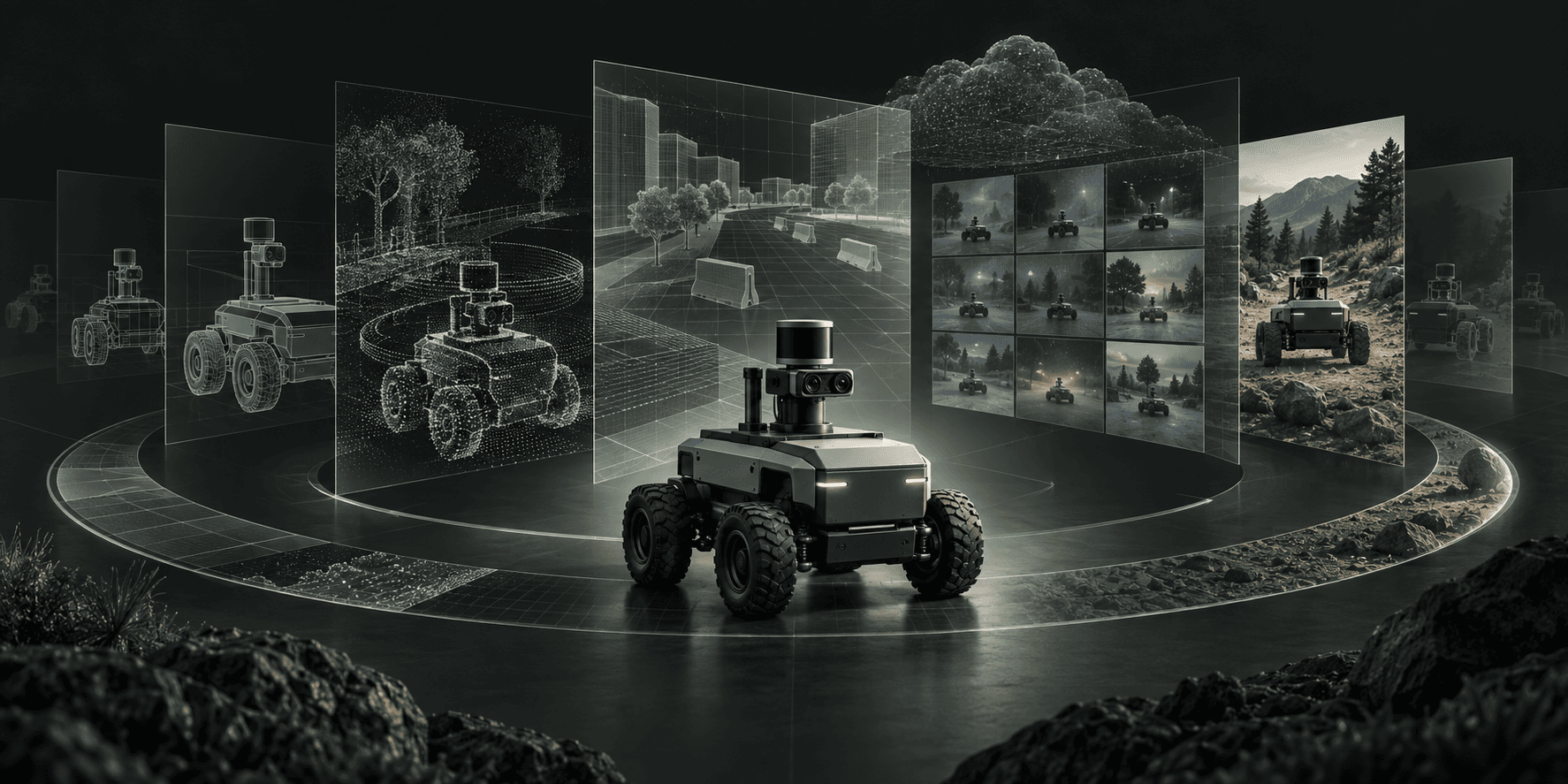
A robot can pass every laboratory test and still fail when sunlight hits a camera at the wrong angle, a pallet shifts a few centimeters, or a wet surface changes traction. Physical testing finds some of those problems, but each run consumes equipment, space, people, and time. The rare cases that matter most can be dangerous or nearly impossible to reproduce on demand.
Antioch is building infrastructure intended to move much of that work into software. Its platform creates digital twins of customer systems, runs their production software across many simulated conditions, records the results, and uses physical outcomes to recalibrate the virtual model. The ambition is not merely to generate synthetic scenes. It is to become the test layer that tells an autonomy team whether a change is ready for hardware.
This report examines the company, product, simulation architecture, sensor and physics stack, customer evidence, cloud model, economics, alternatives, and procurement risks. The central question is simple: when can a buyer trust a simulation enough to make a real engineering decision?
Executive View
Antioch is most compelling as continuous evaluation infrastructure for teams that already operate expensive autonomous hardware. Its value rises when releases are frequent, field tests are costly, failures are rare but consequential, and one scenario library can be reused across a fleet or product line.
The company has a more concrete product than its broad verifier language initially suggests. A public Python package exposes local authoring, repeatable scenarios, remote execution, telemetry, artifacts, and managed Isaac environments. Amazon and Ring provide credible customer evidence, while NVIDIA and Nebius support the simulation and cloud stack.
The evidence is still early. Antioch publishes no general pricing, detailed calibration benchmark, service level agreement, supported hardware matrix, or independent comparison with physical results. A buyer should treat the platform as a promising development system that must earn trust for each hardware class and decision, not as a universal substitute for field testing.
Antioch at a Glance
Product
Published Position
Cloud simulation, digital twins, scenario evaluation, synthetic data, and an agentic development layer.
Buyer Meaning
Evaluate the complete workflow rather than a rendering demo.
Development surface
Published Position
Typed Python software development kit, command line tools, local authoring, and remote managed simulation.
Buyer Meaning
Existing Python and Isaac teams have a recognizable entry point.
Core technical claim
Published Position
Hybrid simulation explicitly models known structure and learns effects that are harder to specify.
Buyer Meaning
Fidelity must be measured for the exact system and outcome.
Named commercial evidence
Published Position
Amazon and Ring, plus Launchpad Build AI.
Buyer Meaning
Useful endorsements, with limited public operating detail.
Technology partners
Published Position
NVIDIA simulation tools and Nebius cloud infrastructure.
Buyer Meaning
These relationships support delivery but are not all customer contracts.
Pricing
Published Position
No public rate card was found.
Buyer Meaning
Request separate setup, compute, storage, support, and continuing calibration prices.
| Dimension | Published Position | Buyer Meaning |
|---|---|---|
| Product | Cloud simulation, digital twins, scenario evaluation, synthetic data, and an agentic development layer. | Evaluate the complete workflow rather than a rendering demo. |
| Development surface | Typed Python software development kit, command line tools, local authoring, and remote managed simulation. | Existing Python and Isaac teams have a recognizable entry point. |
| Core technical claim | Hybrid simulation explicitly models known structure and learns effects that are harder to specify. | Fidelity must be measured for the exact system and outcome. |
| Named commercial evidence | Amazon and Ring, plus Launchpad Build AI. | Useful endorsements, with limited public operating detail. |
| Technology partners | NVIDIA simulation tools and Nebius cloud infrastructure. | These relationships support delivery but are not all customer contracts. |
| Pricing | No public rate card was found. | Request separate setup, compute, storage, support, and continuing calibration prices. |
Sources: Antioch product pages, public software package, September 2026 financing announcement, Greylock, TechCrunch, and SiliconANGLE. Analysis current as of September 10, 2026.
Black Scarab Weekly
Follow the physical AI economy
Get Black Scarab news, deep research, and practical analysis in one clear Thursday briefing.
The Company and the Financing
Antioch was founded in 2025 in New York by a team with backgrounds in autonomy, simulation, machine learning, and software companies. Public profiles identify Harry Mellsop, Alex Langshur, Collin Schlager, Colton Swingle, and Michael Calvey across the founding group. Mellsop previously worked on computer vision at Tesla, while other team members brought experience from Google DeepMind, Meta Reality Labs, and Transpose.
The company announced a $32 million Series A led by Greylock on September 8, 2026. A*, Category Ventures, BoxGroup, Icehouse Ventures, and individual investors participated. Greylock general partner Saam Motamedi joined the board.
Antioch states that the Series A and its $8.5 million April seed bring total funding to $40.5 million. Reports from December 2025 separately described a $4.25 million preseed. The public record does not say whether that amount became part of the later seed total or is excluded from the current figure. This report therefore uses Antioch's stated $40.5 million total and flags the unresolved arithmetic rather than adding the announcements together as if they were necessarily separate closings.
The capital is intended to expand the platform and team across simulation, infrastructure, machine learning, graphics, commercial functions, and operations. The pace is notable for a company little more than a year old. It also raises the burden of proof. Infrastructure businesses need durable usage, not only impressive demonstrations and strategic relationships.
What Antioch Actually Sells
Antioch sells a managed development and evaluation environment for physical autonomy. A customer brings the machine design, sensors, software stack, operating environment, and target decisions. Antioch helps convert those inputs into a digital twin, scenario library, execution environment, result history, and feedback loop connected to physical tests.
The public product spans three jobs. Development lets engineers create or modify simulations and inspect behavior. Evaluation runs defined conditions repeatedly to identify failures and regressions. Synthetic data generation produces sensor observations and uncommon scenarios for model training or testing.
Antioch Agent sits above these functions. The company says it can ingest CAD, BIM, specification sheets, and other system descriptions, then build scenes, define scenarios, run evaluations, and iterate on the autonomy stack. That is a product direction and a current marketed capability. The public material does not expose enough detail to determine which agent actions are autonomous, which require expert review, or how changes enter a customer's source repository.
This distinction matters. A tool that generates a scenario quickly can save engineering time. A tool that changes safety relevant controls requires permissions, review, traceability, and rollback. Buyers should define the acceptable authority of the agent before evaluating its convenience.
The Real to Simulation to Real Loop
A useful digital twin is not a beautiful copy of a machine. It is a model that predicts the outputs relevant to a decision within an agreed error range. The workflow begins by defining that decision. A perception team may care about detection under glare. A mobile robot team may care about stopping distance on a slope. An industrial cell may care about grasp success and accepted output.
Antioch then represents the known parts of the system directly and calibrates uncertain behavior against real data. Scenarios vary the conditions that matter, while regression suites preserve failures so they can be tested after future changes. Results from the physical system return to the model, creating new cases and revealing where the twin diverges.
This loop is the defensible part of the product if it compounds. A customer that turns every field failure into a permanent test can improve coverage over time. Antioch can also improve shared modeling tools across projects, subject to contractual restrictions on customer data and intellectual property.
From Physical System to Release Decision
Define the decision
Work
Identify the behavior, outcome, tolerance, and operating boundary.
Evidence Needed
A measurable acceptance criterion.
Onboard the system
Work
Import geometry, kinematics, sensors, software, and environment information.
Evidence Needed
Versioned source files and documented assumptions.
Calibrate
Work
Compare simulated outputs with physical observations and adjust uncertain models.
Evidence Needed
Error distributions across representative data.
Generate scenarios
Work
Vary weather, geometry, traffic, faults, sensor conditions, and behavior.
Evidence Needed
Coverage tied to known risks, not arbitrary variation.
Run and evaluate
Work
Execute the production stack in parallel and record checks, telemetry, and artifacts.
Evidence Needed
Reproducible results linked to source and configuration versions.
Validate the release
Work
Compare the candidate with the current system and investigate regressions.
Evidence Needed
A documented release decision and remaining physical tests.
Close the loop
Work
Feed physical outcomes and failures back into calibration and test coverage.
Evidence Needed
Evidence that prediction improves over successive iterations.
| Stage | Work | Evidence Needed |
|---|---|---|
| Define the decision | Identify the behavior, outcome, tolerance, and operating boundary. | A measurable acceptance criterion. |
| Onboard the system | Import geometry, kinematics, sensors, software, and environment information. | Versioned source files and documented assumptions. |
| Calibrate | Compare simulated outputs with physical observations and adjust uncertain models. | Error distributions across representative data. |
| Generate scenarios | Vary weather, geometry, traffic, faults, sensor conditions, and behavior. | Coverage tied to known risks, not arbitrary variation. |
| Run and evaluate | Execute the production stack in parallel and record checks, telemetry, and artifacts. | Reproducible results linked to source and configuration versions. |
| Validate the release | Compare the candidate with the current system and investigate regressions. | A documented release decision and remaining physical tests. |
| Close the loop | Feed physical outcomes and failures back into calibration and test coverage. | Evidence that prediction improves over successive iterations. |
Black Scarab functional interpretation of Antioch's published workflow. It is not a proprietary architecture diagram.
How the Hybrid Simulation Model Works
Antioch divides simulation into what can be programmed and what should be learned. Geometry, kinematics, sensor position, and physical constraints can often be expressed explicitly. These models are inspectable, allow controlled variation, and work before a customer has collected a large operating dataset.
The difficult layer contains sensor noise, material interaction, contact behavior, and environmental effects that simplified equations or ideal specifications fail to capture. Antioch proposes learning those residual differences from real observations. As more data becomes available, learned components can replace approximations.
The strategy is practical because a fully learned world model begins with a data problem. Most machines spend their time in normal operation. Rare failures are exactly the cases a development team needs, but they are poorly represented in collected data. Classical simulation can deliberately create those cases, while learned corrections can make their sensor and system behavior more realistic.
The risk is false precision. A digital twin can match one measured output while being wrong for another. A camera model calibrated for detection may still misrepresent timing, glare, blur, or thermal behavior. A dynamics model that predicts a vehicle trajectory may not reproduce component stress. Fidelity belongs to a variable, condition, tolerance, and version. It should never be accepted as a general adjective.
Three Simulation Approaches
Explicit simulation
Strength
Controllable, interpretable, and usable with limited data.
Constraint
Complex contacts, materials, and sensor behavior may be inaccurate.
Best Use
Geometry, kinematics, controlled variation, and early design work.
Learned world model
Strength
Can represent difficult behavior directly from observations.
Constraint
Needs representative data and can be difficult to interpret.
Best Use
Phenomena with sufficient real examples and clear validation.
Antioch hybrid direction
Strength
Uses explicit structure as the base and learns difficult residual behavior.
Constraint
Calibration and data quality remain specific to each system.
Best Use
Continuous evaluation where real outcomes can refine the twin.
| Approach | Strength | Constraint | Best Use |
|---|---|---|---|
| Explicit simulation | Controllable, interpretable, and usable with limited data. | Complex contacts, materials, and sensor behavior may be inaccurate. | Geometry, kinematics, controlled variation, and early design work. |
| Learned world model | Can represent difficult behavior directly from observations. | Needs representative data and can be difficult to interpret. | Phenomena with sufficient real examples and clear validation. |
| Antioch hybrid direction | Uses explicit structure as the base and learns difficult residual behavior. | Calibration and data quality remain specific to each system. | Continuous evaluation where real outcomes can refine the twin. |
The Development and Cloud Architecture
The public software package makes the delivery model easier to understand. Antioch provides a typed Python software development kit and command line interface. Engineers write simulation code in their own project, define scenarios as Python functions, and select the simulation engine through a project manifest.
Execution runs on managed cloud graphics processors. The remote image supplies the heavy Isaac environment, so a developer computer needs Python but does not need a local graphics processor or full Isaac installation. Interactive sessions support streaming, while queued suites can save project files, container images, results, telemetry, and artifacts for later review.
A scenario records its source hash, parameters, checks, telemetry, and output artifacts. Those details matter because a result without version provenance is difficult to reproduce. Antioch also describes suites, parallel machines, saved images, and reruns, which moves the product closer to continuous integration than a one time simulator session.
Nebius is the named cloud infrastructure partner. Antioch says the relationship supports the compute, orchestration, and reliability required for simulation at scale. Buyers should still ask where each workload and dataset is stored, which regions are available, how isolation works, and what happens to saved images and telemetry after a contract ends.
Published Technical Building Blocks
Authoring
Published Components
Python 3.12, Antioch software development kit, command line tools, scenarios, and suites.
Diligence Question
Which source and configuration remain portable outside Antioch?
Simulation engines
Published Components
NVIDIA Isaac Sim and Isaac Lab environments, with PhysX and optional Newton support described publicly.
Diligence Question
Which engine versions are supported for the contract term?
System inputs
Published Components
CAD, BIM, STEP, URDF, specifications, software containers, and site information are shown across product pages.
Diligence Question
What conversion and validation work is manual?
Sensors
Published Components
Camera, LiDAR, radar, infrared, depth, and inertial models are described.
Diligence Question
Is the exact device and firmware calibrated?
Execution
Published Components
Managed cloud graphics processors, interactive machines, queued runs, and parallel scenario dispatch.
Diligence Question
What are the limits, queue behavior, and recovery commitments?
Evidence
Published Components
Checks, telemetry, viewport capture, artifacts, run history, and source hashes.
Diligence Question
Can the customer export a complete audit record?
Infrastructure
Published Components
Nebius partnership and NVIDIA simulation stack integration.
Diligence Question
Which responsibilities belong to Antioch, Nebius, NVIDIA, and the customer?
| Layer | Published Components | Diligence Question |
|---|---|---|
| Authoring | Python 3.12, Antioch software development kit, command line tools, scenarios, and suites. | Which source and configuration remain portable outside Antioch? |
| Simulation engines | NVIDIA Isaac Sim and Isaac Lab environments, with PhysX and optional Newton support described publicly. | Which engine versions are supported for the contract term? |
| System inputs | CAD, BIM, STEP, URDF, specifications, software containers, and site information are shown across product pages. | What conversion and validation work is manual? |
| Sensors | Camera, LiDAR, radar, infrared, depth, and inertial models are described. | Is the exact device and firmware calibrated? |
| Execution | Managed cloud graphics processors, interactive machines, queued runs, and parallel scenario dispatch. | What are the limits, queue behavior, and recovery commitments? |
| Evidence | Checks, telemetry, viewport capture, artifacts, run history, and source hashes. | Can the customer export a complete audit record? |
| Infrastructure | Nebius partnership and NVIDIA simulation stack integration. | Which responsibilities belong to Antioch, Nebius, NVIDIA, and the customer? |
The website displays larger catalog counts and performance examples inside interface illustrations. Those figures should be confirmed in a current product schedule before procurement.
Sensors Are the First Fidelity Test
Antioch entered through perception because every downstream autonomy decision depends on what the simulated sensors produce. A clean virtual point cloud can make a navigation model look excellent while a physical LiDAR loses returns on dark material, glass, distance, rain, or an awkward angle.
The company describes sensor models for cameras, LiDAR, radar, depth, infrared, and inertial measurements. The relevant details include noise, saturation, beam patterns, dropout, motion effects, temperature, and device variation. A specification sheet provides nominal performance. Calibration data reveals how the real unit behaves.
This focus aligns with the disclosed Ring work. Fixed perception products face lighting, weather, occlusion, human motion, and false alarm scenarios that are expensive to stage comprehensively. Simulation can multiply coverage quickly if the sensor output is close enough to physical measurements.
Manipulation is a harder extension. Contact, friction, compliance, flexible material, tool wear, and process quality can interact. Antioch identifies industrial autonomy as a target and lists multiple physics approaches, but it has not published a broad benchmark showing that the same fidelity achieved in a perception use case transfers to contact rich production.
Where Antioch Fits Across Physical Systems
Antioch markets four solution areas: intelligent perception, ground autonomy, aerial autonomy, and industrial autonomy. The common layer is scenario based evaluation. The important output changes by application.
A perception team asks whether the sensor and model detect the right event across environmental variation. A ground robot team asks whether the full stack navigates, avoids conflict, and recovers. An aerial team must add dynamics, wind, signal conditions, and flight safety. An industrial team may need accurate contact, throughput, accepted process quality, and human interaction around the cell.
The best initial project is a bounded decision with physical reference data. Attempting to simulate an entire factory or general robot before proving one measurable use case increases cost and makes error difficult to localize.
Application by Decision
Intelligent perception
Useful First Decision
Compare a sensor or model update across lighting, weather, distance, and occlusion.
Critical Evidence
Detection and false alarm results against held out physical data.
Ground autonomy
Useful First Decision
Test route completion and recovery under traffic, faults, and sensor degradation.
Critical Evidence
Trajectory, intervention, safety state, and completion agreement with field runs.
Aerial autonomy
Useful First Decision
Evaluate control and mission behavior under wind, signal loss, and changing payload.
Critical Evidence
Dynamics and controller response within an approved flight envelope.
Industrial autonomy
Useful First Decision
Compare robot, tool, sensor, or policy configurations before commissioning.
Critical Evidence
Cycle time, collision state, grasp or process result, and physical acceptance checks.
| Application | Useful First Decision | Critical Evidence |
|---|---|---|
| Intelligent perception | Compare a sensor or model update across lighting, weather, distance, and occlusion. | Detection and false alarm results against held out physical data. |
| Ground autonomy | Test route completion and recovery under traffic, faults, and sensor degradation. | Trajectory, intervention, safety state, and completion agreement with field runs. |
| Aerial autonomy | Evaluate control and mission behavior under wind, signal loss, and changing payload. | Dynamics and controller response within an approved flight envelope. |
| Industrial autonomy | Compare robot, tool, sensor, or policy configurations before commissioning. | Cycle time, collision state, grasp or process result, and physical acceptance checks. |
Customers, Partners, and Commercial Evidence
Amazon and Ring provide the strongest public customer evidence. Jason Mitura, an Amazon vice president and Ring's chief product officer, says Antioch simulations closely matched physical test results, including cases withheld from calibration. Held out results are valuable because they test prediction beyond the examples used to tune the model.
The statement does not disclose the system, sample size, error metric, acceptable tolerance, duration, or financial result. It supports the usefulness of Antioch for an Amazon and Ring program. It does not establish fidelity across all products or physical processes.
Launchpad Build AI says Antioch accelerated development of automated manufacturing systems and enabled testing of production scenarios and difficult edge cases. Again, the public endorsement lacks a measured baseline, timeline, and deployment outcome.
NVIDIA and Nebius occupy different roles. Antioch integrates NVIDIA Omniverse libraries, Isaac Sim, and Isaac Lab. Nebius supplies cloud infrastructure. They strengthen the platform architecture, but an integration or infrastructure partnership should not be counted as proof that a third party autonomy customer pays for and relies on the product in production.
Evidence Classification
Amazon and Ring
Disclosed Relationship
Named partner and platform user with an executive testimonial.
What Is Supported
Simulated results reportedly matched physical tests, including held out cases.
What Is Not Public
System details, metrics, contract value, and operating impact.
Launchpad Build AI
Disclosed Relationship
Named user for automated manufacturing development.
What Is Supported
Company testimonial reports faster development and wider scenario coverage.
What Is Not Public
Measured time savings, production deployment, and commercial terms.
NVIDIA
Disclosed Relationship
Simulation technology integration partner.
What Is Supported
Use of Omniverse libraries, Isaac Sim, and Isaac Lab.
What Is Not Public
Customer revenue, exclusivity, and joint service obligations.
Nebius
Disclosed Relationship
Cloud infrastructure partner.
What Is Supported
Infrastructure supports scaled simulation delivery.
What Is Not Public
Commercial terms, regions, capacity commitments, and service levels.
| Organization | Disclosed Relationship | What Is Supported | What Is Not Public |
|---|---|---|---|
| Amazon and Ring | Named partner and platform user with an executive testimonial. | Simulated results reportedly matched physical tests, including held out cases. | System details, metrics, contract value, and operating impact. |
| Launchpad Build AI | Named user for automated manufacturing development. | Company testimonial reports faster development and wider scenario coverage. | Measured time savings, production deployment, and commercial terms. |
| NVIDIA | Simulation technology integration partner. | Use of Omniverse libraries, Isaac Sim, and Isaac Lab. | Customer revenue, exclusivity, and joint service obligations. |
| Nebius | Cloud infrastructure partner. | Infrastructure supports scaled simulation delivery. | Commercial terms, regions, capacity commitments, and service levels. |
Commercial Model and Pricing Evidence
Antioch appears to combine enterprise onboarding and calibration work with recurring software, managed compute, storage, and support. That interpretation follows the public product workflow and book a call sales motion. The company does not publish a standard contract structure or price list.
A website illustration shows an estimated $4.10 cost for 2,048 replicas. It is useful as an example of the intended cloud dispatch experience, but it is not a rate card and should not be extrapolated into a customer budget. The surrounding scene, pass rates, and run time are also illustrative interface content.
The complete cost starts before the first cloud run. Geometry and software must be prepared, sensors and dynamics calibrated, environments built, acceptance criteria defined, and physical reference tests collected. Continuing expenses include compute, storage, data movement, model maintenance, scenario review, engine upgrades, and support.
A buyer should separate one time onboarding from recurring consumption and services. The contract should also explain whether learned models, calibrated assets, scenario libraries, and result histories can be exported and reused after termination.
What Belongs in the Commercial Quote
System onboarding
Scope to Request
Geometry conversion, software packaging, sensor setup, and environment creation.
Common Source of Surprise
Poor source files and undocumented hardware assumptions.
Calibration
Scope to Request
Physical data collection, model fitting, validation, and acceptance thresholds.
Common Source of Surprise
New hardware or firmware can require recalibration.
Cloud execution
Scope to Request
Machine type, replica time, queues, concurrency, retries, and failed run treatment.
Common Source of Surprise
Large scenario sweeps without coverage discipline.
Data and artifacts
Scope to Request
Storage, retention, export, transfer, and deletion.
Common Source of Surprise
Telemetry and rendered output can become large quickly.
Platform and support
Scope to Request
Seats, environments, service levels, training, incident response, and upgrades.
Common Source of Surprise
Simulation engine changes can affect reproducibility.
Professional services
Scope to Request
Scenario development, custom models, integration, and continuing engineering.
Common Source of Surprise
A platform project can become a permanent consulting engagement.
| Cost Category | Scope to Request | Common Source of Surprise |
|---|---|---|
| System onboarding | Geometry conversion, software packaging, sensor setup, and environment creation. | Poor source files and undocumented hardware assumptions. |
| Calibration | Physical data collection, model fitting, validation, and acceptance thresholds. | New hardware or firmware can require recalibration. |
| Cloud execution | Machine type, replica time, queues, concurrency, retries, and failed run treatment. | Large scenario sweeps without coverage discipline. |
| Data and artifacts | Storage, retention, export, transfer, and deletion. | Telemetry and rendered output can become large quickly. |
| Platform and support | Seats, environments, service levels, training, incident response, and upgrades. | Simulation engine changes can affect reproducibility. |
| Professional services | Scenario development, custom models, integration, and continuing engineering. | A platform project can become a permanent consulting engagement. |
A Practical Buyer Example
Consider a fictional warehouse operator evaluating a new autonomous mobile robot release. The fleet occasionally fails to dock when a pallet is slightly out of position and overhead light creates glare. Reproducing the combination physically requires the robot, a test area, an engineer, an operator, repeated resets, and enough runs to separate chance from a real improvement.
The buyer could begin with a narrow Antioch project. Import one robot configuration and the docking area, calibrate camera and vehicle behavior against a set of physical runs, then withhold part of the physical data from calibration. The simulation earns a role only if it predicts success, failure, and timing closely enough on that withheld set.
Once accepted, the team can vary pallet offset, lighting, floor condition, sensor dropout, approach speed, and nearby traffic. The economic comparison is the complete cost of building and maintaining that test suite against the physical test hours, equipment access, release delay, and field failures it avoids.
The simulation should not approve the release by itself on day one. A sensible policy uses it to eliminate weak candidates and focus physical testing on the remaining risks. Authority can increase only after repeated agreement between simulated predictions and field outcomes.
Fictional Pilot Scorecard
Physical regression effort
Baseline
Record all labor, robot time, space, resets, and setup.
Pilot Question
How much work moves into repeatable simulation?
Prediction error
Baseline
Measure agreement on physical cases excluded from calibration.
Pilot Question
Is the error within the decision tolerance?
Failure discovery
Baseline
Count meaningful failures found before field release.
Pilot Question
Would the current physical plan have found them?
Release cycle
Baseline
Measure time from change to approved field test.
Pilot Question
Does simulation reduce delay without weakening evidence?
Reuse
Baseline
Track engineering work for the first and second configuration.
Pilot Question
Does the platform become cheaper to extend?
| Measure | Baseline | Pilot Question |
|---|---|---|
| Physical regression effort | Record all labor, robot time, space, resets, and setup. | How much work moves into repeatable simulation? |
| Prediction error | Measure agreement on physical cases excluded from calibration. | Is the error within the decision tolerance? |
| Failure discovery | Count meaningful failures found before field release. | Would the current physical plan have found them? |
| Release cycle | Measure time from change to approved field test. | Does simulation reduce delay without weakening evidence? |
| Reuse | Track engineering work for the first and second configuration. | Does the platform become cheaper to extend? |
This is a fictional procurement example created by Black Scarab. It does not describe an Antioch customer or published performance result.
Alternatives to Antioch
The main alternative is not another startup. It is an internal simulation team using the underlying engines directly. A capable organization can build on Isaac Sim, Isaac Lab, Gazebo, MuJoCo, or specialized industry tools, then connect its own cloud infrastructure, scenario framework, telemetry, and validation process.
Direct ownership offers control and can fit a company with proprietary systems, stable scale, and permanent simulation expertise. It also means maintaining engine versions, graphics infrastructure, sensor models, asset pipelines, orchestration, result storage, and support.
A second alternative is hardware in the loop and structured field testing. Those methods remain essential for timing, electronics, networking, safety systems, wear, and phenomena the virtual model does not capture. The relevant question is how Antioch changes the mix, not whether it removes physical validation.
Specialist synthetic data vendors can be better when the primary requirement is labeled perception data rather than complete system evaluation. Robot manufacturers may also supply a supported simulator and digital twin for their own equipment. That narrower package can be easier to procure, although it may not cover a mixed fleet or full customer software stack.
Antioch Versus the Main Approaches
Antioch managed platform
Best Fit
Teams seeking local authoring, managed cloud execution, calibration, and reusable evaluation workflows.
Tradeoff
Vendor dependence, private pricing, and fidelity that still requires proof.
Direct engine development
Best Fit
Organizations with a permanent simulation team and unusual requirements.
Tradeoff
Maximum control with substantial infrastructure and maintenance burden.
Robot maker simulator
Best Fit
A supported deployment centered on one hardware family.
Tradeoff
Simpler integration but less independence and cross platform reach.
Synthetic data specialist
Best Fit
Perception training and labeling at scale.
Tradeoff
May not execute the complete production control stack.
Hardware in the loop
Best Fit
Electronics, timing, communications, and real controller validation.
Tradeoff
Limited parallelism and continued equipment dependence.
Field testing
Best Fit
Final acceptance, safety evidence, wear, and unmodeled reality.
Tradeoff
Slow, expensive, and poor at reproducing rare conditions.
| Approach | Best Fit | Tradeoff |
|---|---|---|
| Antioch managed platform | Teams seeking local authoring, managed cloud execution, calibration, and reusable evaluation workflows. | Vendor dependence, private pricing, and fidelity that still requires proof. |
| Direct engine development | Organizations with a permanent simulation team and unusual requirements. | Maximum control with substantial infrastructure and maintenance burden. |
| Robot maker simulator | A supported deployment centered on one hardware family. | Simpler integration but less independence and cross platform reach. |
| Synthetic data specialist | Perception training and labeling at scale. | May not execute the complete production control stack. |
| Hardware in the loop | Electronics, timing, communications, and real controller validation. | Limited parallelism and continued equipment dependence. |
| Field testing | Final acceptance, safety evidence, wear, and unmodeled reality. | Slow, expensive, and poor at reproducing rare conditions. |
Benefits and Where They Come From
Parallel evaluation is the clearest benefit. One physical robot generally runs one condition at a time. Cloud simulation can examine many scenarios and configurations concurrently, provided the model and evaluation metric are valid.
Repeatability is equally important. A field failure that becomes a versioned scenario can be checked after every future release. That converts an unpleasant surprise into durable coverage and reduces the risk of reintroducing a known problem.
Simulation also changes access to hardware. Software and model teams can test without waiting for a scarce machine or physical facility. Distributed teams can work against the same versioned environment, while dangerous conditions can be explored without placing people or equipment at immediate risk.
Finally, comparison becomes more systematic. A team can test sensor positions, robot configurations, models, or control parameters against the same cases. The result does not replace procurement diligence, but it can reduce expensive physical experiments to the candidates that deserve them.
Limitations, Security, and Production Risk
Simulation can fail quietly. A scenario may pass because the virtual sensor is too clean, the material model is too simple, timing is ignored, or the test metric does not represent accepted work. A large green dashboard can create more confidence than the underlying model deserves.
Model drift is another risk. A new camera firmware, tire, payload, gripper, floor coating, or software version can change the relationship between simulation and reality. Calibration is not a one time ceremony. The contract and release process need triggers for revalidation.
Customer inputs can be sensitive. Geometry, site scans, source code, sensor data, incidents, and facility layouts may reveal products and operations. Antioch displays security certification badges on its website, but buyers should review the current audit scope, data flow, subprocessors, access controls, encryption, retention, model training rights, incident obligations, and verified deletion process.
A final risk is organizational. If engineers cannot understand why a scenario failed, simulation becomes another queue rather than a faster loop. Useful tooling must connect results to code, configuration, telemetry, and an owner who can act on the evidence.
Evidence Required Before Production Reliance
Does the twin predict our system?
Useful Evidence
Error measurements on representative physical cases withheld from calibration.
What decisions can it support?
Useful Evidence
Written variables, tolerances, operating boundaries, and excluded phenomena.
Can results be reproduced?
Useful Evidence
Versioned source, containers, engine, models, parameters, and artifacts.
What happens after change?
Useful Evidence
Recalibration triggers, regression policy, rollback, and historical comparability.
Who owns each failure?
Useful Evidence
Responsibility across customer software, Antioch, cloud infrastructure, and simulation engines.
Can we leave?
Useful Evidence
Export rights for scenarios, assets, calibrated models, telemetry, and results.
| Question | Useful Evidence |
|---|---|
| Does the twin predict our system? | Error measurements on representative physical cases withheld from calibration. |
| What decisions can it support? | Written variables, tolerances, operating boundaries, and excluded phenomena. |
| Can results be reproduced? | Versioned source, containers, engine, models, parameters, and artifacts. |
| What happens after change? | Recalibration triggers, regression policy, rollback, and historical comparability. |
| Who owns each failure? | Responsibility across customer software, Antioch, cloud infrastructure, and simulation engines. |
| Can we leave? | Export rights for scenarios, assets, calibrated models, telemetry, and results. |
Black Scarab Verdict
Antioch is attacking a real constraint in physical AI. Model development is accelerating faster than physical validation. Teams that cannot test changes broadly and repeatedly will either release slowly or accept more field risk. A managed platform that turns hardware, environments, and failures into software tests can become important infrastructure.
The company has credible ingredients: a public development surface, current Isaac environments, scenario and evidence tooling, cloud delivery, an Amazon and Ring endorsement, and infrastructure relationships with NVIDIA and Nebius. Its hybrid approach to fidelity is also more practical than pretending explicit physics or learned world models solve every problem alone.
The open question is whether customer specific calibration becomes a reusable platform or an engineering service attached to each deployment. Antioch can answer that with measured held out results, repeat implementation evidence, transparent commercial units, and proof across more demanding physical interactions.
Physical AI teams with expensive test programs should evaluate Antioch now, beginning with one bounded decision and a physical reference set the simulator has not seen. Do not ask whether the graphics look real. Ask whether the predicted outcome is accurate enough to change what you build, test, or release.
Research Method
Prepared September 10, 2026 from Antioch product and solution pages, its public Python software package, company financing materials, Greylock's investment announcement, named partner statements, and independent reporting from TechCrunch and SiliconANGLE. Company claims, partner statements, product interface illustrations, and Black Scarab analysis are identified separately.
Antioch is privately held and does not publish audited financial statements, a general price list, complete customer roster, full supported hardware catalog, service levels, or a detailed independent fidelity benchmark. The cover is an original AI generated editorial illustration of a representative simulation workflow, not a photograph of an Antioch product or customer system.
About the author
Rodolfo is the founder of Black Scarab, where he covers the technologies and commercial signals shaping physical AI adoption.
Meet RodolfoBlack Scarab Weekly
Follow the physical AI economy
Get Black Scarab news, deep research, and practical analysis in one clear Thursday briefing.
Related Insights
Industrial Robotics
Top Robotic Welding Systems in 2026: Eight Options Compared
Compare eight robotic welding systems for fabrication, repeat production and pipework, with public pricing, an interactive payback calculator and a look at adaptive AI and humanoids.
Read related insight
Robotics
How to Build a Robot With NVIDIA
From a virtual warehouse to onboard inference, a practical guide to the tools, data, and engineering decisions behind a working humanoid.
Read related insight
Physical AI Infrastructure
Encord Deep Dive: Founders, Funding and the Robot Data Market
From image labeling to robot data services, Encord is building a business around the experience machines need to learn useful work.
Read related insight