
Deep Dive · Smart Cities
Flock Safety Deep Dive: Hardware, Business Model, Pricing, and Tradeoffs
Flock Safety combines roadside sensors, cellular connectivity, cloud software, shared vehicle intelligence, audio detection, video, and response drones in one public safety platform. This guide explains how every layer fits together, who buys it, what public contracts reveal about pricing, where the benefits are strongest, and which risks buyers must govern.
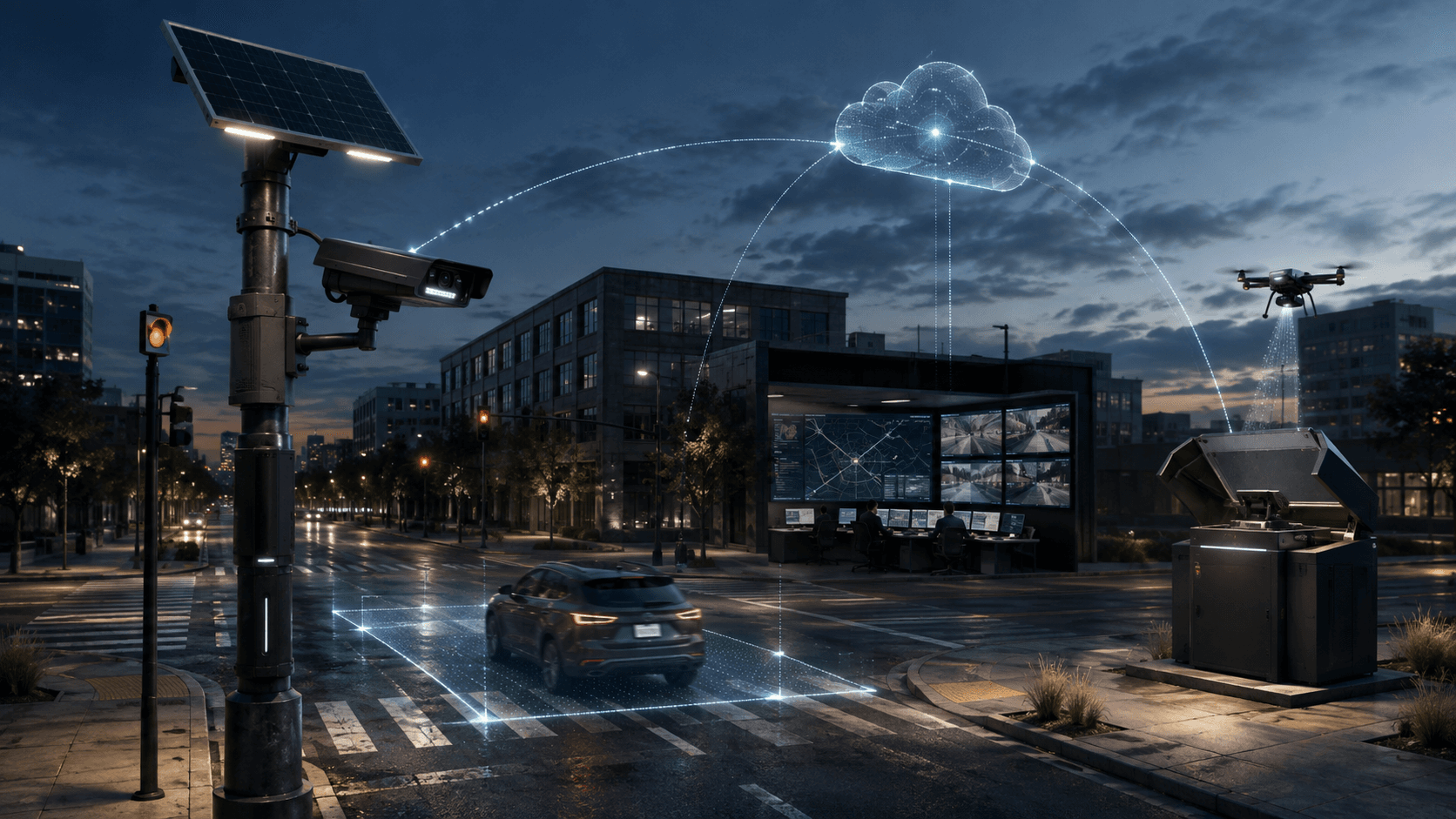
Flock Safety began with a simple proposition: put a small camera beside a road, capture objective vehicle evidence, and make it searchable within seconds. The company has since expanded that idea into a much larger platform. A modern Flock deployment can combine license plate readers, live video, acoustic sensors, mobile trailers, third party cameras, dispatch data, records systems, cloud investigation tools, and remotely launched drones.
The strategic product is not any single camera. It is the connected evidence network. Each sensor adds another observation point. Each participating customer can add more geographic reach. Each software module gives operators another way to turn a detection into a response or an investigation. That creates a strong recurring revenue business, but it also concentrates technical, operational, and governance risk in one platform.
Flock says its network reaches thousands of agencies and communities across 49 states. Current company materials also claim that its technology supported more than one million cases in 2025. Those figures describe scale, not independent proof of effectiveness. The more useful question is where the system measurably improves a workflow, what it costs to operate, and what controls are required when a local camera becomes part of a national search network.
Executive View
Flock has built public safety as a managed subscription. Customers do not simply buy a camera and hire an integrator. They subscribe to a package that can include the device, installation, cellular service, cloud storage, software, maintenance, upgrades, training, support, and help with permits. This removes much of the infrastructure work that slows traditional camera projects.
Its strongest commercial advantage is the combination of simple deployment and network reach. Solar power and cellular connectivity let agencies place readers without trenching for electricity or extending a local data network. The cloud platform then connects detections across approved agencies and private properties. A buyer can start with a few entry points and expand toward a regional operating picture.
The core tradeoff is equally clear. Greater network value comes from more collection, more sharing, and easier access across jurisdictions. Those same properties create civil liberties, security, accuracy, and policy concerns. A serious procurement must therefore evaluate the system and its governance as one package. Camera accuracy alone is not enough.
Flock at a glance
Core product
What the company offers
Vehicle evidence captured by purpose built roadside cameras and organized in cloud software.
What it means for a buyer
A fast path to searchable coverage at selected roads, entrances, lots, and corridors.
Expansion products
What the company offers
Video, audio detection, mobile trailers, third party camera gateways, dispatch tools, investigation software, and drones.
What it means for a buyer
The initial LPR purchase can become a broader command and response platform.
Commercial model
What the company offers
Annual or multiyear subscription with hardware and operating services bundled.
What it means for a buyer
Lower initial integration burden, predictable operating expense, and recurring vendor dependence.
Primary moat
What the company offers
A large installed network, shared data relationships, software integrations, and a managed field service model.
What it means for a buyer
The value of the system can rise as neighboring agencies and private properties participate.
Main risk
What the company offers
A broad vehicle movement database that depends on policy, access controls, auditing, accurate alerts, and lawful use.
What it means for a buyer
Governance quality determines whether technical capability becomes useful evidence or unacceptable exposure.
| Dimension | What the company offers | What it means for a buyer |
|---|---|---|
| Core product | Vehicle evidence captured by purpose built roadside cameras and organized in cloud software. | A fast path to searchable coverage at selected roads, entrances, lots, and corridors. |
| Expansion products | Video, audio detection, mobile trailers, third party camera gateways, dispatch tools, investigation software, and drones. | The initial LPR purchase can become a broader command and response platform. |
| Commercial model | Annual or multiyear subscription with hardware and operating services bundled. | Lower initial integration burden, predictable operating expense, and recurring vendor dependence. |
| Primary moat | A large installed network, shared data relationships, software integrations, and a managed field service model. | The value of the system can rise as neighboring agencies and private properties participate. |
| Main risk | A broad vehicle movement database that depends on policy, access controls, auditing, accurate alerts, and lawful use. | Governance quality determines whether technical capability becomes useful evidence or unacceptable exposure. |
Black Scarab Weekly
Follow the physical AI economy
Get Black Scarab news, deep research, and practical analysis in one clear Thursday briefing.
The System Architecture
A Flock deployment can be understood as seven connected layers. The roadside hardware senses an event. Local electronics package the observation. Solar, battery, or wired power keeps the device operating. LTE moves the record to the cloud. Machine learning converts the image or sound into searchable attributes. FlockOS and related applications organize the information. Alerts, analysts, patrol officers, security teams, or drones close the loop with a physical response.
Flock does not publish a complete component bill for every current device. Public product sheets and procurement records are detailed enough to map the functional assembly, but not enough to identify every image sensor, processor, battery cell, modem, memory device, or firmware dependency. Buyers should request the current technical schedule for the exact model and configuration in their quote.
How the layers fit together
1. Site and mounting
Main components
Breakaway pole or existing pole, brackets, orientation, road geometry, and permitting.
Role in the system
Places the sensor at the correct height, angle, and distance for the target traffic pattern.
Output to the next layer
A stable field of view and a serviceable installation.
2. Sensing
Main components
Camera, optics, illumination, motion trigger, microphone array, or drone payload depending on the product.
Role in the system
Captures the vehicle, scene, acoustic event, or aerial view.
Output to the next layer
Images, short event clips, video, and sensor metadata.
3. Local electronics
Main components
Embedded compute, temporary storage, device control, clock synchronization, and health monitoring.
Role in the system
Processes or packages data, checks device status, and prepares secure transmission.
Output to the next layer
Time stamped observations and operating telemetry.
4. Power
Main components
Solar panel, rechargeable battery, power controls, or alternating current connection.
Role in the system
Keeps the device active without requiring the same utility work as a conventional camera network.
Output to the next layer
Continuous or scheduled field availability.
5. Connectivity
Main components
Integrated LTE for roadside devices, multiple cellular links for Alpha drones, and secure internet connections for gateways.
Role in the system
Moves data from distributed sites into the cloud and sends alerts back to users.
Output to the next layer
Encrypted cloud records, live feeds, and commands.
6. Cloud intelligence
Main components
Flock machine learning, storage, hot list matching, vehicle attributes, search, audit logs, and integrations.
Role in the system
Turns raw observations into searchable evidence and prioritizes matches.
Output to the next layer
Alerts, timelines, candidate vehicles, maps, and case evidence.
7. Operations and response
Main components
FlockOS, Flock911, Flock Nova, mobile access, dispatch systems, analysts, officers, private security, and drones.
Role in the system
Combines context, verifies information, coordinates people, and records the response.
Output to the next layer
A decision, dispatch, investigation, intervention, or documented nonresponse.
| Layer | Main components | Role in the system | Output to the next layer |
|---|---|---|---|
| 1. Site and mounting | Breakaway pole or existing pole, brackets, orientation, road geometry, and permitting. | Places the sensor at the correct height, angle, and distance for the target traffic pattern. | A stable field of view and a serviceable installation. |
| 2. Sensing | Camera, optics, illumination, motion trigger, microphone array, or drone payload depending on the product. | Captures the vehicle, scene, acoustic event, or aerial view. | Images, short event clips, video, and sensor metadata. |
| 3. Local electronics | Embedded compute, temporary storage, device control, clock synchronization, and health monitoring. | Processes or packages data, checks device status, and prepares secure transmission. | Time stamped observations and operating telemetry. |
| 4. Power | Solar panel, rechargeable battery, power controls, or alternating current connection. | Keeps the device active without requiring the same utility work as a conventional camera network. | Continuous or scheduled field availability. |
| 5. Connectivity | Integrated LTE for roadside devices, multiple cellular links for Alpha drones, and secure internet connections for gateways. | Moves data from distributed sites into the cloud and sends alerts back to users. | Encrypted cloud records, live feeds, and commands. |
| 6. Cloud intelligence | Flock machine learning, storage, hot list matching, vehicle attributes, search, audit logs, and integrations. | Turns raw observations into searchable evidence and prioritizes matches. | Alerts, timelines, candidate vehicles, maps, and case evidence. |
| 7. Operations and response | FlockOS, Flock911, Flock Nova, mobile access, dispatch systems, analysts, officers, private security, and drones. | Combines context, verifies information, coordinates people, and records the response. | A decision, dispatch, investigation, intervention, or documented nonresponse. |
This is a functional architecture based on public Flock materials and government procurement documents. It is not a manufacturer bill of materials.
The Roadside LPR Hardware
The fixed license plate reader is the foundation of the network. Public Flock materials describe a motion triggered camera that captures a short sequence as a vehicle enters and exits the frame. The system extracts the plate when visible and also describes objective vehicle traits such as color, body type, make, and visible features. That matters when a witness has only a partial plate or a description.
The standard physical assembly is compact: a camera enclosure, adjustable mount, pole, solar panel, local power system, embedded electronics, and LTE connectivity. The pole and bracket matter as much as the camera because plate capture depends on road speed, lane count, shoulder distance, viewing angle, glare, darkness, weather, vegetation, and vibration. Poor siting can turn an otherwise capable sensor into an unreliable source.
Public product sheets have described a standard Falcon for moderate traffic, a short range model for parking lots and controlled entrances, a long range model for fast multilane roads, and a portable Flex unit for temporary coverage. The current website uses the broader names Standard LPR, Wide Range LPR, Long Range LPR, LPR Pro, Flex LPR, and LPR Trailers. Exact model names and specifications have changed over time, so buyers should match every quoted line to a current data sheet.
Publicly described LPR configurations
Standard fixed reader
Best fit
Typical two lane roads and community entry points.
Publicly described deployment
Earlier Falcon sheets described solar power, LTE, capture at up to 75 miles per hour, and a target distance near 65 feet.
Important design question
Does the selected location remain within the approved angle, distance, and traffic volume envelope?
Short range reader
Best fit
Parking lots, narrow entrances, parks, and controlled access points.
Publicly described deployment
Earlier Falcon SR sheets described solar power, LTE, a wide field of view, and traffic near 25 miles per hour.
Important design question
Will the wider scene still preserve enough plate detail at night and during congestion?
Long range reader
Best fit
Fast roads, multiple lanes, and sites where the camera must sit farther from the target lane.
Publicly described deployment
Earlier Falcon LR sheets described operation near 100 miles per hour and a target distance near 150 feet, with powered and solar options appearing in public contracts.
Important design question
What power, optics, lane coverage, and mounting geometry are included in the quoted version?
Flex reader
Best fit
Investigations, events, construction changes, seasonal traffic, and temporary corridors.
Publicly described deployment
Portable enclosure with rechargeable battery, LTE, mounting hardware, and an optional solar package.
Important design question
Who moves it, how often is the battery serviced, and how is each new site validated?
LPR trailer
Best fit
Temporary deterrence, road safety messaging, and rapid deployment where no pole is available.
Publicly described deployment
Camera, power, cellular service, trailer, and optional radar message sign in one mobile unit.
Important design question
What towing, storage, charging, security, and relocation costs sit outside the subscription?
| Configuration | Best fit | Publicly described deployment | Important design question |
|---|---|---|---|
| Standard fixed reader | Typical two lane roads and community entry points. | Earlier Falcon sheets described solar power, LTE, capture at up to 75 miles per hour, and a target distance near 65 feet. | Does the selected location remain within the approved angle, distance, and traffic volume envelope? |
| Short range reader | Parking lots, narrow entrances, parks, and controlled access points. | Earlier Falcon SR sheets described solar power, LTE, a wide field of view, and traffic near 25 miles per hour. | Will the wider scene still preserve enough plate detail at night and during congestion? |
| Long range reader | Fast roads, multiple lanes, and sites where the camera must sit farther from the target lane. | Earlier Falcon LR sheets described operation near 100 miles per hour and a target distance near 150 feet, with powered and solar options appearing in public contracts. | What power, optics, lane coverage, and mounting geometry are included in the quoted version? |
| Flex reader | Investigations, events, construction changes, seasonal traffic, and temporary corridors. | Portable enclosure with rechargeable battery, LTE, mounting hardware, and an optional solar package. | Who moves it, how often is the battery serviced, and how is each new site validated? |
| LPR trailer | Temporary deterrence, road safety messaging, and rapid deployment where no pole is available. | Camera, power, cellular service, trailer, and optional radar message sign in one mobile unit. | What towing, storage, charging, security, and relocation costs sit outside the subscription? |
What Happens After a Vehicle Passes
First, motion activates capture. The device records several views of the vehicle, attaches the location and time, and holds the data locally only long enough to upload it. Flock says the device clock synchronizes through the LTE network and that its cloud service runs regular health checks.
Second, the encrypted record reaches Flock cloud infrastructure. Machine learning interprets the plate and visible vehicle characteristics. The plate can be checked against a customer list or an authorized state or national list. A candidate match can create an alert, while every record remains available for later search during the configured retention period.
Third, a user must interpret the result. A plate read is a lead, not an automatic finding of fact. Flock policy states that plate translation can be incomplete or inaccurate and that users should confirm the computer result before acting. That human verification step becomes especially important when an alert could lead to a vehicle stop or another coercive response.
Finally, software links the observation to a workflow. An investigator may search by full plate, partial plate, time, location, vehicle type, color, or another visible trait. An operations center may add nearby video. A dispatcher may compare a hit with a call. A drone may launch toward an approved event. The commercial power of Flock is that these actions happen inside one connected environment.
From observation to action
Capture
System action
Record a passing vehicle or qualifying sensor event.
Required control
Document the purpose, placement, coverage area, and notice policy.
Interpret
System action
Convert imagery or sound into machine readable attributes.
Required control
Measure accuracy under local conditions and track false results.
Match
System action
Compare attributes with lists, alerts, and prior observations.
Required control
Validate list quality, refresh timing, and user authorization.
Notify
System action
Send an alert to an approved person or system.
Required control
Define who receives it, what confirmation is required, and when it expires.
Investigate
System action
Search retained records and connect observations across locations.
Required control
Require a case purpose, log every query, and review unusual use.
Respond
System action
Dispatch people, share context, or launch an approved drone mission.
Required control
Keep a trained human responsible for the decision and document the outcome.
Retain or delete
System action
Preserve selected evidence or delete records when the retention period ends.
Required control
Set the shortest useful period and verify legal, contractual, and technical deletion rules.
| Step | System action | Required control |
|---|---|---|
| Capture | Record a passing vehicle or qualifying sensor event. | Document the purpose, placement, coverage area, and notice policy. |
| Interpret | Convert imagery or sound into machine readable attributes. | Measure accuracy under local conditions and track false results. |
| Match | Compare attributes with lists, alerts, and prior observations. | Validate list quality, refresh timing, and user authorization. |
| Notify | Send an alert to an approved person or system. | Define who receives it, what confirmation is required, and when it expires. |
| Investigate | Search retained records and connect observations across locations. | Require a case purpose, log every query, and review unusual use. |
| Respond | Dispatch people, share context, or launch an approved drone mission. | Keep a trained human responsible for the decision and document the outcome. |
| Retain or delete | Preserve selected evidence or delete records when the retention period ends. | Set the shortest useful period and verify legal, contractual, and technical deletion rules. |
Video, Audio, and Mobile Coverage
License plate data tells an operator that a vehicle was observed at a place and time. Video adds the surrounding event. Flock sells fixed and pan tilt zoom video configurations under the Condor family, including solar options and multidirectional bundles. Public materials describe live viewing, recorded footage, artificial intelligence alerts, and up to 30 days of video access in some offerings.
Wing gateways connect existing third party cameras to Flock software. This is strategically important because a city, school, hospital, retailer, or warehouse may already own hundreds of cameras. A gateway can preserve some of that installed base while placing feeds and analytics inside FlockOS. It also expands Flock without requiring the customer to replace every sensor on day one.
The audio layer listens for selected acoustic signatures. Current materials describe gunshots, fireworks, severe crashes, and street takeover events. Flock says most audio is analyzed on the device and discarded, with short clips retained only when the system detects a qualifying event. Audio alerts can be connected to nearby LPR records and video, turning a sound into a location, possible vehicle lead, and visual scene.
Mobile security trailers combine visible deterrence, elevated cameras, solar or battery power, LTE, speakers or lights depending on configuration, and rapid relocation. They serve temporary lots, events, construction sites, logistics yards, retail properties, and changing crime patterns where a permanent installation may not be justified.
The Drone Response Layer
Flock DFR adds an actuator to the sensing network. Instead of waiting for a responder to drive to a scene and manually launch a drone, the platform can send a docked aircraft toward the coordinates of a 911 call, license plate alert, acoustic event, or operator request. Live video returns to dispatchers and field teams while the event is still unfolding.
The current flagship is Flock Alpha, a purpose built response drone paired with a weatherized dock and Flock Aerodome software. Flock advertises a top speed of 60 miles per hour, a four mile operating radius that can represent about 50 square miles of coverage, four independent cellular modems, thermal and low light imaging, powerful zoom, and the ability to read a plate from up to 2,000 feet. Those are manufacturer specifications and must be validated against local airspace, terrain, weather, radio coverage, line of sight, payload, and legal operating limits.
The dock is part of the product, not an accessory. Public materials describe contact charging and automated battery swapping, along with environmental controls and rapid relaunch. Aerodome provides remote flight operations, airspace awareness, mobile access, video sharing, mission records, and reporting. Flock also includes support for Federal Aviation Administration approvals, operating procedures, training, and community engagement in its turnkey pitch.
A drone program has a very different risk profile from a roadside camera. It requires aviation governance, trained operators, maintenance discipline, weather rules, emergency procedures, airspace authorization, clear mission limits, and public transparency. Its benefit is immediate scene awareness. Its burden is that software, aircraft, communications, regulation, and human judgment must all work together during a live event.
Drone system component map
Aircraft
Function
Carries the optical, thermal, navigation, computing, communications, and safety systems.
Dependency
Weather, payload, maintenance, firmware, airspace, and mission range.
Sensor payload
Function
Provides wide view, zoom, low light, and thermal scene intelligence.
Dependency
Visibility, angle, stabilization, operator training, and evidence policy.
Cellular links and antennas
Function
Carry command, telemetry, and live video between the aircraft and remote operator.
Dependency
Carrier coverage, congestion, redundancy, and safe lost link behavior.
Dock
Function
Protects, charges, inspects, launches, receives, and may swap batteries for the aircraft.
Dependency
Power, network, physical security, environmental control, and service access.
Aerodome software
Function
Manages missions, airspace awareness, video, operators, reporting, and integrations.
Dependency
Reliable cloud access, permissions, mapping, dispatch data, and audit records.
Regulatory program
Function
Defines who may fly, where, under which waiver, and with what procedures.
Dependency
Federal approval, local rules, training, documentation, and ongoing compliance.
| Component | Function | Dependency |
|---|---|---|
| Aircraft | Carries the optical, thermal, navigation, computing, communications, and safety systems. | Weather, payload, maintenance, firmware, airspace, and mission range. |
| Sensor payload | Provides wide view, zoom, low light, and thermal scene intelligence. | Visibility, angle, stabilization, operator training, and evidence policy. |
| Cellular links and antennas | Carry command, telemetry, and live video between the aircraft and remote operator. | Carrier coverage, congestion, redundancy, and safe lost link behavior. |
| Dock | Protects, charges, inspects, launches, receives, and may swap batteries for the aircraft. | Power, network, physical security, environmental control, and service access. |
| Aerodome software | Manages missions, airspace awareness, video, operators, reporting, and integrations. | Reliable cloud access, permissions, mapping, dispatch data, and audit records. |
| Regulatory program | Defines who may fly, where, under which waiver, and with what procedures. | Federal approval, local rules, training, documentation, and ongoing compliance. |
The Software Stack
FlockOS is the operating surface. It places LPR, video, drones, gunshot alerts, computer aided dispatch, records data, 911 information, and other integrations on one map. Flock positions it as a real time crime center that can run in a dedicated command room or on a laptop, tablet, or phone. Unlimited user licensing appears in several public procurement schedules, but access should still be limited by role and operational need.
Flock FreeForm adds natural language search and alerts across vehicle and video evidence. Investigations Manager helps assemble footage and records into case workflows. Flock911 can place live 911 information in the operating picture. Flock Nova is a broader public safety data and investigation platform that connects customer records, approved external sources, patrol, dispatch, investigation, and leadership workflows.
The software strategy is classic platform expansion. Flock first captures an event with its own sensor. It then becomes the place where the customer searches, shares, investigates, dispatches, reports, and measures results. Every connected workflow raises switching cost. It also gives Flock more opportunities to sell modules without repeating the original hardware deployment.
Software and network roles
Flock LPR platform
Primary job
Search plates and vehicle attributes, manage hot lists, receive alerts, share approved evidence, and review audit logs.
Commercial role
The entry product and foundation of the network.
FlockOS
Primary job
Unify maps, alerts, video, dispatch, records, drones, sensors, and users.
Commercial role
The command layer that increases platform breadth and retention.
Flock FreeForm
Primary job
Search descriptions and create alerts with natural language.
Commercial role
A higher value artificial intelligence interface across existing evidence.
Flock911
Primary job
Bring live emergency call information into the operational view.
Commercial role
Connects detection with dispatch and response.
Investigations Manager
Primary job
Collect and organize evidence for case work.
Commercial role
Extends usage after the initial alert and into investigative workflow.
Flock Nova
Primary job
Combine customer data and approved information sources into a broader investigation platform.
Commercial role
Moves Flock deeper into agency data infrastructure and analyst work.
National LPR network
Primary job
Allow approved cross agency searching and evidence sharing.
Commercial role
Creates network effects that are difficult for a smaller local installation to match.
Open API and gateways
Primary job
Connect third party cameras, dispatch, records, and partner systems.
Commercial role
Reduces replacement friction and broadens the addressable installed base.
| Product or capability | Primary job | Commercial role |
|---|---|---|
| Flock LPR platform | Search plates and vehicle attributes, manage hot lists, receive alerts, share approved evidence, and review audit logs. | The entry product and foundation of the network. |
| FlockOS | Unify maps, alerts, video, dispatch, records, drones, sensors, and users. | The command layer that increases platform breadth and retention. |
| Flock FreeForm | Search descriptions and create alerts with natural language. | A higher value artificial intelligence interface across existing evidence. |
| Flock911 | Bring live emergency call information into the operational view. | Connects detection with dispatch and response. |
| Investigations Manager | Collect and organize evidence for case work. | Extends usage after the initial alert and into investigative workflow. |
| Flock Nova | Combine customer data and approved information sources into a broader investigation platform. | Moves Flock deeper into agency data infrastructure and analyst work. |
| National LPR network | Allow approved cross agency searching and evidence sharing. | Creates network effects that are difficult for a smaller local installation to match. |
| Open API and gateways | Connect third party cameras, dispatch, records, and partner systems. | Reduces replacement friction and broadens the addressable installed base. |
Who Buys Flock
Flock sells to both public and private organizations. The shared product is objective event evidence. The buyer, workflow, authority, and acceptable use differ considerably. A police department may search for a stolen vehicle. A logistics operator may investigate cargo theft. A hospital may protect parking areas. A residential community may monitor entrances and choose whether to share records with law enforcement.
This mixed customer base is an important part of the business model. Private cameras can add coverage beyond government owned sites, while public agencies make the network more useful to private customers seeking investigation support. The relationship can be valuable, but every data sharing connection needs explicit terms, a documented purpose, and a reviewable owner.
Customer segments and buying logic
Police and sheriff agencies
Typical use
Vehicle alerts, stolen vehicle recovery, missing person cases, violent crime investigation, and regional intelligence.
Economic buyer
Chief, command staff, city manager, county leadership, or grant program.
Success measure
Useful leads, verified alerts, response time, clearances, recoveries, and policy compliance.
Cities and counties
Typical use
A shared public safety platform spanning departments and locations.
Economic buyer
Council, mayor, manager, procurement office, and public safety leadership.
Success measure
Coverage, service reliability, measurable outcomes, public trust, and predictable cost.
Schools and campuses
Typical use
Entry monitoring, parking area evidence, incident response, and coordination with public safety.
Economic buyer
District, university, safety office, or facilities team.
Success measure
Faster incident understanding without excessive monitoring of normal campus life.
Retail and grocery
Typical use
Organized retail crime, parking lot incidents, repeat vehicle detection, and evidence handoff.
Economic buyer
Loss prevention, security, or regional operations.
Success measure
Reduced loss, stronger cases, safer parking areas, and less investigation labor.
Logistics and manufacturing
Typical use
Gate visibility, cargo theft, yard security, trespass, and remote perimeter response.
Economic buyer
Security, operations, risk, or facilities leadership.
Success measure
Lower loss, faster verification, broad site coverage, and fewer unnecessary guard dispatches.
Healthcare and hospitality
Typical use
Parking, perimeter, employee safety, visitor incidents, and coordinated response.
Economic buyer
Security, risk, facilities, or property operations.
Success measure
Faster resolution, improved staff confidence, and documented incidents.
Residential communities
Typical use
Entrance evidence, vehicle based investigation, and optional sharing with police.
Economic buyer
Homeowner association board, property manager, or developer.
Success measure
Actionable evidence, resident approval, clear access limits, and manageable annual cost.
Fire and emergency services
Typical use
Crash awareness, aerial scene assessment, missing person search, fire observation, and shared command context.
Economic buyer
Chief, emergency management, or municipal leadership.
Success measure
Earlier awareness, safer deployment, and better resource allocation.
| Customer | Typical use | Economic buyer | Success measure |
|---|---|---|---|
| Police and sheriff agencies | Vehicle alerts, stolen vehicle recovery, missing person cases, violent crime investigation, and regional intelligence. | Chief, command staff, city manager, county leadership, or grant program. | Useful leads, verified alerts, response time, clearances, recoveries, and policy compliance. |
| Cities and counties | A shared public safety platform spanning departments and locations. | Council, mayor, manager, procurement office, and public safety leadership. | Coverage, service reliability, measurable outcomes, public trust, and predictable cost. |
| Schools and campuses | Entry monitoring, parking area evidence, incident response, and coordination with public safety. | District, university, safety office, or facilities team. | Faster incident understanding without excessive monitoring of normal campus life. |
| Retail and grocery | Organized retail crime, parking lot incidents, repeat vehicle detection, and evidence handoff. | Loss prevention, security, or regional operations. | Reduced loss, stronger cases, safer parking areas, and less investigation labor. |
| Logistics and manufacturing | Gate visibility, cargo theft, yard security, trespass, and remote perimeter response. | Security, operations, risk, or facilities leadership. | Lower loss, faster verification, broad site coverage, and fewer unnecessary guard dispatches. |
| Healthcare and hospitality | Parking, perimeter, employee safety, visitor incidents, and coordinated response. | Security, risk, facilities, or property operations. | Faster resolution, improved staff confidence, and documented incidents. |
| Residential communities | Entrance evidence, vehicle based investigation, and optional sharing with police. | Homeowner association board, property manager, or developer. | Actionable evidence, resident approval, clear access limits, and manageable annual cost. |
| Fire and emergency services | Crash awareness, aerial scene assessment, missing person search, fire observation, and shared command context. | Chief, emergency management, or municipal leadership. | Earlier awareness, safer deployment, and better resource allocation. |
How Flock Makes Money
The core model is recurring subscription revenue attached to a physical device and a cloud service. Flock retains responsibility for much of the deployment and operating stack, while the customer pays annually. The subscription can include leased hardware, installation, LTE, cloud hosting, software, maintenance, support, permitting assistance, and product refreshes. Flock can then expand the account with more sensors, wider geography, advanced software, longer retention where lawful, integrations, trailers, or drones.
This model converts a capital project into an operating expense. It reduces the need for a customer to design poles, power, networking, servers, storage, analytics, service contracts, and upgrades separately. It also means the system depends on renewal. If the customer leaves, public terms indicate that Flock can guide hardware removal and data transition rather than leaving a perpetual camera asset behind.
The second economic engine is account expansion. A small LPR deployment can lead to more cameras, then FlockOS, third party video, audio, 911 integration, investigation software, and DFR. The third engine is Safe City, a population based subscription that offers a broad product package under a five to ten year agreement. That structure can accelerate deployment, but it deserves careful review because it bundles future product decisions into one long commercial relationship.
Flock is private, so complete financial statements and hardware margins are not public. In March 2025 the company said it had exceeded $300 million in annual recurring revenue after 70 percent annual growth and announced $275 million in new funding at a $7.5 billion valuation. Fortune reported that Flock later said it crossed $500 million in annual recurring revenue in the first half of 2026 and raised $500 million at an $8.3 billion valuation. Those later figures are company statements reported by the publication, not audited public filings.
Business model mechanics
Annual sensor subscription
Benefit to Flock
Recurring revenue tied to every deployed site.
Benefit to customer
Predictable cost and one accountable provider.
Customer exposure
Renewal dependence and limited residual hardware value.
Bundled field service
Benefit to Flock
Control over installation quality and ongoing device relationship.
Benefit to customer
Less integrator coordination and fewer surprise maintenance tasks.
Customer exposure
Performance depends on vendor service capacity and contract remedies.
Cloud software tiers
Benefit to Flock
Software expansion with attractive incremental economics.
Benefit to customer
One interface across more data and workflows.
Customer exposure
Permissions, exports, integrations, and exit terms become critical.
Network participation
Benefit to Flock
More utility as customers share approved evidence.
Benefit to customer
Wider investigative reach than a closed local network.
Customer exposure
Local policy can be affected by distant users unless sharing is tightly configured.
Long city agreements
Benefit to Flock
Larger contract value and durable revenue visibility.
Benefit to customer
Faster access to a broad suite with planned upgrades.
Customer exposure
Long commitments can outlast elected leadership, policy preferences, and technology assumptions.
Drone and advanced modules
Benefit to Flock
High value expansion beyond the original camera base.
Benefit to customer
A connected route from detection to live response.
Customer exposure
Higher operational, regulatory, training, and governance burden.
| Mechanic | Benefit to Flock | Benefit to customer | Customer exposure |
|---|---|---|---|
| Annual sensor subscription | Recurring revenue tied to every deployed site. | Predictable cost and one accountable provider. | Renewal dependence and limited residual hardware value. |
| Bundled field service | Control over installation quality and ongoing device relationship. | Less integrator coordination and fewer surprise maintenance tasks. | Performance depends on vendor service capacity and contract remedies. |
| Cloud software tiers | Software expansion with attractive incremental economics. | One interface across more data and workflows. | Permissions, exports, integrations, and exit terms become critical. |
| Network participation | More utility as customers share approved evidence. | Wider investigative reach than a closed local network. | Local policy can be affected by distant users unless sharing is tightly configured. |
| Long city agreements | Larger contract value and durable revenue visibility. | Faster access to a broad suite with planned upgrades. | Long commitments can outlast elected leadership, policy preferences, and technology assumptions. |
| Drone and advanced modules | High value expansion beyond the original camera base. | A connected route from detection to live response. | Higher operational, regulatory, training, and governance burden. |
What It Costs
Flock does not publish a universal retail price list on its website. It says pricing varies by product, sensor count, software package, and property size. Government contracts offer the best public benchmarks, but they are not interchangeable with a current quote. Pricing can change with volume, geography, term, installation conditions, storage, integrations, grants, and negotiated scope.
A 2025 Michigan statewide contract listed a standard fixed LPR at $3,000 per camera per year, a portable Flex reader at $3,500 without solar or $5,000 with solar, and a fixed long range reader at $5,000. The same schedule listed fixed video configurations from $3,000 to $5,700 per camera or bundle per year, a mobile security trailer at $25,000 per year, and DFR packages at $150,000 or $300,000 per drone and dock per year depending on operating configuration.
Software pricing in the Michigan schedule scaled with sworn officer count and package. For example, FlockOS Essentials was listed from $6,000 per year for an agency with up to 15 officers to $24,000 for 51 to 100 officers. Advanced and Elite packages followed different schedules. A buyer should compare the quote with the applicable cooperative contract, state schedule, or public peer procurement and then calculate the full cost across the entire term.
Public procurement benchmarks
Standard fixed LPR
Public benchmark
$3,000 per camera per year
Included in cited schedule
Hardware, software, maintenance, LTE, 30 day cloud storage, list integration, and unlimited agency users.
Pricing caution
New default retention and current package terms may differ from the 2025 schedule.
Long range fixed LPR
Public benchmark
$5,000 per camera per year
Included in cited schedule
Hardware, software, maintenance, LTE, storage, and integrations.
Pricing caution
Confirm power option, lane geometry, speed envelope, and site work.
Flex portable LPR
Public benchmark
$3,500 per camera per year
Included in cited schedule
Portable reader, case, wall charger, and mounting clamps.
Pricing caution
Battery operations and relocation labor still need an owner.
Flex with solar
Public benchmark
$5,000 per camera per year
Included in cited schedule
Portable package plus solar panel, with a minimum quantity in the cited schedule.
Pricing caution
Minimums, shipping, and installation can vary.
Fixed video
Public benchmark
$3,000 to $3,750 per camera per year
Included in cited schedule
Selected solar or powered configurations, software, connectivity, maintenance, and edge storage.
Pricing caution
Camera type, storage, analytics, and power package determine the actual line.
Dual lens PTZ video
Public benchmark
$5,000 per camera per year
Included in cited schedule
Dual lens pan tilt zoom camera, LTE, software, maintenance, and edge storage.
Pricing caution
Mounting, bandwidth, operator coverage, and scene design affect value.
Mobile security trailer
Public benchmark
$25,000 per trailer per year
Included in cited schedule
Trailer, hardware, software, LTE, storage, and maintenance in the cited schedule.
Pricing caution
Shipping, towing, damage, power, storage, and relocation may add cost.
DFR drone and dock
Public benchmark
$150,000 to $300,000 per system per year
Included in cited schedule
Leased hardware, software, service, and storage, with a radar component in the higher schedule.
Pricing caution
Aviation approvals, staffing, local infrastructure, insurance, and extra sites can materially change total cost.
FlockOS Essentials
Public benchmark
$6,000 to $24,000 per year for agencies with 1 to 100 sworn officers
Included in cited schedule
Unlimited agency user accounts in officer count buckets.
Pricing caution
Modules, integration work, data sources, and higher tiers are separate considerations.
Extended LPR retention
Public benchmark
$300 per camera per year for up to 12 months
Included in cited schedule
Applied to all owned Flock LPR devices in the cited schedule.
Pricing caution
Longer retention increases legal, privacy, discovery, and security exposure and may require public approval.
| Item | Public benchmark | Included in cited schedule | Pricing caution |
|---|---|---|---|
| Standard fixed LPR | $3,000 per camera per year | Hardware, software, maintenance, LTE, 30 day cloud storage, list integration, and unlimited agency users. | New default retention and current package terms may differ from the 2025 schedule. |
| Long range fixed LPR | $5,000 per camera per year | Hardware, software, maintenance, LTE, storage, and integrations. | Confirm power option, lane geometry, speed envelope, and site work. |
| Flex portable LPR | $3,500 per camera per year | Portable reader, case, wall charger, and mounting clamps. | Battery operations and relocation labor still need an owner. |
| Flex with solar | $5,000 per camera per year | Portable package plus solar panel, with a minimum quantity in the cited schedule. | Minimums, shipping, and installation can vary. |
| Fixed video | $3,000 to $3,750 per camera per year | Selected solar or powered configurations, software, connectivity, maintenance, and edge storage. | Camera type, storage, analytics, and power package determine the actual line. |
| Dual lens PTZ video | $5,000 per camera per year | Dual lens pan tilt zoom camera, LTE, software, maintenance, and edge storage. | Mounting, bandwidth, operator coverage, and scene design affect value. |
| Mobile security trailer | $25,000 per trailer per year | Trailer, hardware, software, LTE, storage, and maintenance in the cited schedule. | Shipping, towing, damage, power, storage, and relocation may add cost. |
| DFR drone and dock | $150,000 to $300,000 per system per year | Leased hardware, software, service, and storage, with a radar component in the higher schedule. | Aviation approvals, staffing, local infrastructure, insurance, and extra sites can materially change total cost. |
| FlockOS Essentials | $6,000 to $24,000 per year for agencies with 1 to 100 sworn officers | Unlimited agency user accounts in officer count buckets. | Modules, integration work, data sources, and higher tiers are separate considerations. |
| Extended LPR retention | $300 per camera per year for up to 12 months | Applied to all owned Flock LPR devices in the cited schedule. | Longer retention increases legal, privacy, discovery, and security exposure and may require public approval. |
Benchmarks come from Michigan contract 250000000832, executed in 2025. They illustrate public pricing, not a current universal offer. The schedule used a 30 day storage baseline before Flock announced a seven day default for new law enforcement customers in August 2026.
Illustrative annual deployment math
Small corridor pilot
Simple benchmark calculation
10 standard fixed readers equals about $30,000 per year.
What is not included
Nonstandard site work, policy development, staff time, and any separate software tier.
Mid size LPR network
Simple benchmark calculation
30 standard fixed readers plus a $24,000 FlockOS Essentials benchmark equals about $114,000 per year.
What is not included
Video, audio, retention changes, dispatch integration, training time, and contract escalation.
Mixed city coverage
Simple benchmark calculation
40 fixed readers, 5 long range readers, 10 fixed video cameras, and one $150,000 DFR system starts near $327,500 per year before software.
What is not included
Exact camera mix, software tier, dispatch and records integration, site costs, aviation program expense, taxes, and negotiated discounts.
| Deployment | Simple benchmark calculation | What is not included |
|---|---|---|
| Small corridor pilot | 10 standard fixed readers equals about $30,000 per year. | Nonstandard site work, policy development, staff time, and any separate software tier. |
| Mid size LPR network | 30 standard fixed readers plus a $24,000 FlockOS Essentials benchmark equals about $114,000 per year. | Video, audio, retention changes, dispatch integration, training time, and contract escalation. |
| Mixed city coverage | 40 fixed readers, 5 long range readers, 10 fixed video cameras, and one $150,000 DFR system starts near $327,500 per year before software. | Exact camera mix, software tier, dispatch and records integration, site costs, aviation program expense, taxes, and negotiated discounts. |
These examples use selected public contract lines for orientation only. They are not Flock quotes or procurement budgets.
Where the Benefits Are Real
The clearest benefit is investigative compression. A witness may remember only a dark sport utility vehicle with a roof rack. Traditional video review can require hours across unrelated systems. A searchable vehicle record can reduce that task to minutes and identify where investigators should look next. The system can also disprove a theory by showing that a candidate vehicle was not present in the relevant window.
A second benefit is infrastructure speed. Solar and LTE remove many civil works and network dependencies. This is especially useful on roads, rural corridors, temporary sites, parking areas, and private properties where wired cameras would be slow or expensive. Managed maintenance and health monitoring can also make uptime easier to understand than a patchwork of locally maintained devices.
A third benefit is shared context. A plate alert is more useful when an operator can immediately see nearby video, dispatch information, prior observations, and approved partner data. Audio can reveal an event that nobody reported. A drone can show whether a call requires a large response, a smaller response, or no field dispatch at all. The integrated workflow can reduce uncertainty before people enter a risky scene.
The independent evidence base is still developing. A 2026 working paper used staggered Flock deployments across 216 agencies and reported an 11 percent decline in motor vehicle theft after deployment. It also found higher clearance and a modest reduction in recovery time among recorded recoveries, but noted that the clearance increase began before deployment and that recovery timing did not improve across all stolen vehicles. Earlier experiments with patrol mounted readers found investigative gains in some settings but little evidence of deterrence. The responsible conclusion is that fixed LPR networks can improve selected vehicle crime workflows, while broad claims about overall crime reduction remain context dependent.
Benefit, evidence, and measurement
Faster lead generation
Why it can happen
Searchable vehicle attributes replace manual review across many cameras.
How to verify locally
Measure analyst time from incident intake to a usable lead and track how many leads are later verified.
More useful vehicle alerts
Why it can happen
Standing roadside coverage can compare vehicles with approved lists at all hours.
How to verify locally
Track alerts, confirmed matches, false matches, response outcomes, and expired or incorrect list entries.
Improved stolen vehicle work
Why it can happen
Fixed coverage increases opportunities to observe a mobile target.
How to verify locally
Compare theft, clearance, recovery rate, and recovery time with a credible baseline and similar areas.
Better scene awareness
Why it can happen
Video, audio, dispatch context, and drones can arrive before field personnel.
How to verify locally
Measure time to verified understanding, changes in response level, and officer or responder safety outcomes.
Lower deployment friction
Why it can happen
Solar, cellular, cloud, and bundled service reduce local infrastructure tasks.
How to verify locally
Compare time, staff hours, uptime, and total cost with a conventional camera alternative.
Regional coordination
Why it can happen
Approved agencies can search and share evidence across boundaries.
How to verify locally
Track useful partner matches while auditing every external search and rejected request.
| Potential benefit | Why it can happen | How to verify locally |
|---|---|---|
| Faster lead generation | Searchable vehicle attributes replace manual review across many cameras. | Measure analyst time from incident intake to a usable lead and track how many leads are later verified. |
| More useful vehicle alerts | Standing roadside coverage can compare vehicles with approved lists at all hours. | Track alerts, confirmed matches, false matches, response outcomes, and expired or incorrect list entries. |
| Improved stolen vehicle work | Fixed coverage increases opportunities to observe a mobile target. | Compare theft, clearance, recovery rate, and recovery time with a credible baseline and similar areas. |
| Better scene awareness | Video, audio, dispatch context, and drones can arrive before field personnel. | Measure time to verified understanding, changes in response level, and officer or responder safety outcomes. |
| Lower deployment friction | Solar, cellular, cloud, and bundled service reduce local infrastructure tasks. | Compare time, staff hours, uptime, and total cost with a conventional camera alternative. |
| Regional coordination | Approved agencies can search and share evidence across boundaries. | Track useful partner matches while auditing every external search and rejected request. |
The Limitations Buyers Must Price In
The platform observes vehicles at selected points. It does not create continuous coverage everywhere, establish who was driving, prove why a vehicle was present, or replace an investigation. Plate obstruction, temporary tags, cloned plates, glare, weather, darkness, road angle, high speed, traffic density, and dirty lenses can affect capture. Vehicle attribute search can create a candidate set, not certainty.
Solar and LTE simplify deployment but introduce dependencies. Shade, winter conditions, battery health, cellular dead zones, carrier congestion, damage, vandalism, and road construction can interrupt coverage. A cloud platform also creates concentration risk. If connectivity, identity systems, vendor services, or integrations fail, an agency needs a documented degraded mode rather than assuming the map will always be available.
Alerts create workload. A broad hot list, weak list hygiene, or poor threshold design can overwhelm users or encourage action on unverified information. The operational system therefore includes list governance, user training, confirmation rules, dispatch procedures, supervisor review, and outcome tracking. Those activities consume staff time even when hardware maintenance is included.
Vendor integration can become vendor dependence. The more dispatch data, video, evidence, investigation history, workflows, and response assets that move into Flock, the harder it becomes to leave. Procurement should require data export, deletion verification, integration documentation, transition support, service levels, remedies, ownership language, and a tested exit plan before deployment grows.
Operational risk register
Capture quality
Failure mode
A plate or vehicle is missed or misread.
Control
Local acceptance testing by road type, time, weather, speed, and plate condition.
False alert
Failure mode
A user treats an incorrect match as confirmed fact.
Control
Mandatory visual confirmation, fresh list data, clear alert language, and response training.
Coverage gap
Failure mode
Power, network, damage, vegetation, or construction takes a site offline.
Control
Health alerts, service targets, spare coverage, periodic field inspection, and a documented fallback.
Data exposure
Failure mode
An account, integration, or sharing rule reveals more information than intended.
Control
Strong identity controls, multifactor authentication, least privilege, encryption, monitoring, and independent testing.
Mission expansion
Failure mode
The system is used for purposes that were never publicly approved.
Control
A binding use policy, offense limits, approval for new features, public reporting, and enforceable sanctions.
Vendor concentration
Failure mode
A renewal dispute or service failure affects multiple public safety workflows.
Control
Open interfaces, exports, modular contracting, performance remedies, and a funded transition plan.
Unproven outcome
Failure mode
Anecdotes are treated as proof that the overall program reduces crime.
Control
Define metrics before launch and use a credible evaluation design with transparent results.
| Risk | Failure mode | Control |
|---|---|---|
| Capture quality | A plate or vehicle is missed or misread. | Local acceptance testing by road type, time, weather, speed, and plate condition. |
| False alert | A user treats an incorrect match as confirmed fact. | Mandatory visual confirmation, fresh list data, clear alert language, and response training. |
| Coverage gap | Power, network, damage, vegetation, or construction takes a site offline. | Health alerts, service targets, spare coverage, periodic field inspection, and a documented fallback. |
| Data exposure | An account, integration, or sharing rule reveals more information than intended. | Strong identity controls, multifactor authentication, least privilege, encryption, monitoring, and independent testing. |
| Mission expansion | The system is used for purposes that were never publicly approved. | A binding use policy, offense limits, approval for new features, public reporting, and enforceable sanctions. |
| Vendor concentration | A renewal dispute or service failure affects multiple public safety workflows. | Open interfaces, exports, modular contracting, performance remedies, and a funded transition plan. |
| Unproven outcome | Anecdotes are treated as proof that the overall program reduces crime. | Define metrics before launch and use a credible evaluation design with transparent results. |
Privacy, Governance, and the Current Backlash
Flock is now at the center of a national argument about automated vehicle tracking. Supporters point to missing person cases, stolen vehicle recovery, violent crime investigations, and faster response. Critics argue that a dense network can reconstruct ordinary travel without a warrant, especially when local records are searchable across jurisdictions. Both views arise from the same architecture: a camera is local, but the value and the risk come from the network.
In August 2026 Flock announced a seven day recommended default retention period for new law enforcement customers, down from 30 days, while allowing existing customers to keep previously approved periods. It also announced Evidence Mode for preserving selected records in active cases, required case codes, broader audit assistance, proactive controls for suspected misuse, offense based sharing filters, mandatory multifactor authentication, and an independent security review. Private sector customers retain the terms established for their accounts rather than automatically moving to the new default.
These changes reduce some exposure, but they do not settle the policy debate. The Associated Press reported growing bipartisan opposition and documented misuse concerns. The American Civil Liberties Union argues that short retention and audit tools do not eliminate the ability to conduct broad location searches or the risk of mission expansion. A United States Senate Judiciary subcommittee inquiry is seeking information about collection, retention, dissemination, placement, and access. Several communities have reconsidered, limited, or ended contracts, while others continue expanding deployments.
The right control model begins before purchase. Elected officials and the public should know the exact locations, purpose, retention period, permitted offenses, partner access, federal access rules, alert response protocol, complaint process, audit schedule, transparency metrics, and renewal criteria. Administrators should review actual search logs, not merely confirm that logging exists. A useful system should be able to prove both what it accomplished and what it prevented users from doing.
Minimum governance package
Purpose
Decision to document
Exactly which investigations, alerts, and emergencies are allowed.
Evidence to publish or review
Binding policy with prohibited uses and approval authority for changes.
Retention
Decision to document
How long each data type is kept and how evidence preservation works.
Evidence to publish or review
Configured settings, deletion tests, preservation logs, and legal basis.
Access
Decision to document
Which roles can search, export, share, administer, and approve users.
Evidence to publish or review
User roster, role matrix, access review, and multifactor authentication status.
Sharing
Decision to document
Which organizations can search local data and for which offenses.
Evidence to publish or review
Partner list, offense filters, external search logs, and rejected access events.
Accuracy
Decision to document
What confirmation is required before any action.
Evidence to publish or review
Local error sample, false alert record, list quality audit, and corrective actions.
Transparency
Decision to document
What residents can learn without compromising active cases.
Evidence to publish or review
Locations or coverage policy, use statistics, outcomes, complaints, audits, and policy changes.
Oversight
Decision to document
Who reviews use and who can suspend access.
Evidence to publish or review
Independent audit, supervisor review, incident process, and public governing body report.
Exit
Decision to document
What happens to devices, integrations, records, and evidence after termination.
Evidence to publish or review
Export test, deletion certificate, removal schedule, and transition plan.
| Control | Decision to document | Evidence to publish or review |
|---|---|---|
| Purpose | Exactly which investigations, alerts, and emergencies are allowed. | Binding policy with prohibited uses and approval authority for changes. |
| Retention | How long each data type is kept and how evidence preservation works. | Configured settings, deletion tests, preservation logs, and legal basis. |
| Access | Which roles can search, export, share, administer, and approve users. | User roster, role matrix, access review, and multifactor authentication status. |
| Sharing | Which organizations can search local data and for which offenses. | Partner list, offense filters, external search logs, and rejected access events. |
| Accuracy | What confirmation is required before any action. | Local error sample, false alert record, list quality audit, and corrective actions. |
| Transparency | What residents can learn without compromising active cases. | Locations or coverage policy, use statistics, outcomes, complaints, audits, and policy changes. |
| Oversight | Who reviews use and who can suspend access. | Independent audit, supervisor review, incident process, and public governing body report. |
| Exit | What happens to devices, integrations, records, and evidence after termination. | Export test, deletion certificate, removal schedule, and transition plan. |
Competition and Strategic Position
Flock competes with several large public safety and vehicle intelligence vendors. Axon offers fixed LPR products and can connect them with body cameras, digital evidence, drones, and the Fusus operating environment. Motorola Solutions combines Vigilant vehicle intelligence with Avigilon video and CommandCentral. Rekor emphasizes roadway intelligence and plate recognition. Genetec AutoVu appeals to customers that want flexible camera and video management architecture. Leonardo and other established suppliers remain active in mobile and fixed plate recognition.
Flock is strongest when a buyer values rapid solar deployment, managed service, simple software, private and public participation, and access to a broad existing network. Axon is dangerous where an agency already standardizes on body cameras, evidence, and response tools. Motorola can use an equally broad command, radio, video, and records footprint. Genetec can appeal where open architecture and customer controlled infrastructure matter more than a turnkey national network.
The competitive question is shifting from who reads a plate best to who becomes the public safety operating layer. Cameras are becoming one input among many. The winning platform will connect sensors, evidence, people, and response while satisfying demanding rules for accuracy, security, interoperability, and civil liberties. Flock has a powerful lead in network density, but current backlash shows that social license can become as important as technical performance.
Competitive frame
Flock Safety
Strategic strength
Fast managed field deployment, large shared LPR network, private and public customer base, and expanding software and drone stack.
When a buyer may prefer it
The buyer wants turnkey coverage and values the installed network.
Axon
Strategic strength
Deep evidence, body camera, response, and agency relationships with a growing fixed LPR portfolio.
When a buyer may prefer it
The agency wants LPR inside an existing Axon operating environment.
Motorola Solutions
Strategic strength
Broad communications, command center, video, and Vigilant vehicle intelligence portfolio.
When a buyer may prefer it
The buyer wants one established supplier across radio, video, command, and LPR.
Genetec
Strategic strength
Flexible video management and AutoVu architecture with integrator and camera choice.
When a buyer may prefer it
The buyer prioritizes interoperability, infrastructure control, and a broader security platform.
Rekor
Strategic strength
Roadway intelligence, traffic data, and plate recognition software.
When a buyer may prefer it
The program combines public safety with transportation and roadway analytics.
Leonardo and specialist vendors
Strategic strength
Established mobile and fixed plate recognition options with different ownership and deployment models.
When a buyer may prefer it
The buyer wants a focused LPR system or specific existing hardware compatibility.
| Provider | Strategic strength | When a buyer may prefer it |
|---|---|---|
| Flock Safety | Fast managed field deployment, large shared LPR network, private and public customer base, and expanding software and drone stack. | The buyer wants turnkey coverage and values the installed network. |
| Axon | Deep evidence, body camera, response, and agency relationships with a growing fixed LPR portfolio. | The agency wants LPR inside an existing Axon operating environment. |
| Motorola Solutions | Broad communications, command center, video, and Vigilant vehicle intelligence portfolio. | The buyer wants one established supplier across radio, video, command, and LPR. |
| Genetec | Flexible video management and AutoVu architecture with integrator and camera choice. | The buyer prioritizes interoperability, infrastructure control, and a broader security platform. |
| Rekor | Roadway intelligence, traffic data, and plate recognition software. | The program combines public safety with transportation and roadway analytics. |
| Leonardo and specialist vendors | Established mobile and fixed plate recognition options with different ownership and deployment models. | The buyer wants a focused LPR system or specific existing hardware compatibility. |
What the Model Means for Mexico and Latin America
The underlying architecture is highly relevant to the region even when the exact Flock product, network, and public data integrations are designed primarily around the United States. Solar power and cellular connectivity fit roads, industrial parks, logistics corridors, mines, ports, hospitality properties, residential developments, and municipal sites where trenching and fixed network access are difficult. Vehicle based evidence is also useful for cargo theft, perimeter security, unauthorized access, and incident reconstruction.
The platform cannot simply be copied without localization. Plate formats, temporary permits, motorcycle prevalence, vehicle fleets, road geometry, lighting, weather, carrier coverage, local hot lists, emergency dispatch, data residency, public records, criminal procedure, private security authority, and aviation rules all change the system design. Models must be tested with local plates and conditions. Sharing must reflect local law and institutional trust rather than inherit a foreign default.
The commercial opportunity may be strongest in controlled private environments before national public networks. Industrial campuses, logistics yards, ports, retail distribution, resorts, hospitals, toll roads, and residential developments can define clear boundaries, measure loss and response, and integrate with existing security operations. A regional provider could combine local installation, connectivity, compliance, Spanish language workflows, sovereign hosting options, and response partners around the same managed subscription logic.
For Black Scarab, the broader lesson is that successful physical systems are sold as outcomes, not parts. The camera, solar panel, modem, cloud, model, software, service team, and operator procedure form one commercial unit. A local platform that owns only the hardware will struggle against a supplier that also owns deployment, uptime, data workflow, and renewal economics.
The Buyer Checklist
Start with a problem map, not a camera count. Identify the incidents, roads, entrances, response times, and evidence gaps that justify collection. Define a small set of measurable outcomes. Then design sensor placement and software around those workflows rather than buying broad coverage and searching for a purpose later.
Request an architecture schedule for every layer. It should identify the device model, optics and coverage assumptions, power design, local storage behavior, network carriers, encryption, cloud region, data flow, integration method, retention, model update process, uptime commitment, field service target, cyber incident obligations, and end of contract procedure.
Run a limited pilot with a written evaluation plan. Test day and night, each road type, poor weather, damaged and temporary plates, common local vehicles, motorcycles, heavy traffic, weak cellular coverage, and planned alert lists. Measure misses and false results. Have operations staff validate the workflow, and have privacy, legal, security, procurement, and community representatives review the same evidence.
Questions to answer before signing
Outcome
Question
Which measurable problem will this system improve, and what result would justify renewal?
Placement
Question
Why is each site necessary, and what vehicles, lanes, properties, or public spaces enter its view?
Accuracy
Question
What are the local read, miss, and false alert rates under realistic operating conditions?
Human control
Question
Who must verify an alert before a stop, dispatch, search, or drone launch?
Data
Question
What is captured, where is it processed, how long is it kept, and how is deletion verified?
Sharing
Question
Which partners can search the data, for which offenses, under whose approval, and with what audit?
Security
Question
What identity, encryption, monitoring, testing, incident response, and disclosure controls apply?
Service
Question
What uptime, repair time, replacement, relocation, cellular coverage, and support remedies are contractual?
Economics
Question
What is the five year total cost including staff, integrations, aviation, site work, escalators, and exit?
Exit
Question
Can the customer export evidence and audit history, remove integrations, verify deletion, and replace the vendor without losing critical operations?
| Area | Question |
|---|---|
| Outcome | Which measurable problem will this system improve, and what result would justify renewal? |
| Placement | Why is each site necessary, and what vehicles, lanes, properties, or public spaces enter its view? |
| Accuracy | What are the local read, miss, and false alert rates under realistic operating conditions? |
| Human control | Who must verify an alert before a stop, dispatch, search, or drone launch? |
| Data | What is captured, where is it processed, how long is it kept, and how is deletion verified? |
| Sharing | Which partners can search the data, for which offenses, under whose approval, and with what audit? |
| Security | What identity, encryption, monitoring, testing, incident response, and disclosure controls apply? |
| Service | What uptime, repair time, replacement, relocation, cellular coverage, and support remedies are contractual? |
| Economics | What is the five year total cost including staff, integrations, aviation, site work, escalators, and exit? |
| Exit | Can the customer export evidence and audit history, remove integrations, verify deletion, and replace the vendor without losing critical operations? |
Black Scarab Takeaway
Flock Safety has built one of the clearest examples of a physical AI business that is larger than its hardware. The visible device is a camera on a pole. The actual product is a managed loop that senses an event, moves it through cellular infrastructure, interprets it with machine learning, places it in a shared cloud context, and helps a person or drone respond.
The model is commercially powerful because it removes friction at every stage. Hardware arrives with power, connectivity, software, installation, maintenance, and upgrades. The buyer gets predictable annual pricing. Flock gets recurring revenue, expansion paths, network effects, and a durable position inside daily operations. Its growth from LPR into video, audio, investigation software, 911 data, and drones follows naturally from that foundation.
The same integration creates the central strategic risk. A broad, easy to search network can outperform isolated systems, but it can also outgrow the policy that originally authorized it. The strongest deployment is therefore not the one with the most cameras. It is the one that produces verified outcomes with the narrowest necessary collection, visible rules, disciplined human confirmation, active audits, independent oversight, and a credible exit path.
Flock should be evaluated neither as a miracle crime reduction tool nor as a simple roadside camera. It is public safety infrastructure delivered as a subscription. Buyers should demand the rigor they would apply to any critical infrastructure platform: technical acceptance testing, measurable economics, security assurance, lawful governance, operational resilience, and public legitimacy.
Sourcing and Verification
This guide was compiled from current Flock product, pricing, trust, policy, and funding materials; public cooperative procurement schedules and city records; a 2026 independent working paper on vehicle theft and clearance; local government program reporting; company filings from competitors; and current reporting from the Associated Press, Axios, and Fortune. Product names, specifications, prices, network scale, retention settings, software capabilities, and legal requirements change over time.
Manufacturer performance figures are identified as company claims. Public contract prices are benchmarks, not quotes. The 2026 vehicle theft study is a working paper and should not be treated as final peer reviewed consensus. Buyers should verify the exact equipment, model version, data architecture, accuracy, cyber controls, service terms, integrations, retention, sharing rules, aviation approvals, and complete contract cost directly with Flock and qualified legal, security, procurement, and operational advisers before deployment.

About the author
Rodolfo is the founder of Black Scarab, where he covers the technologies and commercial signals shaping physical AI adoption.
Meet RodolfoBlack Scarab Weekly
Follow the physical AI economy
Get Black Scarab news, deep research, and practical analysis in one clear Thursday briefing.
Related Insights
Smart Cities
Case Study #7: Las Vegas Valley – Solar-Powered Edge AI for Urban Deterrence
A real-world look at how solar-powered, edge-enabled surveillance trailers gave cities a fast, off-grid way to monitor temporary crime hotspots and reduce false alarms.
Read related insight
Smart Cities
Case Study #3: Singapore's Smart Nation – The Lamppost-as-a-Platform (LaaP)
A real-world look at how Singapore turned lampposts into edge-computing hubs to manage traffic, public safety, and environmental sensing without overwhelming centralized networks.
Read related insight
Industrial Robotics
Top Robotic Welding Systems in 2026: Eight Options Compared
Compare eight robotic welding systems for fabrication, repeat production and pipework, with public pricing, an interactive payback calculator and a look at adaptive AI and humanoids.
Read related insight