
Case Study · Smart Cities
Case Study #7: Las Vegas Valley – Solar-Powered Edge AI for Urban Deterrence
A real-world look at how solar-powered, edge-enabled surveillance trailers gave cities a fast, off-grid way to monitor temporary crime hotspots and reduce false alarms.
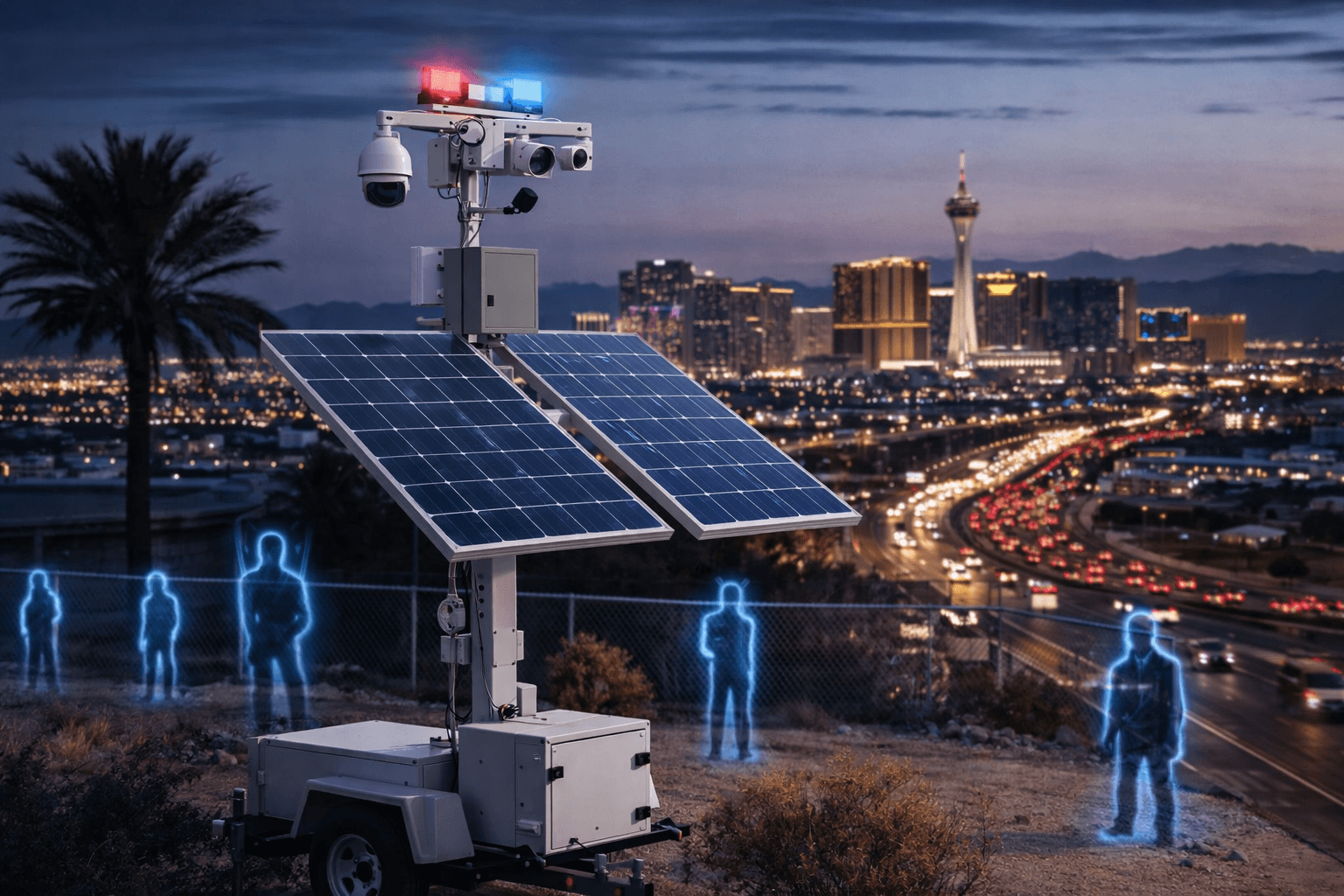
In this study we examine how the Las Vegas Valley has deployed portable solar powered surveillance trailers to combat crime hotspots without the need for permanent infrastructure. By utilizing LiveView Technologies (LVT) units equipped with Edge AI these systems act as a 24/7 force multiplier for law enforcement and private security.
1. The Challenge: Managing "Dark Zones" Without Power
Urban environments often have transient crime hotspots, such as sprawling parking lots or temporary event spaces, where installing traditional hardwired cameras is too slow and expensive.
Infrastructure Dead Zones: Many high-crime areas like construction sites or overflow parking lack the electrical grid access needed for standard security systems.
Staffing Gaps: With local police departments facing labor shortages they cannot station officers at every potential hotspot 24/7.
The Reaction Gap: Traditional CCTV only records crime for later review. By the time a human monitors the footage the suspect is often long gone.
Black Scarab Weekly
Follow the physical AI economy
Get Black Scarab news, deep research, and practical analysis in one clear Thursday briefing.
2. The Solution: Autonomous "Sentry" Trailers
The deployment involves mobile LVT trailers topped with high-efficiency solar panels and telescoping masts equipped with sophisticated Edge AI hardware.
Edge-Based Behavioral Analysis: The heart of the unit is an NVIDIA Jetson edge AI platform. Rather than just recording, the processor analyzes video locally to distinguish between normal foot traffic and "suspicious dwell time." This allows the system to ignore a shopper but instantly flag a person lingering near a loading dock.
The LVT Hardware Suite: Each unit typically features high-definition PTZ (Pan-Tilt-Zoom) cameras and thermal sensors. Because the AI processes data on-device, it can trigger a Talk-Down speaker system or high-intensity strobe lights the millisecond a perimeter breach is detected, functioning entirely without a cloud connection.
Thermal and LPR Integration: Many units include edge-powered Automatic License Plate Recognition (ALPR). By using dedicated OCR (Optical Character Recognition) algorithms running on the edge, the trailer can cross-reference vehicle plates against "hot lists" in real time, alerting authorities to stolen vehicles before a crime occurs.
3. Key Outcomes and Impact
The integration of solar-powered autonomy and edge intelligence has created a mobile "safety net" that adapts to a city's shifting needs.
30% to 40% Crime Reduction: Departments in cities like Perth Amboy and Dallas reported significant drops in property crime and vehicle theft after deploying these visible autonomous units in parking lots.
99% False Alarm Reduction: By processing data at the edge the system can filter out swaying trees or animals locally only alerting human operators when a genuine threat is detected.
Rapid Deployment: Unlike permanent cameras which take months to permit and wire these trailers can be "dropped and active" in less than 20 minutes for emergency response or public events like the MLB All-Star game.
4. The Edge Advantage
For urban safety the edge is the parking lot corner. By combining solar energy with local intelligence cities have created a flexible deterrent that operates entirely off-grid ensuring that even the most remote or temporary locations remain under a watchful "AI eye."
Sourcing & Verification
This article was compiled using publicly available material on LiveView Technologies deployments, municipal and event security references tied to solar surveillance trailers, and documentation on edge-based analytics, ALPR, and rapid-deployment deterrence systems.
Black Scarab Weekly
Follow the physical AI economy
Get Black Scarab news, deep research, and practical analysis in one clear Thursday briefing.
Related Case Studies
Smart Cities
Flock Safety Deep Dive: Hardware, Business Model, Pricing, and Tradeoffs
Flock Safety combines roadside sensors, cellular connectivity, cloud software, shared vehicle intelligence, audio detection, video, and response drones in one public safety platform. This guide explains how every layer fits together, who buys it, what public contracts reveal about pricing, where the benefits are strongest, and which risks buyers must govern.
Read related insight
Smart Cities
Case Study #3: Singapore's Smart Nation – The Lamppost-as-a-Platform (LaaP)
A real-world look at how Singapore turned lampposts into edge-computing hubs to manage traffic, public safety, and environmental sensing without overwhelming centralized networks.
Read related insight
Industrial Robotics
Top Robotic Welding Systems in 2026: Eight Options Compared
Compare eight robotic welding systems for fabrication, repeat production and pipework, with public pricing, an interactive payback calculator and a look at adaptive AI and humanoids.
Read related insight