
Guide · Cross-Industry
Apple Mac mini for Local LLMs: Why M-Series Macs Are a Private AI Hub in 2026
A practical guide to using the Apple Mac mini for local LLMs, private AI, and on-device inference, with a focus on unified memory, Apple MLX, and the privacy advantages of running language models locally.
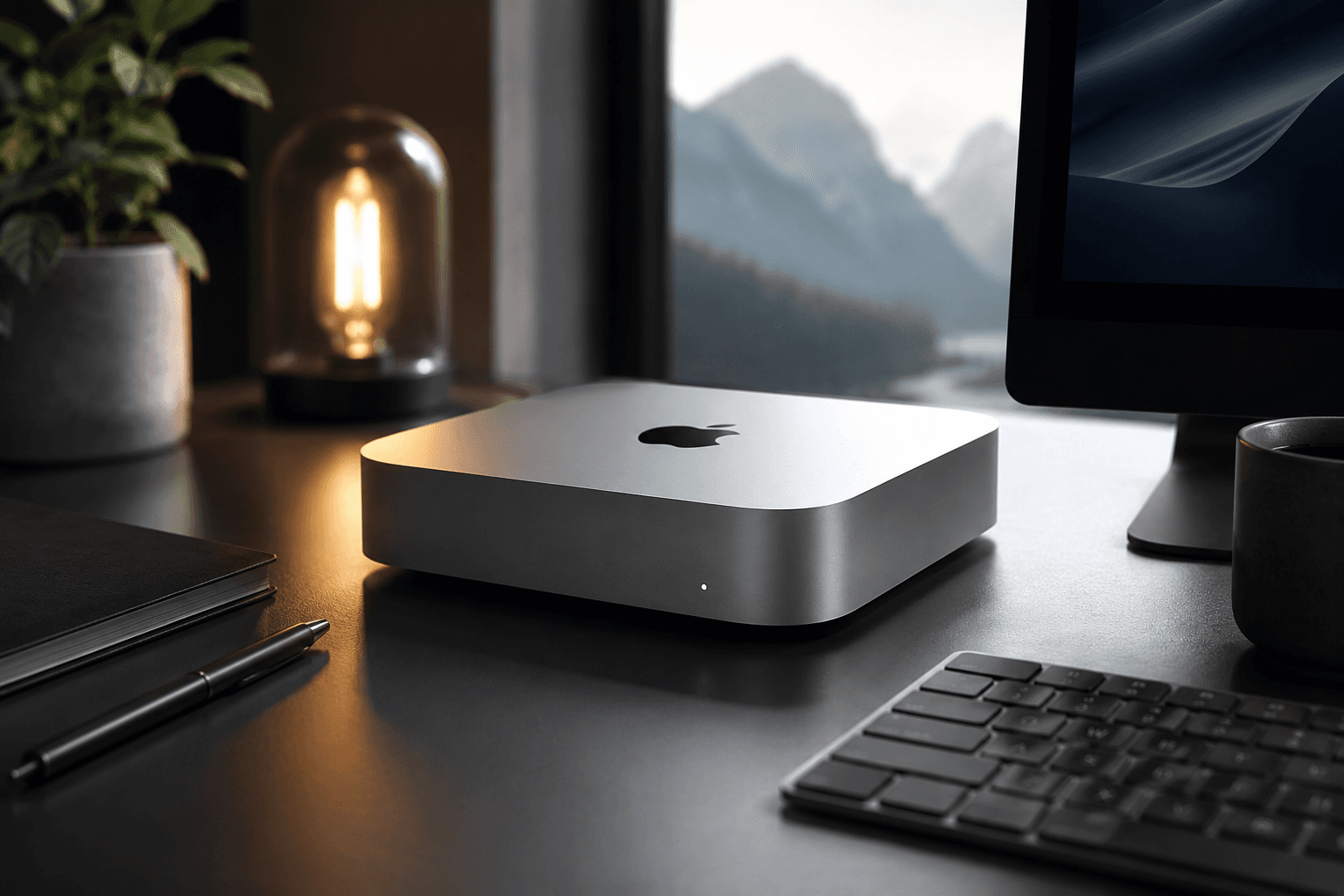
In the race for AI infrastructure, the Apple Mac mini has carved out a unique niche. It is no longer just a compact desktop computer. For many developers, research teams, and privacy-sensitive businesses, it has become one of the most practical machines for running local LLMs and other on-device AI workloads without sending sensitive data into the cloud.
That is the Mac mini's real appeal. It offers a relatively accessible path to private AI, especially for teams that want ChatGPT-style capabilities, local document analysis, or internal copilots while keeping the data inside their own building or network perimeter.
This article belongs to the Edge AI Roadmap series. Read it beside the first local AI server guide, Cerebras WSE-3, NVIDIA Jetson AGX Orin, and Intel OpenVINO to compare private local inference, centralized reasoning infrastructure, embedded GPU compute, and portable enterprise deployment.
1. The Unified Memory Advantage
The secret weapon in Apple Silicon is not just raw compute. It is the unified memory architecture that lets the CPU, GPU, and other accelerators operate from the same shared memory pool.
No More Traditional VRAM Bottlenecks: On many PC AI setups, the limiting factor is GPU memory. If a model is too large for available VRAM, the workflow becomes slower, more fragmented, or simply impossible on a given machine.
Shared High-Speed Memory: On a Mac mini, the system can allocate from one unified memory pool instead of splitting work across separate RAM and VRAM silos. That is why higher-memory Apple Silicon systems have become so attractive for local LLM workloads, retrieval pipelines, and document-heavy AI tasks.
Black Scarab Weekly
Follow the physical AI economy
Get Black Scarab news, deep research, and practical analysis in one clear Thursday briefing.
2. Deep Dive: Why Apple MLX Matters
To really unlock Apple Silicon for AI, developers increasingly turn to MLX, Apple's open-source machine learning framework for Apple Silicon.
Built for the Platform: MLX is designed specifically around the memory model and execution characteristics of Apple Silicon, which is why it has become one of the most important tools in the Mac-based local LLM ecosystem.
Efficient Local Inference: MLX makes it easier to run quantized models and experiment with local inference workflows without treating the Mac mini like a generic fallback machine.
Private AI Workflows: The combination of Apple Silicon plus MLX is especially appealing for teams building secure internal assistants, local document querying systems, and offline-capable AI tooling.
3. Application: Privacy-Focused Healthcare Assistants
Healthcare organizations are an obvious fit for local AI because privacy is not optional. In many workflows, keeping data off third-party clouds is part of the value proposition, not just a technical preference.
The Local Clinical Assistant: A Mac mini can serve as a local AI hub for summarizing patient notes, organizing documentation, assisting with internal search, or supporting transcription and workflow automation inside a controlled environment.
Reduced Data Exposure: Because the inference can stay local, organizations reduce the need to move sensitive information through external APIs for every task.
4. Application: Local Legal-Tech Analysis
Law firms and legal operations teams deal with large volumes of sensitive documents, contracts, and discovery material. That makes the Mac mini a natural fit for private AI workflows.
Document Interrogation: A local LLM setup can help teams search, summarize, and query large document collections without pushing confidential material into a public cloud workflow.
Sovereign Intelligence: The advantage is not just speed. It is control. The knowledge layer stays inside the firm, which is exactly why the Mac mini has become such a popular private AI platform.
Summary: The Verdict
The Apple Mac mini has become one of the most important private AI machines in the market because it removes two of the biggest barriers to local LLM adoption: cost and data exposure.
It proves that you do not need a server room to experiment with serious on-device AI. For teams that care about privacy, local control, and Apple MLX workflows, the Mac mini is one of the clearest entry points into practical local AI in 2026.
Sourcing & Verification
This guide was compiled using Apple's official Mac mini hardware pages and the official MLX project documentation, alongside broad industry usage patterns around local LLMs and private AI on Apple Silicon.
Black Scarab Weekly
Follow the physical AI economy
Get Black Scarab news, deep research, and practical analysis in one clear Thursday briefing.
Related Insights
Cross-Industry
The Best Way to Source GPU Compute in 2026
Compute Exchange Deep Dive: How its marketplace helps organizations source reserved GPU capacity and future commitments, and how it compares with hyperscalers, specialist GPU clouds, and direct deals.
Read related insight
Cross-Industry
Ouster Deep Dive: Digital LiDAR, Spatial Perception, and the 3D Sensing Layer of Physical AI
A business and investor deep dive on Ouster, the digital LiDAR company building 3D sensing hardware and software for autonomy, robotics, smart infrastructure, mapping, security, warehouses, ports, and industrial intelligence.
Read related insight
Cross-Industry
Hailo Deep Dive: Edge AI Acceleration, Low-Power Inference, and the Physical AI Compute Layer
A business and investor deep dive on Hailo, the edge AI processor company behind Hailo-8, Hailo-8L, Hailo-10H, Hailo-15, and the Hailo AI Software Suite, showing why efficient local inference is becoming a core deployment layer for physical AI.
Read related insight