
Guide · Cross-Industry
Raspberry Pi 5 + Hailo-8: Why the AI HAT+ Is a Top Edge AI Platform in 2026
A practical guide to Raspberry Pi 5 plus Hailo-8 acceleration, covering the Raspberry Pi AI HAT+, dedicated NPU performance, software stack, model deployment flow, and real-world edge AI use cases.
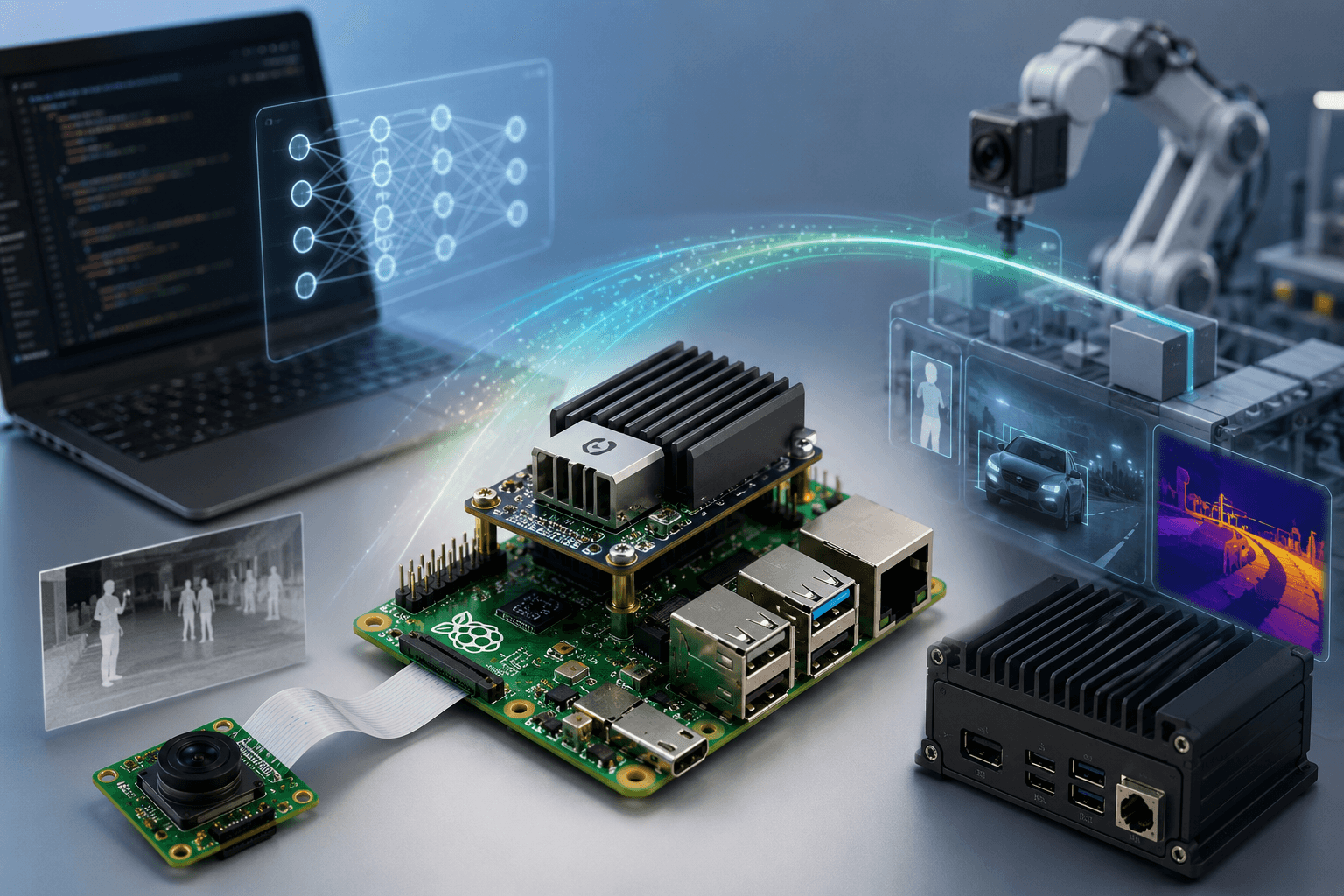
For years, developers were forced to choose between the low-cost Raspberry Pi and much more expensive industrial AI hardware. Raspberry Pi 5 plus Hailo acceleration has finally created a practical middle ground. It gives developers a realistic path from Python prototyping to dedicated neural inference without abandoning the Raspberry Pi ecosystem they already know.
One important distinction matters here. Raspberry Pi's original AI Kit used the 13 TOPS Hailo-8L and is now discontinued for new designs, while the newer AI HAT+ line includes both 13 TOPS and 26 TOPS options. When people search for Raspberry Pi 5 plus Hailo-8 in 2026, they are usually looking for the more capable 26 TOPS Raspberry Pi AI HAT+ configuration built around the Hailo-8 accelerator.
This article belongs to the Edge AI Roadmap series. Read it beside Hailo's edge AI acceleration layer, Google Coral Edge TPU, Arduino Nicla Vision, and Edge Impulse's embedded AI deployment layer to compare low-cost acceleration, ultra-efficient inference, TinyML, and the software workflow that turns edge data into deployable models.
1. The Power of Dedicated Acceleration
Raspberry Pi 5 is a strong general-purpose computer, but heavy vision workloads can quickly overwhelm a CPU-only setup. Adding Hailo acceleration changes that equation by offloading inference to a dedicated neural processing unit.
Performance: The 26 TOPS Raspberry Pi AI HAT+ is built around the Hailo-8 accelerator, giving Raspberry Pi 5 a much more serious local AI inference profile than CPU-only deployments can deliver.
Efficiency: By moving neural inference onto the NPU, the Raspberry Pi 5 CPU stays available for application logic, web services, robotics control, or local orchestration tasks.
Latency: This architecture is designed for real-time edge AI workloads, especially object detection and camera-based pipelines, without forcing every workload back into the cloud.
Black Scarab Weekly
Get the next Black Scarab deep dive
Keep reading now, then get every new deep dive and news report in Thursday's briefing.
2. The Hailo Software Stack: Moving Beyond Hello World
The real value of this pairing is not just the silicon. It is the software path that makes the hardware usable by developers.
Model Access: Raspberry Pi and Hailo provide access to supported example models and software tooling that help developers move from demos into more realistic pipelines.
TAPPAS and Pipelines: Hailo's application tooling makes it easier to stand up more complete workflows such as detection, tracking, and camera-based post-processing instead of stopping at a toy example.
Python Integration: Because the surrounding stack works with common Linux, camera, and media workflows, developers can connect accelerated inference into familiar Python, GStreamer, and OpenCV-style pipelines.
3. Practical Model Deployment Flow
Getting a model onto Hailo hardware follows a more structured deployment path than CPU-only experimentation, but that structure is part of why the platform is attractive for real edge AI work.
Translation: Models trained in common frameworks can be brought into the Hailo toolchain for conversion into an accelerator-friendly format.
Optimization: The Hailo workflow includes analysis and optimization steps that help developers evaluate model behavior before deployment.
Compilation: The final output is a binary optimized for the NPU so the accelerator can execute inference efficiently with low power draw and predictable runtime behavior.
4. Real-World Applications
This Raspberry Pi 5 plus Hailo combination is not just for hobbyist demos. It is a strong fit for low-cost pilots and developer-led deployments where local inference matters.
Smart Traffic Monitoring: The platform is well suited to local counting, detection, and lightweight roadside or municipal computer vision experiments where cloud dependence adds latency and cost.
Maker-Grade Automation: Small manufacturers and integrators can use Raspberry Pi 5 plus Hailo acceleration for quality checks, detection tasks, and low-cost automation pilots.
Low-Cost Vision at the Edge: The platform is attractive in drones, remote monitoring, camera-based robotics, and environmental sensing use cases where power, cost, and local inference all matter.
Summary: The Verdict
Raspberry Pi 5 plus Hailo-8 acceleration gives developers a missing middle ground. It offers professional-grade local AI acceleration on top of one of the most familiar and accessible computing platforms in the market.
That is why it matters. For teams trying to prove an edge AI concept before moving into more expensive industrial hardware, the Raspberry Pi AI HAT+ on Raspberry Pi 5 has become one of the strongest on-ramps available in 2026.
Sourcing & Verification
This guide was compiled using Raspberry Pi's official AI HAT+, AI Kit, and AI software documentation along with official Hailo and Raspberry Pi materials describing the accelerator options, software flow, and supported edge AI use cases.
Black Scarab Weekly
Catch up on physical AI in one email
Every new Black Scarab deep dive and news report, collected into one clear Thursday briefing.
Related Insights
Cross-Industry
The Best Way to Source GPU Compute in 2026
Compute Exchange Deep Dive: How its marketplace helps organizations source reserved GPU capacity and future commitments, and how it compares with hyperscalers, specialist GPU clouds, and direct deals.
Read related insight
Cross-Industry
Ouster Deep Dive: Digital LiDAR, Spatial Perception, and the 3D Sensing Layer of Physical AI
A business and investor deep dive on Ouster, the digital LiDAR company building 3D sensing hardware and software for autonomy, robotics, smart infrastructure, mapping, security, warehouses, ports, and industrial intelligence.
Read related insight
Cross-Industry
Hailo Deep Dive: Edge AI Acceleration, Low-Power Inference, and the Physical AI Compute Layer
A business and investor deep dive on Hailo, the edge AI processor company behind Hailo-8, Hailo-8L, Hailo-10H, Hailo-15, and the Hailo AI Software Suite, showing why efficient local inference is becoming a core deployment layer for physical AI.
Read related insight
Next Step
Explore a commercial opportunity in Mexico
If you are exploring how a physical AI technology could fit the Mexican market, Black Scarab can help assess the opportunity, map relevant stakeholders, and define a credible commercial next step.