
Guide · Cross-Industry
Tesla AI5 (HW5) Latest Update: Release Timeline, Specs, and Production Outlook for 2026
A practical guide to the latest Tesla AI5 and HW5 updates, covering the expected release timeline, likely specs, production outlook, Optimus and Cybercab use cases, foundry strategy, and what current Tesla owners should expect.
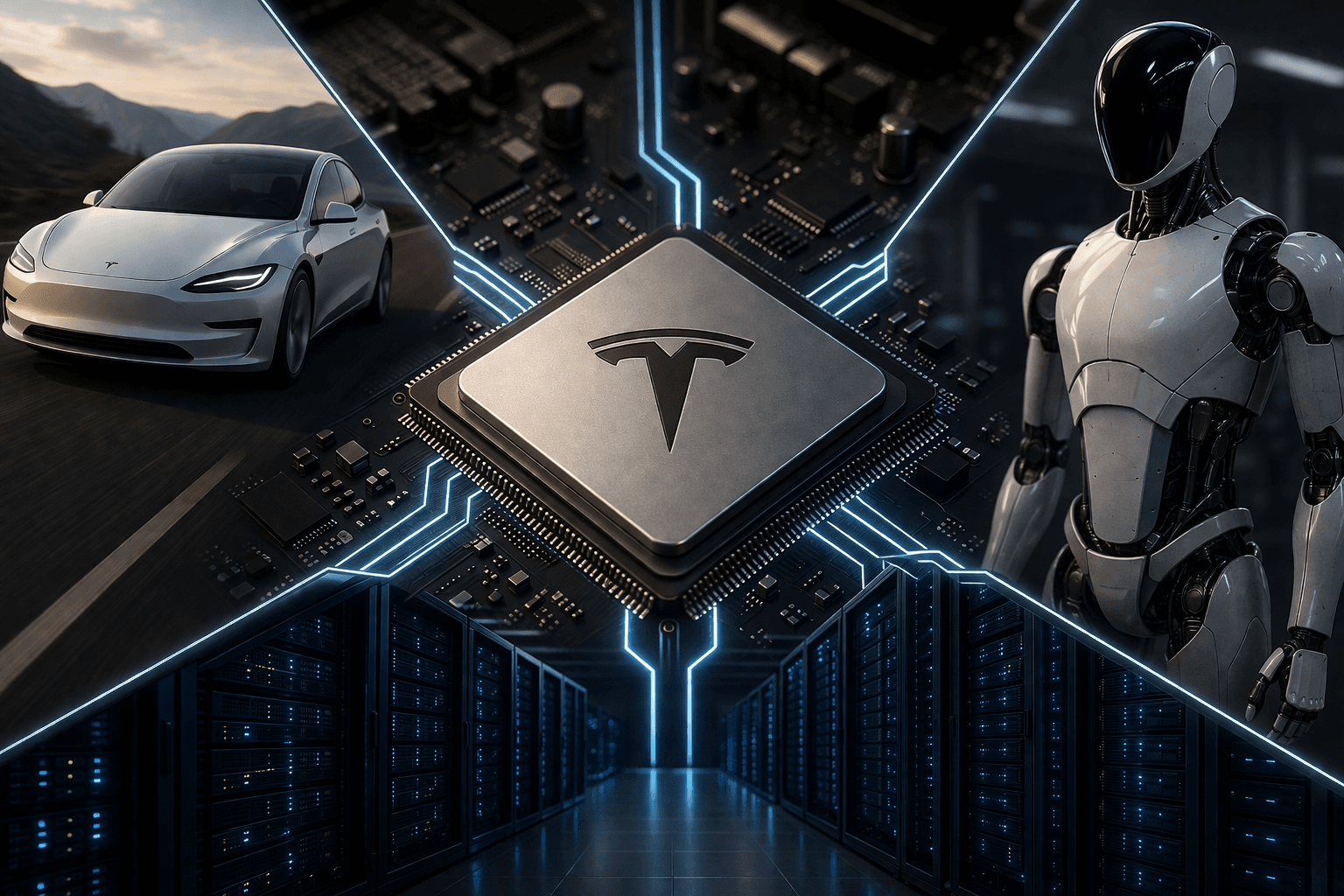
Because Tesla has not yet released a full official specification sheet for Tesla AI5 (HW5), the details below are based on public reporting, industry discussion, and unofficial source aggregation around Tesla's next-generation AI chip.
Tesla AI5 (formerly referred to as Hardware 5 or HW5) represents the most significant architectural shift in Tesla's history. While previous generations relied on adapted or redundant chip designs, AI5 is a ground-up custom silicon solution designed to unify Tesla's ecosystem across vehicles, robotics, and supercomputers. As of mid-2026, it is the "monster" chip that could move Tesla from an automaker to a pure-play AI powerhouse.
This article belongs to the Edge AI Roadmap series. Read it beside Tesla Optimus, NVIDIA Jetson AGX Orin, Cerebras WSE-3, and Qualcomm Robotics RB5 to compare Tesla's vertical silicon thesis against embedded AI, centralized inference, connected robotics, and the Optimus deployment path.
1. Architectural Leap and Performance
The jump from AI4 to AI5 is far larger than the previous transition from HW3. According to official reports, a single AI5 chip delivers roughly 5 times the useful compute power of the dual-SoC AI4 setup found in earlier models.
Raw Compute: Early benchmarks suggest up to an 8x increase in raw compute and nearly 40x improvement in specific neural network efficiency.
Memory and Bandwidth: Tesla has addressed the critical bottlenecks of AI4 by moving to a massive 144GB of unified memory (a 9x increase from AI4's 16GB).
Consolidated Design: Tesla is reportedly moving away from the redundant dual-chip design of previous generations, signaling a new level of confidence in the hardware's reliability and focusing on maximizing efficiency per watt.
Black Scarab Weekly
Get the next Black Scarab deep dive
Keep reading now, then get every new deep dive and news report in Thursday's briefing.
2. Strategic Use Cases: More Than Just Cars
In a departure from tradition, the initial focus for AI5 is not consumer vehicles like the Model 3 or Model Y.
Optimus and Supercomputers: The primary recipients of early AI5 production are the Optimus humanoid robots and Tesla's internal AI training clusters. The chip's design is optimized for the real-time inference required for bipedal movement and complex manipulation.
The Cybercab: While the upcoming Cybercab robotaxi was initially expected to launch on AI5, current production timelines suggest early 2026 units may still utilize AI4.1 (AI4+) hardware due to volume constraints.
3. Installation and Rollout Timeline
The "installation" of AI5 is currently limited to low-volume validation units and internal projects.
Volume Production: High-volume production is targeted for late 2026 or mid-2027. Tesla is utilizing a dual-sourcing strategy, partnering with TSMC (2nm/3nm process) in Taiwan and Arizona, as well as Samsung in Taylor, Texas.
Retrofits: There is currently no official retrofit path for HW3 or HW4 owners to upgrade to AI5. Tesla has indicated that AI4 is already capable of achieving safety levels significantly better than human drivers, potentially making an AI5 upgrade unnecessary for current vehicles to achieve unsupervised autonomy.
4. Custom Features: Efficiency and Power
AI5 is engineered for maximum performance per dollar by stripping away unnecessary legacy components found in general-purpose chips.
Power Optimization: Despite its massive power, the chip can be optimized down to nearly 250W, balancing the high-performance needs of a robot or vehicle with the limitations of mobile battery systems.
Terafab Project: Tesla is moving toward total vertical integration with its "Terafab Project," a dedicated facility for manufacturing custom AI and memory chips to ensure supply chain resilience against geopolitical risks.
Summary: The Verdict
The AI5 isn't just an "upgrade"; it is the foundation for Tesla's long-term push toward unsupervised autonomy and mass-market robotics. By designing for a single customer—itself—Tesla has eliminated the bloat of third-party silicon to deliver what is likely the most efficient AI inference engine in existence.
Sourcing & Verification
This guide was compiled using Tesla's official AI and robotics materials, Tesla's support documentation on AI computer installations, and current public reporting on Tesla AI5 production timing, foundry strategy, and rollout expectations.
Black Scarab Weekly
Catch up on physical AI in one email
Every new Black Scarab deep dive and news report, collected into one clear Thursday briefing.
Related Insights
Cross-Industry
The Best Way to Source GPU Compute in 2026
Compute Exchange Deep Dive: How its marketplace helps organizations source reserved GPU capacity and future commitments, and how it compares with hyperscalers, specialist GPU clouds, and direct deals.
Read related insight
Cross-Industry
Ouster Deep Dive: Digital LiDAR, Spatial Perception, and the 3D Sensing Layer of Physical AI
A business and investor deep dive on Ouster, the digital LiDAR company building 3D sensing hardware and software for autonomy, robotics, smart infrastructure, mapping, security, warehouses, ports, and industrial intelligence.
Read related insight
Cross-Industry
Hailo Deep Dive: Edge AI Acceleration, Low-Power Inference, and the Physical AI Compute Layer
A business and investor deep dive on Hailo, the edge AI processor company behind Hailo-8, Hailo-8L, Hailo-10H, Hailo-15, and the Hailo AI Software Suite, showing why efficient local inference is becoming a core deployment layer for physical AI.
Read related insight
Next Step
Explore a commercial opportunity in Mexico
If you are exploring how a physical AI technology could fit the Mexican market, Black Scarab can help assess the opportunity, map relevant stakeholders, and define a credible commercial next step.