
Case Study · Healthcare
Case Study #9: Medtronic GI Genius and Edge AI for Real-Time Colonoscopy Detection
A real-world look at how Medtronic's GI Genius intelligent endoscopy module uses edge AI to support real-time polyp detection, improve adenoma detection rates, and reduce missed lesions during colonoscopy.
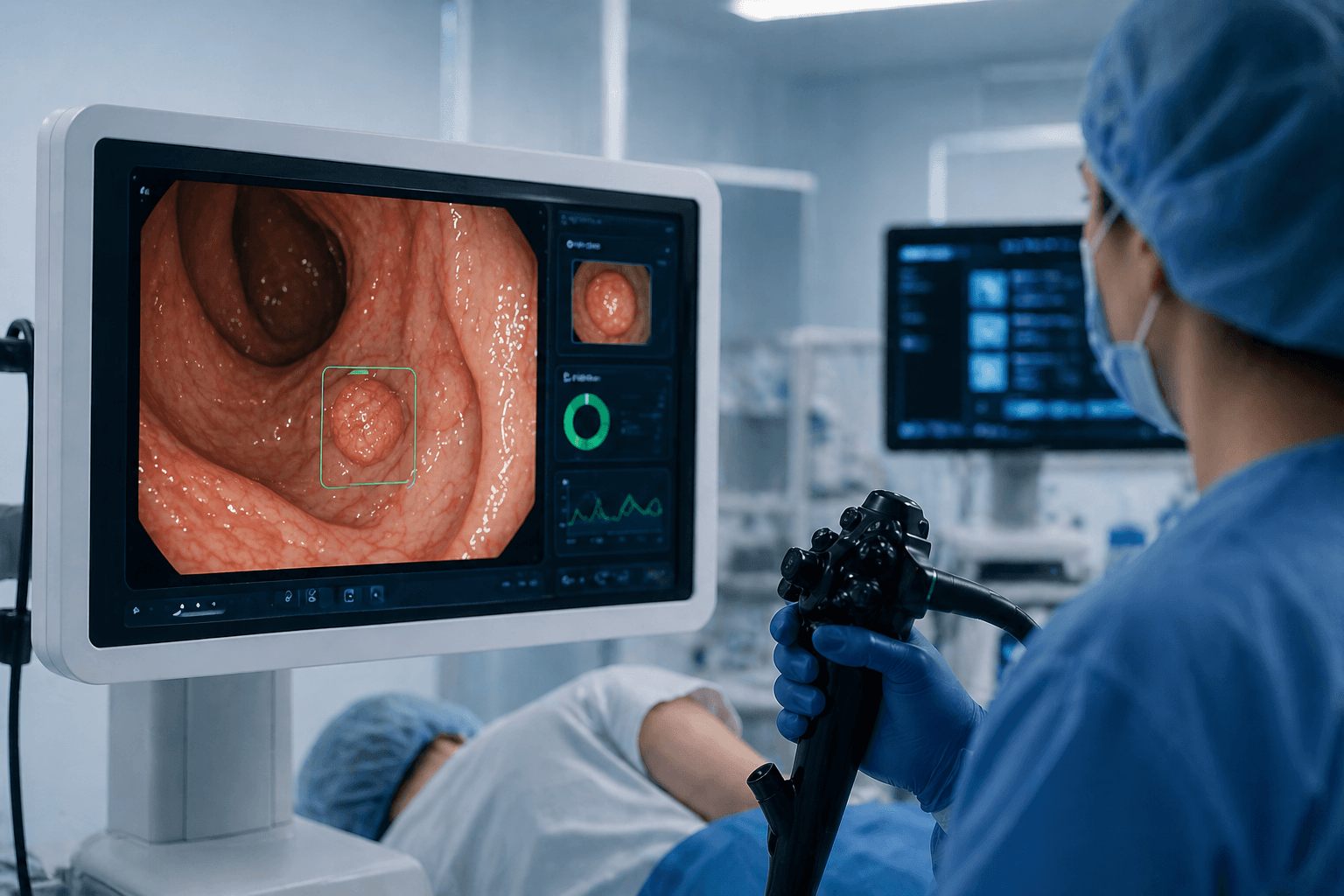
In this case study, we examine how Medtronic has integrated Edge AI into gastrointestinal care through its GI Genius intelligent endoscopy module. The platform uses real-time computer vision to assist gastroenterologists in identifying potential colorectal lesions during colonoscopy, processing the video stream locally to provide immediate procedural support.
1. The Challenge: The "Human Gap" in Detection
Colorectal cancer is one of the clearest examples of where better detection changes outcomes, but colonoscopy remains highly operator dependent.
The Miss Rate Problem: Medtronic cites clinical literature showing that colorectal neoplasia can still be missed during standard procedures, especially when lesions are small, flat, or visually subtle.
Variable Performance: Adenoma detection rates can vary significantly from one endoscopist to another, and consistency can be affected by fatigue, workload, and procedure complexity.
The Latency Constraint: If AI is going to be useful inside a live procedure, it has to respond while the lesion is still on screen. That makes local, edge-based inference fundamentally more practical than cloud-dependent processing.
Black Scarab Weekly
Follow the physical AI economy
Get Black Scarab news, deep research, and practical analysis in one clear Thursday briefing.
2. The Solution: Real-Time "AI Eyes" at the Edge
Medtronic positions GI Genius as an always-on second observer that operates directly in the procedure room.
Hardware at the Edge: The module sits in the local endoscopy hardware chain and overlays visual markers on the live colonoscopy video without replacing the clinician's judgment.
Deep Learning on the Video Stream: Medtronic says the system is trained on a dataset of 13 million polyp images and is designed to detect polyps of different sizes, shapes, and morphologies in real time.
Clinical Workflow Fit: Because GI Genius is designed as an accessory to standard white-light colonoscopy and integrates with major endoscopy brands, hospitals can add AI assistance without replacing their full installed base.
Real-Time Visual Marking: When the system detects a potential lesion, it places a graphical marker on screen immediately, keeping the decision support at the exact point of care.
3. Key Outcomes and Impact
The deployment of Edge AI in endoscopy shifts AI from retrospective analysis into the live procedural moment where it can change outcomes.
14% Absolute Increase in ADR: Medtronic highlights studies showing GI Genius can improve adenoma detection rate by an absolute value of up to 14%.
High Sensitivity: Medtronic reports an overall sensitivity per lesion of 99.7% with less than 1% false positives in cited performance data.
Efficiency Without Changing Withdrawal Time: Medtronic also states the system can reduce the risk of undetected polyps without requiring a change in withdrawal time, helping fit AI into existing endoscopy workflows.
Real-World Scale: On November 25, 2024, Medtronic announced a three-year VA contract that added almost 100 GI Genius units across VA medical centers, extending AI-assisted colonoscopy access to veterans nationwide.
4. The Edge Advantage
For Medtronic, the edge is the procedural monitor itself. By embedding intelligence directly into the live video stream, GI Genius creates a digital safety net that supports the physician at the exact moment a subtle lesion appears, where speed, reliability, and local inference matter most.
Sourcing & Verification
This article was compiled using Medtronic GI Genius product materials, Medtronic educational documentation on AI-assisted colonoscopy, the public GI Genius information page, and Medtronic's November 25, 2024 VA contract announcement.
Black Scarab Weekly
Follow the physical AI economy
Get Black Scarab news, deep research, and practical analysis in one clear Thursday briefing.
Related Case Studies
Healthcare
Intuitive da Vinci 5 Deep Dive: Surgical Robotics, Hospital ROI, Pricing, Adoption, and Deployment Strategy
A business-focused deep dive on Intuitive da Vinci 5, covering surgical robotics, hospital adoption, pricing context, operating-room workflow, training, service economics, data, force feedback, and what leaders should verify before investing in robotic surgery.
Read related insight
Healthcare
Case Study #6: Mount Sinai & Butterfly Network – Edge AI for Point-of-Care Diagnostics
A real-world look at how Mount Sinai and Butterfly Network used handheld, edge-enabled imaging to extend diagnostic capability into rural, low-resource, and emergency care environments.
Read related insight
Industrial Robotics
Top Robotic Welding Systems in 2026: Eight Options Compared
Compare eight robotic welding systems for fabrication, repeat production and pipework, with public pricing, an interactive payback calculator and a look at adaptive AI and humanoids.
Read related insight