
Case Study · Healthcare
Case Study #6: Mount Sinai & Butterfly Network – Edge AI for Point-of-Care Diagnostics
A real-world look at how Mount Sinai and Butterfly Network used handheld, edge-enabled imaging to extend diagnostic capability into rural, low-resource, and emergency care environments.
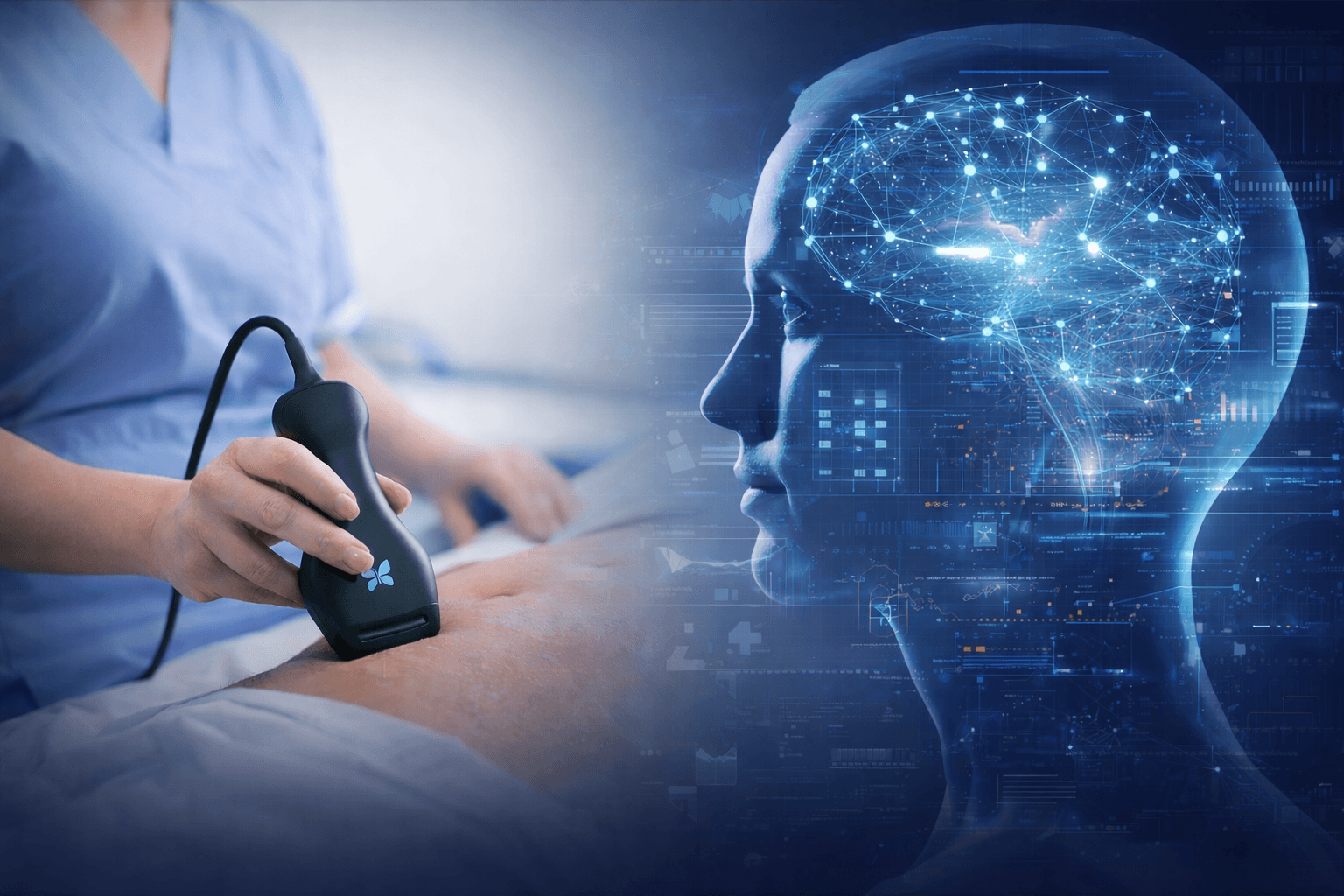
In this study, we explore how Mount Sinai Hospital and Butterfly Network have utilized Edge AI to bring advanced medical imaging to rural and low-resource environments. By embedding AI directly into handheld ultrasound devices, they have enabled non-specialist health workers to perform complex diagnostic screenings without a connection to a central hospital or the cloud.
1. The Challenge: The Radiologist Gap in Rural Areas
Traditional medical imaging, such as ultrasound, requires two things often missing in remote areas: bulky, expensive machinery and a highly trained radiologist to interpret the images.
Connectivity barriers: In rural regions like Assam, India, unstable electricity and lack of high-speed internet make cloud-based AI analysis impossible.
Expertise scarcity: There are often not enough specialists to go around, meaning critical conditions like fetal abnormalities or internal organ issues go undetected until they become emergencies.
Time-sensitive diagnostics: For conditions like stroke or trauma, waiting hours for a specialist to review a scan can be the difference between recovery and permanent disability.
Black Scarab Weekly
Follow the physical AI economy
Get Black Scarab news, deep research, and practical analysis in one clear Thursday briefing.
2. The Solution: A Radiologist in Your Pocket
Mount Sinai deployed the Butterfly iQ, a handheld ultrasound scanner that uses an Edge AI chip to interpret images on the fly.
On-device inference: The device runs compressed neural networks locally. Instead of sending raw video to a server, the device sees the internal organs and provides immediate diagnostic suggestions to the operator.
Guidance for non-specialists: The Edge AI provides real-time visual feedback, helping paramedics or nurses position the probe correctly to capture the best possible image, effectively teaching them as they work.
Privacy-first processing: Because the medical data is processed entirely on the handheld unit, sensitive patient information never leaves the room, ensuring compliance with strict privacy regulations even in the field.
3. Key Outcomes and Impact
The shift to portable, edge-powered diagnostics has significantly expanded the reach of preventative medicine.
9% referral rate: In a pilot program involving 3,000 patients, the system flagged over 280 cases, such as kidney cysts and gallstones, for urgent hospital referral that would have otherwise been missed.
Zero-latency triage: In emergency settings, AI-enabled ambulances can now detect strokes in real-time, allowing paramedics to begin life-saving treatment before the patient even reaches the ER.
Increased accuracy: In related trials at the Mayo Clinic, bedside edge devices for ECG analysis identified abnormal heart rhythms with over 92% accuracy, allowing for instant intervention.
4. The Edge Advantage
For Mount Sinai, the edge is the bedside. By putting expert-level intelligence into a battery-operated, rugged device, they have decoupled life-saving diagnostics from the four walls of the hospital, proving that Edge AI can be a critical tool for global health equity.
Sourcing & Verification
This article was compiled using publicly available material on Butterfly iQ deployments, Mount Sinai point-of-care imaging work, and clinical references tied to rural ultrasound pilots and bedside AI-assisted diagnostics.
Black Scarab Weekly
Follow the physical AI economy
Get Black Scarab news, deep research, and practical analysis in one clear Thursday briefing.
Related Case Studies
Healthcare
Intuitive da Vinci 5 Deep Dive: Surgical Robotics, Hospital ROI, Pricing, Adoption, and Deployment Strategy
A business-focused deep dive on Intuitive da Vinci 5, covering surgical robotics, hospital adoption, pricing context, operating-room workflow, training, service economics, data, force feedback, and what leaders should verify before investing in robotic surgery.
Read related insight
Healthcare
Case Study #9: Medtronic GI Genius and Edge AI for Real-Time Colonoscopy Detection
A real-world look at how Medtronic's GI Genius intelligent endoscopy module uses edge AI to support real-time polyp detection, improve adenoma detection rates, and reduce missed lesions during colonoscopy.
Read related insight
Industrial Robotics
Top Robotic Welding Systems in 2026: Eight Options Compared
Compare eight robotic welding systems for fabrication, repeat production and pipework, with public pricing, an interactive payback calculator and a look at adaptive AI and humanoids.
Read related insight