
Zipline raises $1.5 billion as Walmart plans 300 more drone delivery sites
Zipline has announced $1.5 billion in new funding at a $21.5 billion valuation, alongside a national agreement with Walmart to launch 300 additional drone delivery sites.
At a glance
- Zipline announced $1.5 billion in funding at a $21.5 billion valuation, led by Paradigm, WCM Investment Management and Layer Global.
- Walmart and Zipline plan 300 additional drone delivery sites under a multiyear national agreement.
- The capital will support expanded U.S. manufacturing and hiring as the delivery network grows.
Capital meets a retail rollout
Zipline has raised $1.5 billion at a $21.5 billion valuation as Walmart commits to launching 300 additional drone delivery sites across the United States.
The companies announced the financing and expansion on November 5. Paradigm, WCM Investment Management and Layer Global led the round. Zipline says the money will expand its U.S. manufacturing facilities and support hiring as it builds a national delivery network.
The Walmart agreement spans multiple years and allows further expansion. It builds on a partnership that began in 2021. FreightWaves reports that the companies currently operate together at 21 sites, giving the planned additions a substantially larger footprint than their existing service.
For Zipline, the two announcements connect the supply and demand sides of expansion. Financing provides resources to manufacture aircraft and support operations. A major retail partner offers locations, merchandise and customers who already use its ordering system. The commercial task is to bring those pieces together repeatedly across new markets.
A small order, delivered from a nearby store
Walmart positions drone delivery around a handful of everyday items needed quickly. It says tens of thousands of eligible products can arrive in as little as 30 minutes where the service is available. Customers see the option in the Walmart app or on Walmart.com when their address falls within the delivery area.
That matters for adoption. A shopper can use an existing retail account and familiar checkout rather than learn a separate shopping service. Orders can also be placed through the Zipline app at eligible addresses.
Walmart says its broader drone delivery program has completed more than two million deliveries. That total covers the retailer’s program across providers. It gives context for the expansion without assigning every delivery to Zipline.
The retail logic starts with proximity. Walmart says 90 percent of Americans live within 10 miles of one of its stores. Local inventory can therefore provide a starting point for fast delivery, although an individual address still needs to fall within an operating service area.
In Black Scarab’s assessment, the opportunity is to make a small, urgent order convenient enough that customers repeat it. Missing ingredients, household essentials and similar purchases create a different delivery pattern from a large weekly grocery shop. That pattern shapes the aircraft, the loading process and the economics of each location.
Black Scarab Weekly
Follow the physical AI economy
Get Black Scarab news, deep research, and practical analysis in one clear Thursday briefing.
The aircraft stays above the doorstep
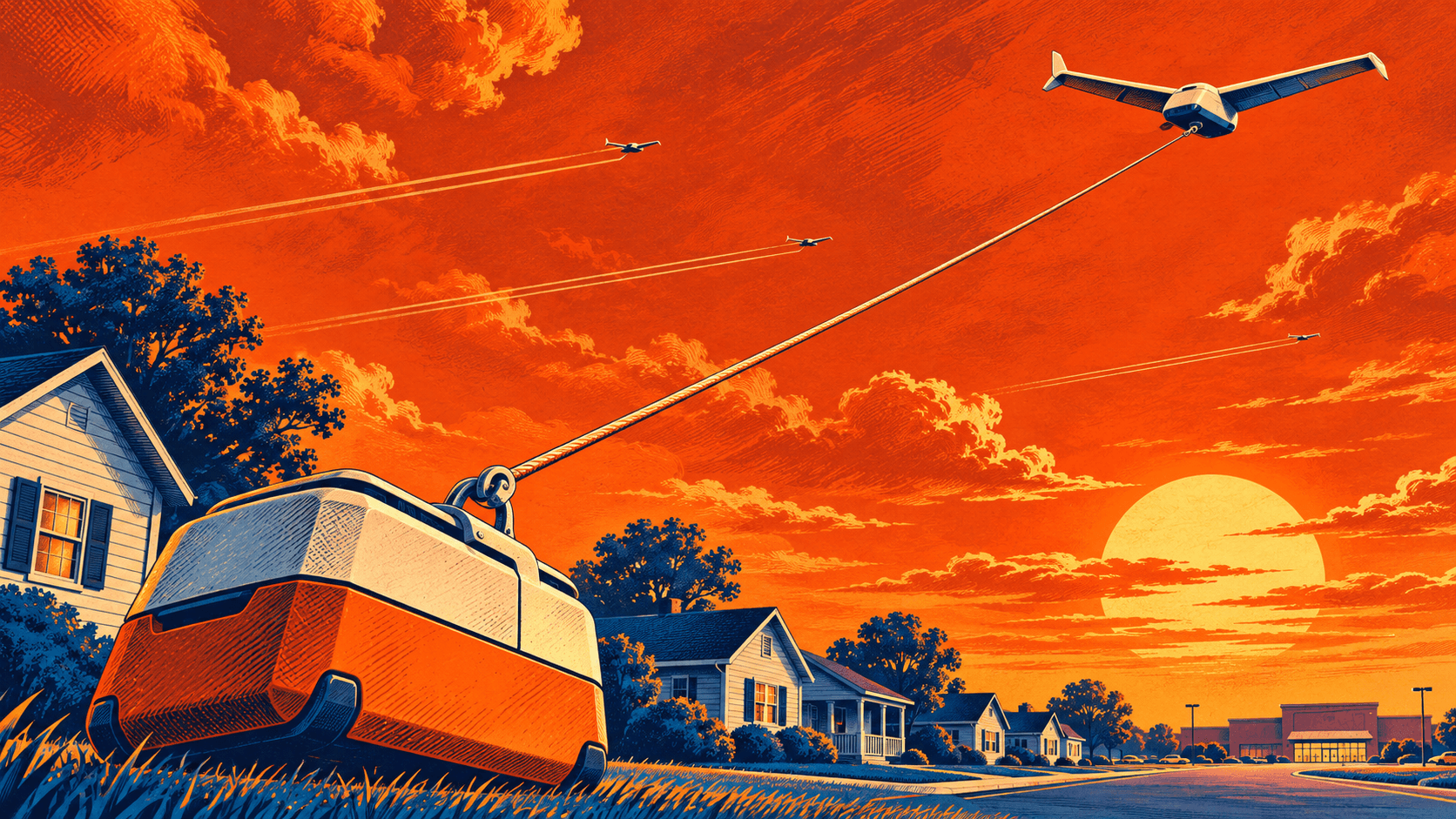
Zipline’s home delivery system separates the main aircraft from the final placement of the order. Walmart describes an aircraft remaining roughly 330 feet overhead while a pod descends on a tether to deliver to a front yard, backyard or driveway.
The arrangement gives the smaller device the job of reaching the delivery point while the larger aircraft stays farther from people and buildings. Zipline’s original Platform 2 announcement described a pod that can steer during descent, allowing the service to place an order rather than simply release it from overhead.
The company’s public fact sheet lists an eight pound payload and a 10 mile service radius for Platform 2 return flights. Those specifications describe a bounded service for suitable orders. Weight, distance and the available drop area affect which purchases can travel this way.
Zipline also operates Platform 1 for longer range distribution, including healthcare deliveries. The Walmart home delivery expansion concerns a different operating pattern: frequent local orders with a precise delivery point.
Flight speed is only part of that experience. The item must be picked, packed and loaded before it can leave. A fast trip through the air cannot recover time lost waiting for the order on the ground. The useful measure is the complete journey from checkout to receipt.
Manufacturing has to follow the rollout
The financing includes Valor Equity Partners, Fidelity Management & Research Company, Uber, Tiger Global, J.P. Morgan, ARK Invest and Salesforce Ventures, according to Zipline. The $21.5 billion figure is its stated value after the financing.
Zipline says it designs, tests and assembles its drones in the United States. Expanding manufacturing alongside the delivery network brings a familiar industrial challenge: equipment supply and service capacity have to grow at a pace that matches usable demand.
Too little capacity can slow openings and replacement supply. Deploying equipment too far ahead of orders can leave expensive assets underused. A large retail agreement offers a pipeline of potential locations against which to plan, while local demand determines how productive each one becomes.
Repeated installations could help standardize training, maintenance and loading procedures. The same process still has to accommodate differences between stores, neighborhoods and delivery areas. A design that works at one site becomes a national business through consistent execution across many sites.
Black Scarab sees the manufacturing commitment as a consequential part of this announcement. The funding supports an organization that must keep aircraft available and orders moving after each opening, as well as produce the equipment for the next one.
Neighborhood operations shape the network
The FAA lists Zipline as having received its air carrier certificate with authority to operate under Part 135 in June 2022. The agency’s current package delivery guidance also describes airspace authorization, environmental review and local requirements as parts of establishing operations.
A national retail agreement therefore has to translate into authorized, functioning local services. Site selection involves the delivery area and launch infrastructure as well as where customers want to order.
Noise is another practical condition of repeated neighborhood flights. On October 27, Zipline announced an update using onboard sound modeling and real time wind measurements to adjust transitions between hovering and wing supported flight.
The company says the update and other improvements reduced overall sound exposure per flight by 68 percent compared with its 2025 fleet, based on internal modeling. That figure describes Zipline’s modeled comparison. The operating question is how frequent deliveries fit into the places underneath the routes.
Reliability and community acceptance reinforce one another. Customers need a service they can use predictably, while neighbors experience the accumulated flights around a busy site. Expansion has to work for both groups.
The next milestone is routine service
The clearest next signal will be new locations entering service, followed by sustained order activity. The 300 additional sites are a multiyear commitment to build toward, so openings and operating volume will show how the agreement is progressing.
Utilization will matter alongside the site count. More orders can spread equipment and support costs across additional deliveries, provided preparation, maintenance and flight operations keep pace. Opening many locations with little activity would produce a different business from building dense, repeat use.
Black Scarab’s assessment is that the Walmart agreement gives Zipline a concrete route for deploying its new capital. It connects manufacturing investment to an established retailer’s local inventory and customer relationships. The measure of success will be how reliably those locations turn everyday orders into completed deliveries.
Sources and further reading
- Zipline, November 5 financing and Walmart expansion announcement
- Walmart: November 5 agreement and existing delivery program
- Zipline fact sheet and platform specifications
- Zipline, original Platform 2 home delivery system announcement, March 15, 2023
- FAA, package delivery by drone under Part 135
- Zipline, October 27 acoustics update
- FreightWaves: independent reporting and current Zipline site count

About the author
Rodolfo is the founder of Black Scarab, where he covers the technologies and commercial signals shaping physical AI adoption.
Meet Rodolfo