
Samsung SDS builds Team REX to bring ten robot companies onto the factory floor
The alliance brings together robot bodies, dexterous hands, learned behavior, data, and simulation. Samsung SDS wants to connect them to production through a robot orchestration platform planned for 2027.
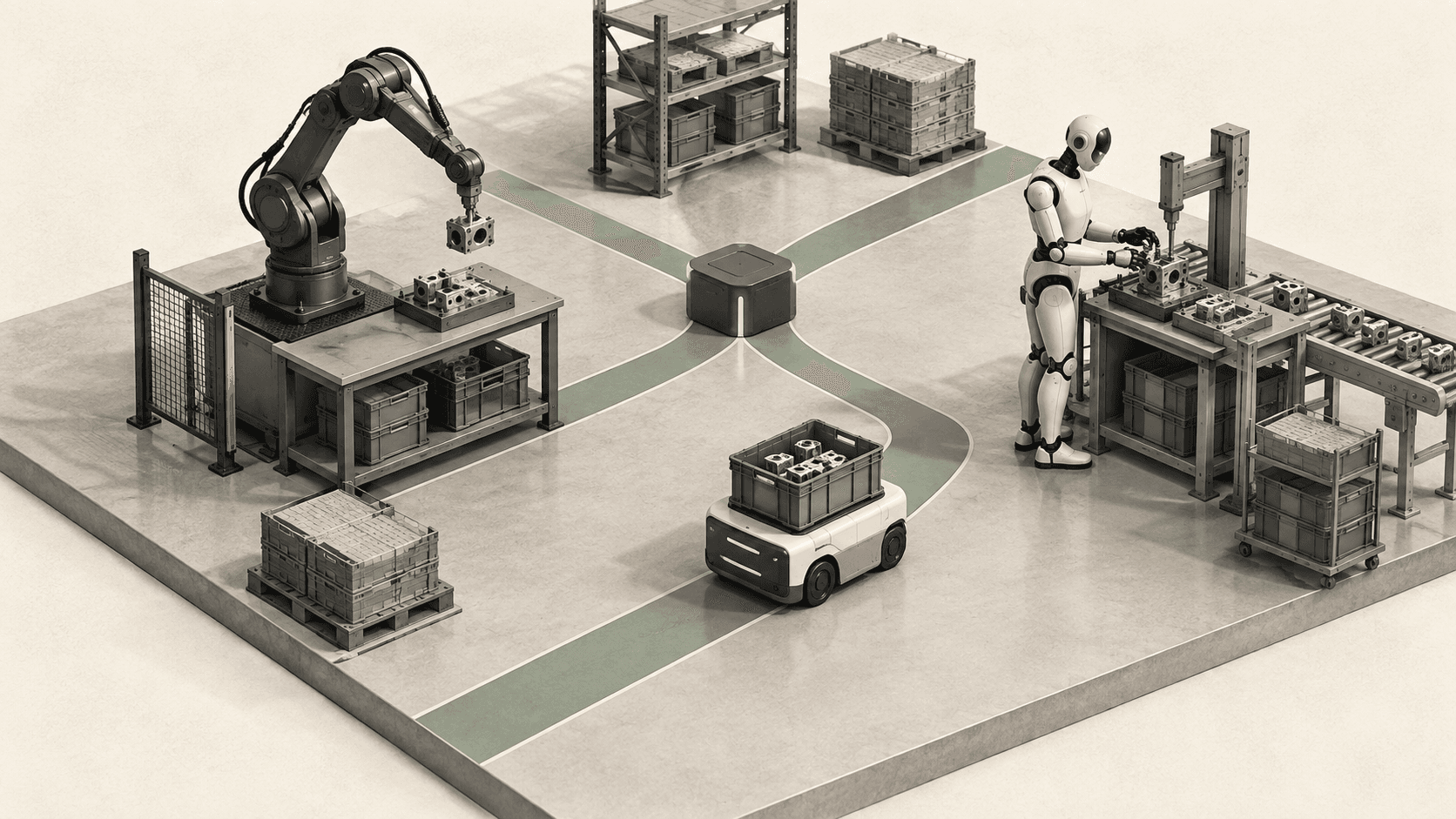
At a glance
- Samsung SDS has assembled Team REX, a ten company robotics alliance spanning hardware, intelligence, data, and simulation.
- A robot orchestration platform is planned for 2027, building on Samsung SDS’s manufacturing software and automation experience.
- The partners bring distinct capabilities, but the commercial test will be reliable production, repeatable installations, and measurable economics.
Ten partners, one integration problem
Samsung SDS has assembled Team REX, a ten company robotics alliance intended to help manufacturers put different machines and AI systems to work together. The initiative accompanies its entry into robotics transformation, announced at REAL Summit 2026 in Seoul on September 8.
The company plans to introduce a robot orchestration platform in 2027. Its stated ambition is to connect robots with production equipment, extending its role from manufacturing software and automation into the coordination of physical work.
That makes this more than a bet on a particular humanoid. A factory needs parts delivered, machines tended, quality maintained, and exceptions resolved in the right order. A capable robot becomes commercially valuable when it fits into that operation.
Team REX is an attempt to assemble the pieces around that problem. Samsung SDS supplies the factory relationships and integration experience. Its partners supply a range of machines, manipulation capabilities, AI, and development tools.
Who is in Team REX
Seoul Economic Daily identifies five hardware participants: AI Robot, Genesis AI, Holiday Robotics, Rainbow Robotics, and Wuji Technology. The intelligence group consists of Real World, RoboForce, and Walden Robotics. ConfigIntelligence provides the data component, while NDot Light covers simulation.
These are the reported alliance categories, rather than strict boundaries around each company’s business. Walden, for example, describes itself as building hardware, software, AI, and applications together.
The roster reveals the breadth of the integration job. A robotic hand must work with an arm and its control software. A learned task must fit the production sequence. Simulation and data tools must support deployment decisions that hold up on the actual floor.
Membership alone does not establish that every partner’s technology already works with every other member’s products. The value of the alliance will depend on which combinations Samsung SDS can qualify and deploy repeatedly.
Black Scarab Weekly
Follow the physical AI economy
Get Black Scarab news, deep research, and practical analysis in one clear Thursday briefing.
Wuji and Holiday put the focus on hands
Wuji’s own documentation specifies 20 active degrees of freedom for its Wuji Hand, with four per finger, and a weight of 580 grams, plus or minus 10 grams, excluding cables. These are manufacturer specifications for that product, rather than proof of performance in a Samsung production process.
The attraction is understandable. Picking up a part is only the beginning of many manufacturing tasks. The machine may need to rotate it, maintain contact, align a connector, or adjust its grip when the object moves. A hand with more controllable motion expands the range of actions an integrator can attempt.
It also adds questions that matter to buyers: how well the hand tolerates contamination, how frequently it needs service, and whether the complete robot can sustain the required pace without damaging parts. Dexterity is valuable when it survives repetition.
Holiday Robotics approaches the same challenge through humanoids. Its July 13 company announcement describes a $105 million Series A and emphasizes dexterous manipulation for industrial work. The funding gives the company resources to pursue commercialization; it does not establish the economics of a customer deployment.
For Team REX, the practical opportunity is to match manipulation capabilities to specific jobs. A sophisticated hand could be justified for a variable assembly task, while a simpler gripper may remain the better choice for a predictable transfer.
Walden brings learned behavior
Walden says its robots use Large Behavior Models, building on research from the Toyota Research Institute team that founded the company. Its launch announcement describes robots performing production work at a Toyota plant in North America since February 2026. That is Walden’s account of deployment, not an independently audited performance result.
The company’s proposition is that robots can learn tasks and improve through experience. For a manufacturer, the commercial attraction would be less effort spent programming and adapting each task as parts, fixtures, or operating conditions change.
That remains a different responsibility from orchestration. The robot needs to execute a manipulation successfully. The factory system needs to decide when that manipulation should happen, whether the next station is ready, and what to do if completion takes longer than expected.
Black Scarab’s reading is that these layers are complementary. Better robot behavior could expand the work that can be automated. Better coordination could help that work contribute to the output of the whole factory.
What Samsung has actually tested
Samsung SDS disclosed more specific activity around its RX ART gathering, held in Mountain View from August 31 to September 1. The company says it assessed industrial use cases with robotics partners and Samsung affiliates, including work involving Walden and RoboForce.
According to that release, Walden’s applicability was evaluated for parts handling and consumables replacement at Samsung Electro-Mechanics and SEMES. RoboForce was assessed for rough outdoor environments associated with Samsung Heavy Industries and Samsung E&A.
The release also describes collecting industrial task data for AI training and planning further testing. It does not provide a common set of cycle times, intervention rates, fleet sizes, or financial returns for those projects.
These disclosures give the strategy more substance than a partner list. They identify concrete tasks and industrial settings. They still leave a gap between technical feasibility and a repeatable commercial installation running to a production contract.
The software has to handle the bad shift
Edaily describes the planned orchestration system as coordinating robots from different manufacturers, managing movement paths, and responding when a machine fails. Its reporting also says Team REX will work on interoperability interfaces and common performance standards.
Consider a hypothetical assembly operation. A mobile robot supplies parts to a station, a manipulator loads a fixture, and a downstream machine processes the component. If the fixture is occupied or the delivery arrives late, each machine can be individually functional while the overall process produces nothing.
The coordination layer needs a shared picture of task status and available capacity. It must distinguish a short delay from a fault, decide when work should be reassigned, and give an operator a clear way to intervene.
That example illustrates the commercial problem, rather than a demonstrated Team REX capability. A system that works during a clean demonstration still needs to cope with damaged parts, maintenance, congestion, and the ordinary surprises of a shift.
Buyers should therefore look beyond how many robot brands appear on a dashboard. The useful measure is whether a mixed operation completes more acceptable work with a manageable level of supervision.
Samsung SDS has a route to customers
Samsung SDS says it has accumulated 25 years of experience in manufacturing execution systems and equipment and logistics automation across roughly 430 customers. Those relationships span industries including semiconductors, batteries, automotive, and food production.
A manufacturing execution system helps manage what happens on the production floor. For a robotics supplier, working with an integrator already familiar with those processes could shorten the path to a relevant task, a plant decision maker, and the surrounding systems.
That installed base is a distribution opportunity, not a disclosed backlog of Team REX orders. Existing software customers will still need to justify new equipment, approve operating changes, and decide who is responsible when something fails.
The commercial terms matter as much as the technology. Buyers will need clarity on hardware ownership, software charges, maintenance, training, and support. The reviewed announcements do not establish a public Team REX price list or a standard customer contract.
For entrepreneurs, the implication is practical: fitting into an industrial delivery channel can be as important as improving the robot itself. A supplier with a narrow, dependable capability may be useful to this kind of alliance if its product is straightforward to integrate and support.
What would make this a business
The next milestones should be specific. Samsung SDS needs to show which combinations of equipment its platform supports, what the 2027 release includes, and how responsibility is divided across the alliance.
Customer evidence should then move from feasibility descriptions to sustained operating results. Useful disclosures would include production hours, accepted output, human interventions, recovery times, and the cost of maintaining service. A second installation completed with less engineering effort would be especially informative.
Black Scarab’s assessment is that Team REX addresses a consequential bottleneck: getting promising robotics technologies into a production system that a manufacturer can actually run. Its breadth and Samsung SDS’s customer access make the effort worth following.
The decisive result will be a repeatable way to deliver reliable work. If Samsung SDS can establish that, the alliance could become an important route to market for its partners and a more practical purchasing path for manufacturers.
Sources and further reading
- Samsung SDS: REAL Summit 2026 and the 2027 robotics roadmap, September 8
- Samsung SDS: RX ART industrial use case validations
- Seoul Economic Daily: Team REX partner roster, September 8
- Edaily: orchestration plans and manufacturing integration strategy, September 8
- Newsis: Samsung SDS enters robotics transformation, September 8
- Wuji Technology: Wuji Hand product documentation
- Holiday Robotics: Series A announcement, July 13
- Walden Robotics: launch announcement and company deployment claims

About the author
Rodolfo is the founder of Black Scarab, where he covers the technologies and commercial signals shaping physical AI adoption.
Meet Rodolfo