
RobCo reaches a $1 billion valuation and puts Alfie on the launch calendar
RobCo says it has passed a $1 billion valuation in a transaction that combines new investment with liquidity for employees. Alfie’s commercial launch is planned for March 4, 2027.
At a glance
- The transaction includes employee share sales. Its headline value should not be read as an equivalent amount of new operating capital.
- Alfie's commercial launch is planned for RobCo's first RobCoN summit in Munich on March 4, 2027.
- RobCo already sells industrial automation through a recurring service model. The practical question is how far that operating base can carry a more flexible machine.
What happened
RobCo says it has passed a $1 billion valuation in a transaction that combines new investment with liquidity for employees. The industrial robotics company also set March 4, 2027, as the planned commercial launch date for Alfie, its mobile robot with two arms. The announcement puts a financing milestone beside a much more demanding operating milestone: turning a flexible robot into something a manufacturer can buy and use. RobCo announcement, October 5
What the valuation actually tells us
The Wall Street Journal reports a $40 million share sale, mostly involving employee holdings. RobCo's own release describes both additional investment and employee liquidity without breaking out their proportions. Those are different uses of money. Shares bought from an employee reward an existing owner; money invested into the company can finance development, installation capacity or working capital. Readers should keep that distinction when assessing the transaction. Wall Street Journal, October 5
A valuation is a price agreed for a particular transaction. It does not measure robot uptime, customer savings or the amount of cash now available to build machines. It can still matter commercially. Employee liquidity may help a growing hardware company retain people whose equity has previously existed only on paper. New capital can help fund the long period between building a system and earning dependable revenue from it. The details determine how much of either benefit this transaction provides.
RobCo names Sequoia, Lightspeed, Greenfield, Kindred, Lingotto, Promus Ventures, Cherry Ventures and European Tech Collective among the participants. The company says the valuation has doubled in nine months. Those statements establish the company's description of the transaction; they do not establish each investor's allocation or a completed transfer date for every share. RobCo announcement
For a factory customer, the relevant consequence is continuity. A robot installed beside a production line needs maintenance, software support and an accountable supplier over years. A stronger financing position can help support that promise, but the promise is ultimately tested through service delivery. An investor list cannot substitute for an installation plan, a support agreement or evidence from a comparable task.
Black Scarab Weekly
Follow the physical AI economy
Get Black Scarab news, deep research, and practical analysis in one clear Thursday briefing.
Alfie changes the installation problem
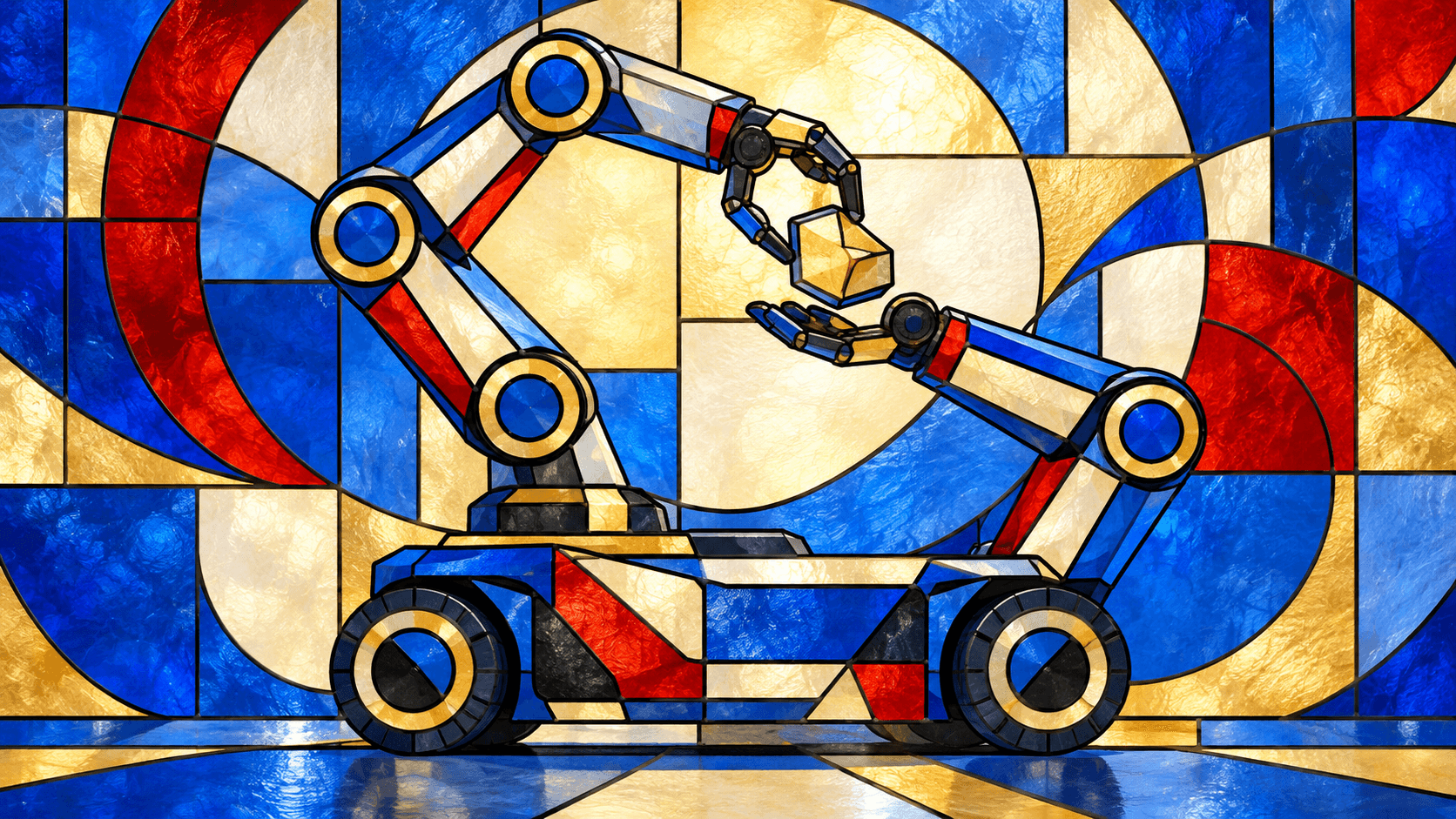
RobCo describes Alfie as a mobile platform with two arms, combining perception, reasoning and execution. The intended settings include changing part mixes, containers and layouts. The company describes learning through simulation, teleoperation and experience at a site, and says selected manufacturers are involved. Its product page also places safety certification and commercial terms within a customer discussion. These are descriptions of the development and pilot program, rather than proof of reliable operation across every factory environment. Alfie product page
The appeal is straightforward. Traditional automation often asks a factory to make the work predictable: present parts consistently, hold fixtures in fixed locations and keep the robot's surroundings controlled. A machine that can handle more variation could reduce some of that preparation. Mobility could also let one machine serve more than one location.
Each additional freedom creates an engineering obligation. A mobile base must arrive where the arms can reach safely. The vision system must distinguish the right part from the background. A grasp must survive the move to the next station. The machine must recognize when an attempted action has failed and recover without creating a larger interruption. Useful flexibility is the amount of variation the system can manage while maintaining an acceptable production result.
That makes the boundaries of the first commercial application especially important. A narrowly defined task with documented exceptions can be more valuable than an impressive demonstration whose limits are unclear. A manufacturer should be able to describe the parts, containers, presentation conditions, cycle requirements and recovery procedure before judging whether a robot is a fit.
The existing business provides a starting point
RobCo's January 29 announcement described a $100 million Series C led by Lightspeed and Lingotto Innovation. That earlier release positioned the company around modular industrial hardware, its own software and a service model, with applications including machine tending and palletizing. It is background to today's announcement, rather than another fresh financing event. RobCo Series C announcement, January 29
An established automation business can provide advantages for a new platform. It brings contact with real production constraints, experience installing equipment and a channel for learning what customers will pay to automate. It can also make the transition demanding. Customers familiar with a repeatable machine tending cell will expect a newer system to come with similarly understandable acceptance criteria.
RobCo promotes a service model with no upfront capital expenditure. That can change the buyer's budgeting and reduce the initial purchase hurdle. It does not remove the economics of the installation. A recurring fee, integration effort, downtime, operator supervision and supporting equipment still belong in the calculation. A useful comparison looks at the total cost of completing the task over a defined period.
The supplier takes on obligations too. Under a recurring model, a robot that remains expensive to service can consume the revenue it earns. Repeatable commissioning and effective remote support become part of the business model, not simply technical conveniences. A flexible platform must therefore become easier to operate at scale, as well as capable of doing more things.
What to watch before March
RobCo says the United States is its fastest growing market, with operations across more than a dozen states, assembly in Austin and a robotics lab in San Francisco. The March launch is planned in Munich. Those locations describe the company's operating footprint; they do not establish identical commercial availability in every market. RobCo announcement
The useful next evidence would connect a task to an operating result: what Alfie handled, how often it needed assistance, how long commissioning took and what happened when conditions changed. A commercial offer also needs a clear division of responsibility between the robot supplier, the integrator and the customer's staff.
Today's announcement matters because capital and product timing now meet in a specific company plan. The valuation gives RobCo a financing milestone. The March date gives customers a point at which to assess an actual offer. The larger opportunity will depend on whether flexibility translates into productive hours that a factory can purchase, support and repeat.
Sources and dates: RobCo's original announcement is dated October 5, 2026, with no publication time shown. The Wall Street Journal report was published October 5 at 07:00 UTC. The product page supplies current company descriptions; the January 29 financing announcement is historical context. The planned March 4, 2027 launch is a future event.
Sources and further reading
About the author
Rodolfo is the founder of Black Scarab, where he covers the technologies and commercial signals shaping physical AI adoption.
Meet Rodolfo