
Physical Superintelligence raises $58 million to build an AI native physics lab
The new public benefit corporation is building virtual physicists to accelerate discovery, beginning with data center optimization and an ambitious mission to Alpha Centauri.
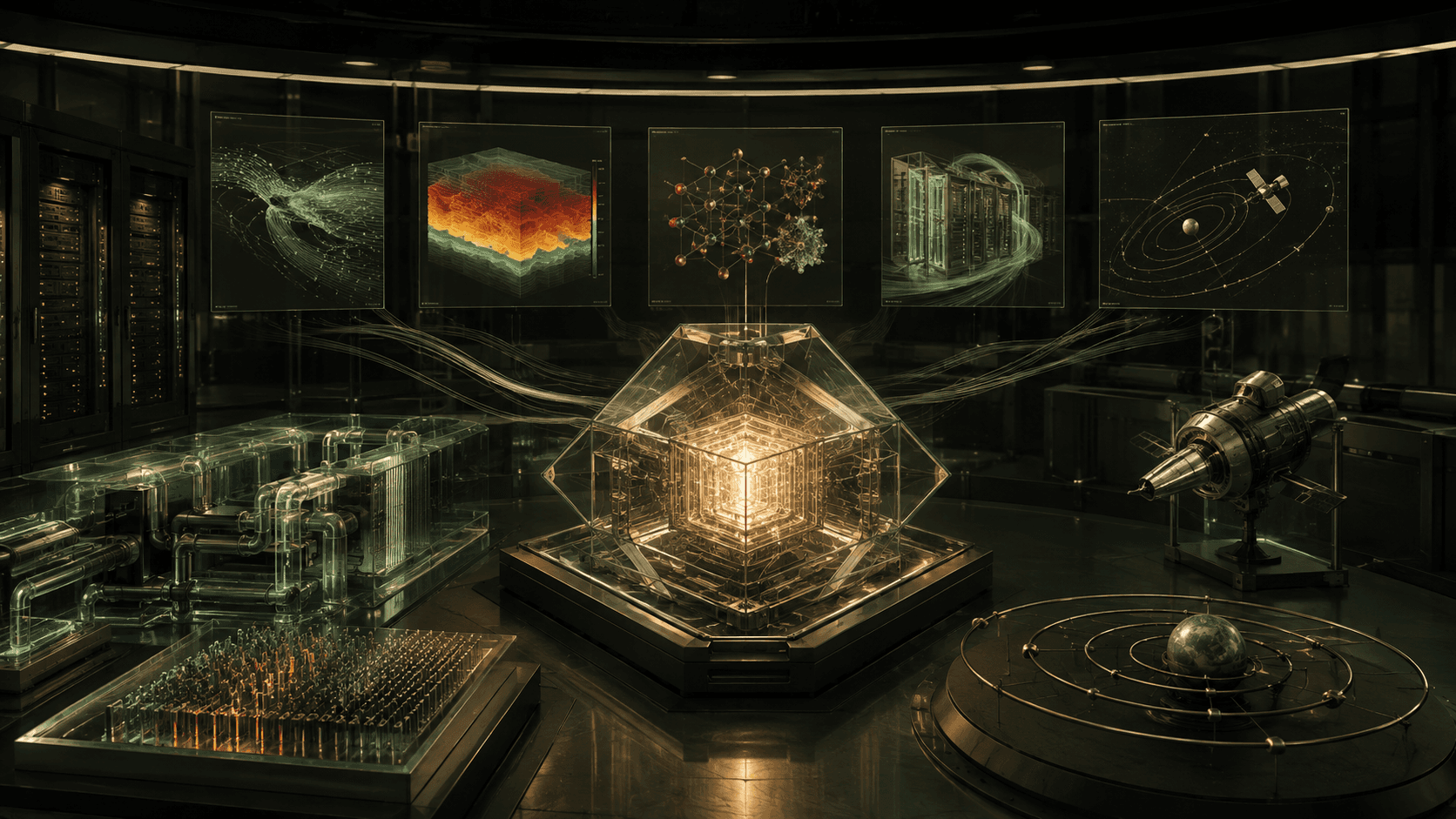
At a glance
- Physical Superintelligence launched with a $58 million seed round led by Breakthrough Energy Ventures.
- Its Emmy platform is designed to run autonomous research campaigns that connect hypotheses, simulations, verification, experiments, engineering, and deployment.
- The company is beginning with data center design and optimization while also supporting a privately funded mission concept to Alpha Centauri.
A $58 million bet on faster physics
A new research company wants to give physics the same kind of industrial acceleration that artificial intelligence brought to software. Physical Superintelligence, known as PSI, launched this week with $58 million in seed funding to build an AI native laboratory staffed by what it calls virtual physicists.
Breakthrough Energy Ventures led the round. Dragon Global, Solari Capital, Robot Ventures, Susa Ventures, Variant Fund, SV Angel, Valkyrie, 021T, Balaji Srinivasan, Anthony Scaramucci, and other investors participated.
The company was founded by Matthew Pines, Alex Klokus, and physicist and computer scientist Alex Wissner Gross. PSI is organized as a public benefit corporation and says its charter prioritizes safety, independent verification, responsible development, and broad public benefit alongside commercial goals.
That is an ambitious starting point. The important question is not whether AI can produce ideas about physics. Models already do that. The harder problem is whether a system can consistently turn an idea into a result that survives simulation, testing, engineering constraints, and skeptical review.
What PSI is actually building
PSI calls its core platform Emmy, after mathematician and physicist Amalie Emmy Noether. Emmy is intended to coordinate specialized AI agents that can work through a complete scientific campaign rather than answer a single prompt.
A campaign starts with a problem defined by human researchers. Virtual physicists then generate hypotheses, test them in simulations, challenge the results, propose experiments, and translate promising findings into engineering and deployment plans. Human scientists direct the mission and decide what deserves further attention.
The company says independent agents must converge on a result before it advances. In practical terms, one model is not supposed to grade its own homework. Different verification paths look for mathematical errors, physical inconsistencies, unrealistic assumptions, and conclusions that do not follow from the evidence.
PSI describes the campaign, not the model response, as its basic unit of work. That distinction is central to the pitch. A useful scientific system needs memory, simulation tools, data pipelines, evaluation rules, and repeatable processes. A clever answer in a chat window is not enough.
Black Scarab Weekly
Follow the physical AI economy
Get Black Scarab news, deep research, and practical analysis in one clear Thursday briefing.
Emmy starts with data centers
The first proving ground is the physical infrastructure behind AI itself. PSI says Emmy is being developed for terrestrial and orbital data center optimization, with early work focused on cooling, electrical systems, power flow, and facility design.
Semafor reported that the company is beginning with a large data center site in Texas. Before construction, Emmy can explore combinations of cooling equipment, power delivery, building geometry, climate conditions, and operating loads. The goal is to identify designs that use less energy, cost less to operate, or support more compute within the same physical limits.
This is a sensible place to begin because the problem is valuable and measurable. Data centers convert electricity into computation, heat, and eventually useful AI output. Small improvements in cooling efficiency, power distribution, or equipment layout can become meaningful when repeated across a large facility.
It is also a difficult test. A simulated improvement has to survive real equipment tolerances, changing workloads, weather, maintenance schedules, construction constraints, and safety requirements. PSI will need to show that Emmy can produce recommendations engineers trust and that those recommendations improve operating results after deployment.
The verification problem
Scientific discovery has a higher bar than fluent writing. A model can produce a convincing explanation while quietly violating a conservation law, applying a formula outside its valid range, or assuming a material behaves differently than it does in the real world.
PSI is responding with what it calls hard verifiers. These can include equations, numerical solvers, physics simulators, experimental measurements, and separate agents assigned to attack a proposed result. The company says important conclusions require multiple independent forms of support.
That architecture is promising, but it is not automatic proof. Simulations inherit the limits of their inputs and models. Two agents can agree because they share the same blind spot. An automated audit can miss a flawed assumption that an experienced scientist would question immediately.
The strongest evidence will come from reproducible results evaluated outside PSI. That means published methods, independent replication, real experiments, and engineering outcomes that can be measured against a clear baseline. The company has described its safeguards, but it has not yet published a broad record of peer reviewed discoveries produced by Emmy.
An early test beyond Earth
PSI is also a founding technical partner for the Fermi Explorer Mission, a privately funded concept for an AI planned journey toward Alpha Centauri. The company says Emmy assessed the mission physics and identified a more efficient trajectory under mass and budget constraints.
The project is meant to test more than orbital mathematics. PSI says it will contribute scientific instruments and use AI across mission planning, spacecraft design, and research operations. A space mission forces every recommendation to contend with limited energy, limited mass, radiation, communications delay, and very little room for repair.
The destination makes for a dramatic announcement, but the practical value may come from the engineering discipline. Systems built for extreme constraints can generate tools for power management, thermal control, materials, sensing, and autonomous operations closer to home.
For now, the Fermi Explorer remains a mission concept rather than evidence that PSI has solved interstellar travel. The company has not published a launch date, final spacecraft design, complete budget, or independent technical validation of the proposed trajectory.
Who is building it
Matthew Pines serves as chief executive. Alex Wissner Gross is chief scientist and chief of strategy. Alex Klokus is president, and Alessandro Morari is chief technology officer. PSI says its team includes more than 25 researchers and engineers.
Wissner Gross is a physicist, computer scientist, entrepreneur, and investor whose work has crossed artificial intelligence, information theory, and complex systems. Pines has worked at the intersection of emerging technology and national security. Klokus previously founded Futurism, and Morari has worked on machine learning systems and scientific computing.
The funding syndicate gives PSI time to recruit expensive technical talent and build the simulation, data, and verification infrastructure required for its approach. It also creates expectations. A $58 million seed round is unusually large, and investors will eventually look for evidence that autonomous research campaigns can become a repeatable product rather than a collection of impressive demonstrations.
What still needs to be proven
PSI has presented a detailed vision, but many commercial details remain private. The company has not disclosed pricing, revenue, named customers beyond its reported early data center work, contract values, or the performance gains produced by Emmy.
There is also a gap between optimizing a known system and discovering new physics. Improving a cooling design can be evaluated against engineering metrics. Finding a new law of nature requires evidence that holds up across experiments, institutions, and years of scrutiny. Success in the first category would not automatically prove success in the second.
The next milestones should be concrete: a data center design that delivers measured savings, an independently reproduced scientific result, a published verification method, or an engineering system that performs better because Emmy found an approach humans had missed.
PSI has assembled capital, technical talent, and a serious first market. It is now trying to prove that AI can move beyond assisting scientists and begin coordinating the machinery of discovery itself. The idea is bold. The results will have to be unusually solid.
Sources and further reading

About the author
Rodolfo is the founder of Black Scarab, where he covers the technologies and commercial signals shaping physical AI adoption.
Meet Rodolfo