
NEURA Robotics puts its $1.4 billion financing to the production test
The German robotics company has assembled an unusually large investor group and is already adding manufacturing partners, training facilities, and acquired robot businesses. The harder question is how much capital is committed today and how quickly it can become dependable production.
At a glance
- NEURA announced a Series C with a total potential size of up to $1.4 billion, led by Tether and supported by a group of technology, industrial, and financial investors.
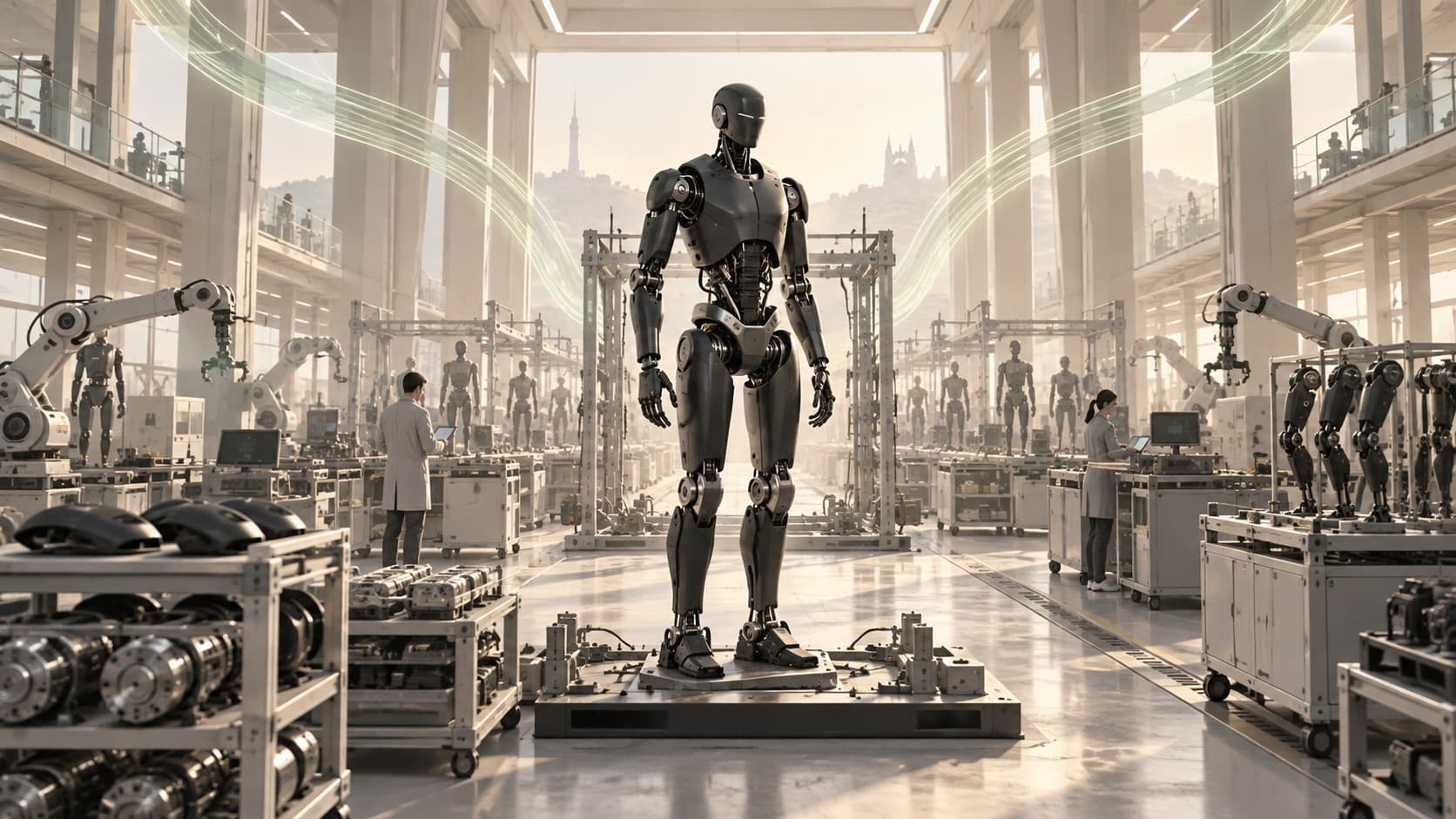
- The company says the capital will support robot production at multimillion unit scale by 2030 and the expansion of real world training facilities called NEURA Gyms.
- Public disclosures do not break out cash already funded, later commitments, valuation, investor allocations, revenue, unit shipments, or binding customer orders.
A very large round with an important qualifier
NEURA Robotics announced on June 10 that its Series C could reach a total size of up to $1.4 billion. Tether is leading the financing, while the disclosed investor group includes Qualcomm Technologies, Amazon, NVIDIA, imec.xpand, Bosch, Schaeffler, the European Investment Bank, Lingotto Horizon, and InterAlpen Partners.
For a German robotics company founded in 2019, the headline is enormous. The words up to matter just as much as the number. NEURA and Tether describe the maximum round size, but their announcements do not provide a closing schedule, the amount already transferred, the conditions attached to future funding, or the allocation among investors.
Bloomberg reported in March that NEURA was raising about €1 billion at a valuation of roughly €4 billion, citing people familiar with the matter. NEURA did not disclose a valuation in its June announcement, so the reported figure should not be treated as a confirmed term of the final round.
The financing is still consequential. Law firm DLA Piper confirmed that it advised Qualcomm Technologies on participation in the round, while Taylor Wessing said it advised Lingotto. The European Investment Bank separately records a €40 million financing signed with NEURA in January. These disclosures support the presence of serious strategic and institutional backers, but they do not resolve how much of the $1.4 billion is available for immediate use.
The ambition extends beyond a humanoid
NEURA is often introduced through 4NE1, its humanoid robot. Its larger plan is to create a connected system spanning industrial arms, mobile robots, humanoids, sensors, software, training data, and outside developers.
The software layer is called Neuraverse. NEURA describes it as an open ecosystem where robots, components, artificial intelligence models, data, compute, and services can work together. The strategic goal is to let capabilities learned by one machine become reusable across other machines and applications.
That platform idea changes the financing case. A single robot manufacturer can grow by selling more machines. A platform company tries to benefit when developers add skills, partners contribute components, customers generate useful data, and multiple types of robots share the same underlying tools.
Tether presents an additional layer. The lead investor says it wants to support machines that can operate autonomously and participate in a future machine economy. That is the investor's strategic thesis, not evidence that NEURA robots are currently conducting financial transactions or generating platform revenue.
Black Scarab Weekly
Follow the physical AI economy
Get Black Scarab news, deep research, and practical analysis in one clear Thursday briefing.
Capital is moving into factories, suppliers, and training
NEURA says the round will help it pursue production at multimillion unit scale by 2030. That objective requires far more than a capable prototype. It requires stable designs, qualified suppliers, production tooling, testing, service capacity, software support, working capital, and enough customer demand to keep factories economically occupied.
Several developments since the financing announcement show where management is placing its bets. In August, NEURA agreed to take over Bosch Rexroth's ACTIVE Shuttle autonomous transport system, effective October 1. Later that month, NEURA Mobile Robots acquired all of ADLATUS Robotics, bringing hundreds of installed autonomous cleaning systems and navigation software into the group.
On September 7, NEURA and Italian embedded computing company SECO announced a partnership to design and manufacture Qualcomm based computing modules for cognitive robots, including 4NE1. The agreement gives NEURA a defined partner for a critical part of the electronics stack as it works toward repeatable European production.
NEURA is also expanding its training infrastructure. A planned NEURA Gym with RWTH Aachen covers 2,300 square meters and carries a stated €17 million commitment. Around 20 university institutes are expected to participate. The facility is intended to let companies test robotics in realistic workflows and generate data for machine learning.
These moves are consistent with the stated use of proceeds, but acquisition prices, capital budgets, production capacity, and deployment schedules were not disclosed. Announcing the pieces of an industrial system is different from demonstrating that they operate together at the promised scale.
Strategic investors can contribute more than money
The investor list resembles a potential supply and commercialization network. Qualcomm can contribute edge computing technology. Bosch and Schaeffler bring industrial engineering and manufacturing experience. Amazon operates logistics systems at immense scale. NVIDIA supplies accelerated computing and simulation tools. imec.xpand invests around semiconductor innovation.
That alignment may reduce some execution risk because NEURA can work with companies that understand processors, actuators, industrial production, logistics, and artificial intelligence infrastructure. It may also give the company access to prospective testing environments and commercial relationships.
Investment alone does not establish a purchase commitment, preferred supplier agreement, or customer deployment. NEURA's announcement identifies backers but does not say that Amazon will buy robots, that every investor will supply production components, or that the relationships are exclusive. Each commercial connection needs its own evidence.
The group also creates coordination risk. A robot platform can depend on processors, models, cloud services, electronics, actuators, sensors, and manufacturing partners with different roadmaps. NEURA will need to preserve enough technical control to integrate those contributions and support customers through product changes.
The funding comparison needs discipline
NEURA calls the financing the largest capital raise by a full stack robotics company. The claim is difficult to compare cleanly because robotics rounds use different structures and disclosures. A maximum potential round, cash at closing, strategic investment, debt facility, and merger transaction are not equivalent forms of capital.
The comparison also says little about operating efficiency. Robotics companies consume cash through engineering, inventory, factories, field support, and long customer qualification cycles. A larger balance sheet can extend the runway and accelerate development, but it can also raise the level of future performance required to justify the investment.
NEURA previously announced a €120 million Series B in January 2025. Moving from that round to a Series C of up to $1.4 billion signals a sharp increase in ambition. Publicly available materials do not disclose current revenue, gross margin, annual cash consumption, or the economics of individual robot products.
The company has referred publicly to substantial demand and future production volumes, but it has not provided enough detail for outsiders to separate paid deployments, binding orders, refundable reservations, pilot agreements, and expressions of interest. Those categories have very different commercial value.
What buyers still need to see
For industrial customers, the financing matters only if it improves the product and reduces deployment risk. A well funded supplier may be better able to maintain spare parts, support integrations, invest in safety engineering, and remain available through a long equipment life.
Customers will still need evidence at the task level. How often does the robot finish a job without intervention? What happens when an object moves or a sensor becomes uncertain? How long does deployment take? What are the maintenance requirements, safety limits, energy use, cycle time, and complete operating cost?
The answers may differ across NEURA's portfolio. An autonomous transport system with an established operating envelope is not the same commercial proposition as a general humanoid. Acquiring deployed mobile and cleaning robots could give NEURA useful customers, service experience, and real world data while humanoid capabilities mature.
That portfolio approach may prove more durable than betting the entire company on one body design. It can also become difficult to manage if acquisitions, internal products, and partner technologies do not converge on a coherent software and support model.
The production test starts now
The next milestone is not another impressive funding headline. It is evidence that committed capital is arriving, designs are stabilizing, suppliers are qualified, and customers are operating robots in useful work.
Black Scarab will watch four signals. First, NEURA should clarify the funded and conditional portions of the Series C. Second, it should disclose production capacity and deliveries by product family. Third, named customers should describe measurable deployment results. Fourth, Neuraverse should demonstrate that capabilities and data can move across multiple robot types without creating an unmanageable integration burden.
NEURA has assembled capital, strategic partners, acquisitions, and research infrastructure with unusual speed. That gives the company a credible opportunity to build a significant European robotics platform. The financing buys time and options. Production reliability, customer economics, and transparent commercial evidence will determine what those options are worth.
Sources and further reading
- NEURA Robotics Series C announcement, June 10, 2026
- Tether statement on leading the NEURA financing
- Bloomberg reporting on the proposed financing and valuation
- European Investment Bank project record for NEURA Robotics
- DLA Piper confirmation of Qualcomm Technologies participation
- Taylor Wessing confirmation of Lingotto participation
- NEURA Robotics acquisition of ADLATUS Robotics
- NEURA Robotics acquisition of Bosch Rexroth ACTIVE Shuttle
- NEURA Robotics and SECO production partnership
- NEURA Robotics and RWTH Aachen training facility announcement

About the author
Rodolfo is the founder of Black Scarab, where he covers the technologies and commercial signals shaping physical AI adoption.
Meet Rodolfo