
Bonsai World puts the next farm inside a simulator before the robot arrives
Bonsai Robotics introduced Bonsai World on October 2 to prepare rugged autonomy in simulated environments before deployment. Its commercial test is less repeated field work and dependable operation at new sites.
At a glance
- Bonsai World generates simulated environments and conditions for training and evaluation before field deployment.
- Bonsai reports more than 50 million real world samples collected across more than one million acres. Those are company dataset figures, not a new deployment count.
- Faster preparation is the commercial objective. The launch does not independently establish that field commissioning can be eliminated.
What happened
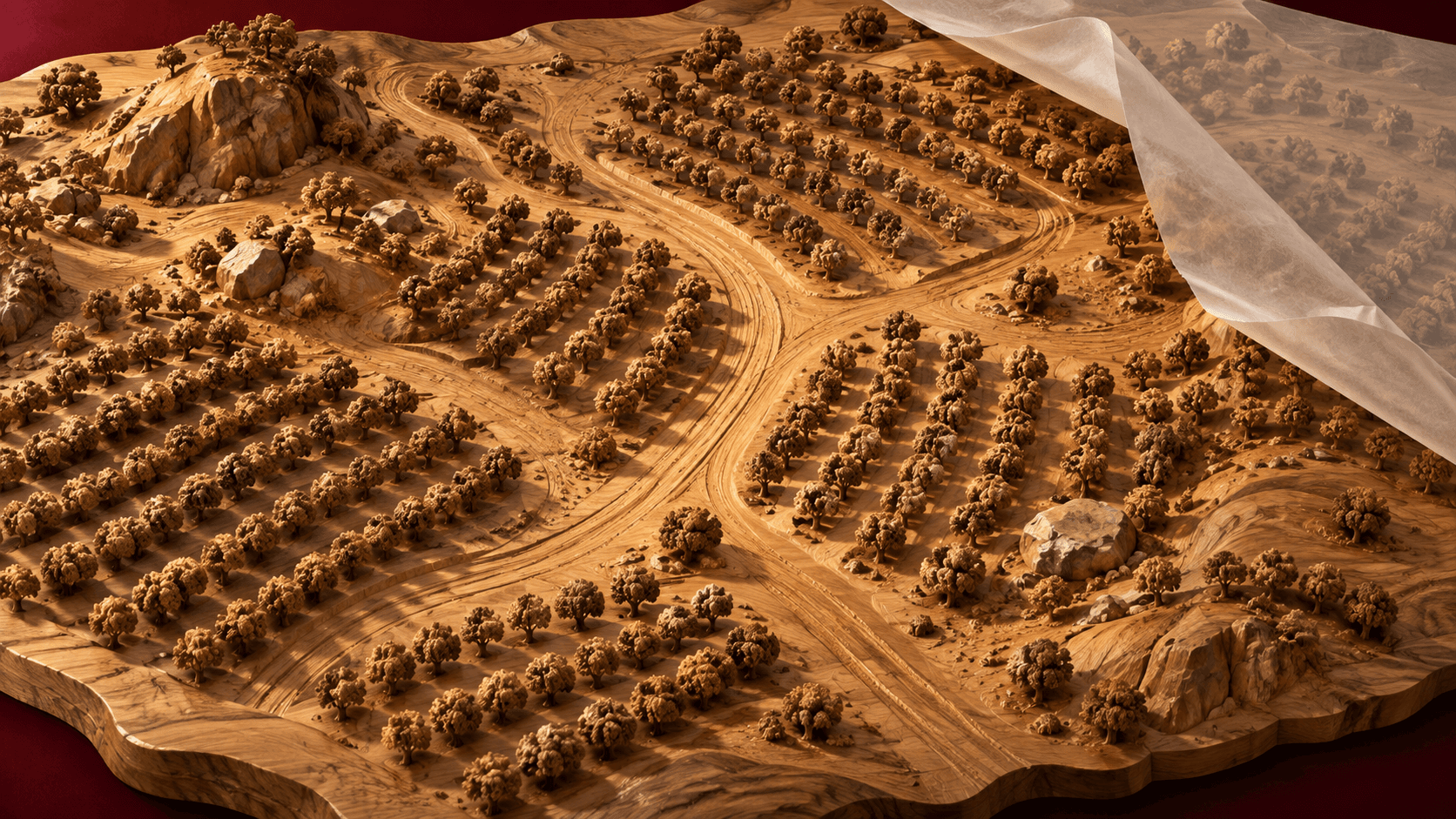
Bonsai Robotics introduced Bonsai World on October 2, adding a simulation application that builds virtual rugged environments to prepare its autonomy software for places and conditions its machines have not yet encountered.
The company says the application sits within Bonsai Intelligence, which powers its Amiga machines and equipment fitted with its autonomy technology. Its starting point is satellite imagery, interpreted with Google's Gemini vision language model and turned into a structured three dimensional environment. Original announcement
Preparing for a place the fleet has not seen
The announcement describes generating ground level views and variations such as dust, animals, debris, vehicles and changing terrain. It identifies Google Cloud infrastructure with NVIDIA accelerators for training and simulation generation. These are development resources; the release does not establish that those cloud GPUs sit on the vehicles. System description
The engineering problem is familiar to anyone trying to move autonomy beyond a carefully prepared site. Knowing how to drive through one orchard is useful, but the next orchard can have different spacing, visibility and obstacles. A route that was navigable on one visit can look different after equipment moves or weather changes.
A simulator creates a way to practice those variations without sending a machine out for every experiment. It can also make a difficult scenario repeatable. An engineer can compare two versions of a model against the same virtual obstruction rather than hoping that a similar event happens again in the field.
That repeatability is the more grounded attraction than the number of synthetic images a system can produce. More data helps only when it represents problems the machine must solve and when evaluation can distinguish a useful improvement from a cosmetic one.
Black Scarab Weekly
Follow the physical AI economy
Get Black Scarab news, deep research, and practical analysis in one clear Thursday briefing.
The platform was already bigger than perception
Bonsai's earlier engineering account describes a learning cycle that spans field logs, simulation, testing on production hardware and controlled software releases. It explains that vehicle data must preserve timing and context so engineers can reconstruct what the machine sensed, decided and actually did. It also describes different physical vehicles connected to a shared autonomy stack through machine specific interfaces. Bonsai's August engineering account
That background helps place the new application. A virtual environment is one part of a development system. The model trained there still has to run within a vehicle's computing limits, receive the right sensor information and issue commands that the physical machine can execute.
For example, a perception system can correctly identify open space while a vehicle takes longer than expected to stop. A route can be sensible for one machine and awkward for another with different steering geometry or an attached implement. Those are integration questions that a convincing image alone cannot settle.
Bonsai's existing emphasis on hardware testing is therefore relevant. Simulation becomes commercially useful when its lessons survive the rest of the stack, including timing, calibration and control. The launch should be read as an expansion of that development process, not a replacement for it.
Why deployment time matters
Field preparation has an economic cost even when the robot itself works. Engineers may need to visit, collect data, test routes, adjust a configuration and return to resolve a problem. If much of that effort repeats at each new site, the supplier's business starts to resemble a sequence of integration projects.
Reducing that repeated work could change the economics of expansion. A supplier could prepare more deployments with the same engineering team, while an operator could reach useful work sooner. Those are plausible benefits of the approach, not measured outcomes of this release.
Agriculture adds a scheduling constraint. A machine can be ready in a technical sense but miss the period when a particular task is valuable. Preparation that can happen before equipment arrives may be worth more during a short operating season than during a job that can wait indefinitely.
The useful denominator is consequently time to dependable work at a new site. That includes preparation and commissioning, plus the interventions needed after the machine starts. Cutting initial setup while increasing later support calls would move the cost rather than remove it.
An August AgFunderNews interview placed Bonsai's simulation work within its agricultural autonomy strategy. It provides specialist context for the approach, but its account of company progress is not an independent benchmark of the newly announced application. Earlier specialist reporting
A realistic picture is only part of reality
Satellite imagery can help organize the visible layout of a site. It cannot, by itself, establish every current ground condition. A virtual scene still needs assumptions about what is present, how objects behave and which situations deserve attention.
Those assumptions are where the evaluation should concentrate. A model can become very good at handling variations generated by its own simulator while struggling with a variation the generator never produces. Testing on separate field locations and unfamiliar conditions helps distinguish useful generalization from familiarity with synthetic scenes.
Rare events matter as well. A fleet may collect a large number of routine examples and relatively few consequential failures. Dataset size does not reveal that balance. The right comparison is whether the added simulation improves performance on difficult cases without making ordinary operation worse.
There is also a compute tradeoff. Generating more scenarios and training on them consumes development resources. A supplier needs those costs to produce a meaningful reduction in engineering time, field risk or operational interruption. A faster model development loop that does not improve deployed behavior would have limited value to the operator.
The next useful proof
Readers should look for results from new sites that separate simulated preparation from work still required in the field. Commissioning hours, intervention frequency and repeatability across machines would make the claimed benefit easier to assess than another visualization.
Bonsai also discusses expansion into industries such as mining and defense. The October announcement does not establish a new customer deployment in either market. Agricultural experience can inform that work, but each application brings its own machines, conditions and operating constraints.
Bonsai World addresses a practical scaling question: how much preparation can move off the site before the machine arrives? Its value will be clearer when that preparation yields dependable operation with less repeated field work.
Sources and further reading

About the author
Rodolfo is the founder of Black Scarab, where he covers the technologies and commercial signals shaping physical AI adoption.
Meet Rodolfo