
Physical AI Series · Cross-Industry
Roboflow Deep Dive: Computer Vision Infrastructure, Visual Data, and the Physical AI Perception Layer
A business and investor deep dive on Roboflow, the computer vision platform helping teams turn images, video, camera streams, datasets, models, and workflows into production visual intelligence for physical AI systems.
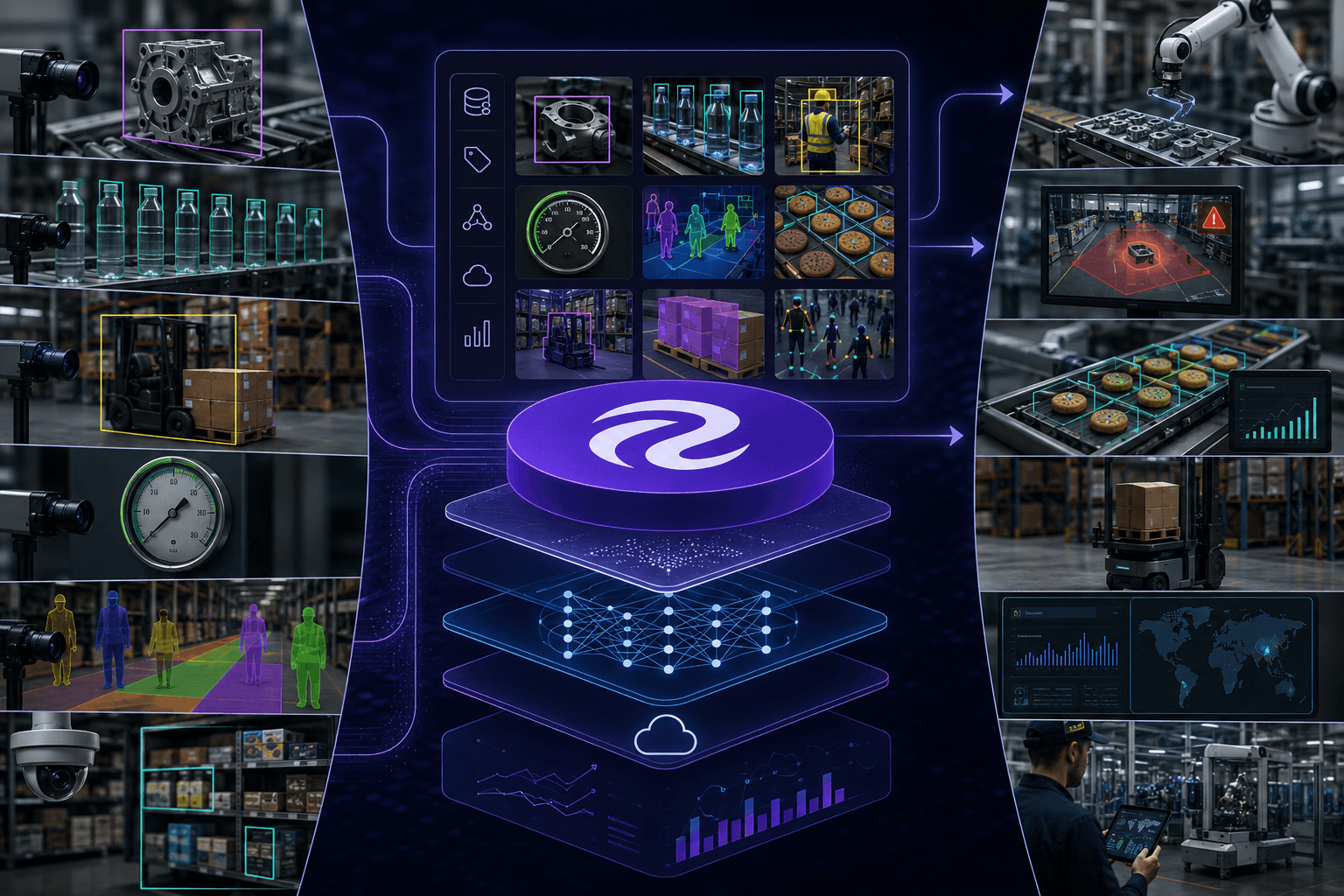
Roboflow is one of the clearest software companies in the physical AI chain because computer vision is often the first way a business turns the real world into structured data. Before a company buys a robot, it may need to detect defects, count objects, monitor safety zones, track inventory, read gauges, inspect surfaces, verify worker behavior, or understand what is happening in a camera feed.
This deep dive is part of Black Scarab's Top 15 Physical AI Infrastructure Companies series, which maps the infrastructure layers behind physical AI: compute, robot intelligence, perception, safety, deployment software, and field data.
For the rest of the perception stack, read this beside Luxonis OAK spatial AI cameras, Stereolabs ZED spatial perception, and Prophesee's event-based vision layer because visual AI becomes more useful when 2D detection, depth, motion, and edge deployment are understood together.
That makes Roboflow important even when no robot is involved. A camera looking at a conveyor belt, rail yard, warehouse aisle, parking lot, production cell, clinic, field, loading dock, or sports court can become an operational sensor if the software can reliably convert pixels into events. That conversion is one of the foundations of physical AI.
The company's value is not only labeling or training. It is the workflow around visual intelligence: datasets, annotation, model selection, model training, evaluation, deployment, monitoring, iteration, and the logic that turns predictions into action. In physical environments, iteration is not optional. Lighting changes, camera angles shift, products change packaging, workers behave unpredictably, weather changes scenes, and models decay when the world drifts.
Roboflow's importance is not that every physical AI system will use its platform. It is that the category it represents is unavoidable. The world has to be labeled, detected, segmented, tracked, and turned into events before software can act on it.
Executive Summary
Roboflow is a computer vision platform for building, deploying, and operating visual AI applications. Its official positioning is direct: AI that sees and understands the physical world. The company says more than 1 million engineers deploy visual intelligence with Roboflow, more than 16,000 organizations build with it, and over half of the Fortune 100 uses the platform.
The product stack spans the computer vision lifecycle. Roboflow Annotate helps teams label and manage image datasets. Roboflow Train provides hosted training across multiple vision task types. Roboflow Deploy supports hosted APIs, self-hosted inference, edge hardware, and production environments. Roboflow Workflows lets teams chain models, logic, and integrations into deployable vision applications. Roboflow Universe provides a large public ecosystem of datasets and pre-trained models.
The strategic point is that physical AI needs a perception operating layer. Cameras are cheap and everywhere, but raw video is not useful until it becomes counts, locations, classifications, defects, violations, alerts, measurements, identities, or workflow events. Roboflow sits in that translation layer.
For investors, the key question is whether computer vision platforms become horizontal infrastructure or get absorbed into vertical products. A generic platform can scale across industries, but vertical workflows may own more of the customer budget. Roboflow's opportunity is to remain close enough to developers while expanding toward production deployment and business-critical vision operations.
Roboflow at a Glance
What is it?
Practical Answer
A computer vision platform for datasets, labeling, model training, model deployment, workflows, inference, and visual AI operations.
What layer does it target?
Practical Answer
The perception layer: turning images, video, and camera streams into structured events that software can use.
Why does it matter?
Practical Answer
Many physical AI systems begin with vision because cameras are already present in factories, warehouses, stores, yards, roads, clinics, labs, farms, and public spaces.
What is the platform wedge?
Practical Answer
A developer-friendly workflow that spans data, annotation, training, deployment, iteration, and production inference.
What is the core risk?
Practical Answer
Computer vision may fragment into vertical applications, OEM-native camera stacks, cloud platforms, and open-source tooling that absorb parts of the workflow.
| Question | Practical Answer |
|---|---|
| What is it? | A computer vision platform for datasets, labeling, model training, model deployment, workflows, inference, and visual AI operations. |
| What layer does it target? | The perception layer: turning images, video, and camera streams into structured events that software can use. |
| Why does it matter? | Many physical AI systems begin with vision because cameras are already present in factories, warehouses, stores, yards, roads, clinics, labs, farms, and public spaces. |
| What is the platform wedge? | A developer-friendly workflow that spans data, annotation, training, deployment, iteration, and production inference. |
| What is the core risk? | Computer vision may fragment into vertical applications, OEM-native camera stacks, cloud platforms, and open-source tooling that absorb parts of the workflow. |
Black Scarab Weekly
Follow the physical AI economy
Get Black Scarab news, deep research, and practical analysis in one clear Thursday briefing.
Why Vision Comes First
Physical AI has many inputs: LiDAR, radar, audio, vibration, temperature, force, current, GPS, inertial sensors, pressure sensors, and machine telemetry. But camera vision often comes first because it is intuitive, flexible, and already deployed across the built world.
A manager can look at a camera feed and understand why it might matter. Is the pallet in the wrong place? Is a worker too close to a forklift? Is a part missing? Is the gauge in range? Is the shelf empty? Is the train wheel damaged? Is the product label readable? Is the parking space occupied? These questions are operational, not academic.
That is why Roboflow belongs in the physical AI infrastructure map. The company gives builders a way to turn visual scenes into machine-readable state. Once the state is available, the rest of the system can act: send an alert, update inventory, stop a line, route a robot, trigger maintenance, generate a report, reject a defective item, or escalate to a human.
This is also why computer vision can precede robotics adoption. A company may not be ready to automate a full task, but it may be ready to understand it. Roboflow's market expands wherever seeing better is the first step toward operating better.
The Dataset Engine
The hidden center of computer vision is not the model. It is the dataset. A model trained on clean, balanced, convenient examples can fail the moment it sees glare, blur, dirt, occlusion, odd packaging, weird camera height, a new SKU, a winter uniform, a dirty lens, or a slightly different production batch.
Roboflow's dataset and annotation layer is therefore strategically important. The company says more than 750,000 datasets and more than 575 million images have been labeled using Roboflow. That scale matters because visual AI is not a one-time training problem. It is a data curation problem that repeats as the physical environment changes.
Annotation is also where human judgment enters the system. A defect boundary, safety-zone violation, damaged component, rare medical pattern, or ambiguous inventory object often requires domain knowledge. A platform that makes labeling faster, easier to review, and easier to turn into model versions can reduce the friction between the business expert and the machine-learning workflow.
Roboflow's AI-assisted labeling tools point toward the future of the category. Foundation models can reduce labeling burden, but they do not eliminate the need for domain alignment. The key is not replacing human labeling entirely. The key is letting teams spend less time drawing obvious boxes and more time capturing the edge cases that actually break production systems.
Why Visual Datasets Matter
Scene drift
Physical Example
A camera is moved, lighting changes, or a workstation layout changes.
Why It Matters
A once-accurate model can degrade without any change in code.
Class drift
Physical Example
New packaging, parts, uniforms, tools, or vehicles appear.
Why It Matters
The model may miss the new object or confuse it with old classes.
Rare events
Physical Example
Defects, safety violations, damaged components, or unusual failures are uncommon.
Why It Matters
The most valuable events can be the hardest examples to collect.
Annotation ambiguity
Physical Example
Experts disagree on the boundary of a defect or what counts as a violation.
Why It Matters
Bad label definitions create inconsistent model behavior.
Operational feedback
Physical Example
False positives and false negatives appear after deployment.
Why It Matters
Production systems need a loop for finding and retraining on failures.
| Dataset Problem | Physical Example | Why It Matters |
|---|---|---|
| Scene drift | A camera is moved, lighting changes, or a workstation layout changes. | A once-accurate model can degrade without any change in code. |
| Class drift | New packaging, parts, uniforms, tools, or vehicles appear. | The model may miss the new object or confuse it with old classes. |
| Rare events | Defects, safety violations, damaged components, or unusual failures are uncommon. | The most valuable events can be the hardest examples to collect. |
| Annotation ambiguity | Experts disagree on the boundary of a defect or what counts as a violation. | Bad label definitions create inconsistent model behavior. |
| Operational feedback | False positives and false negatives appear after deployment. | Production systems need a loop for finding and retraining on failures. |
From Labeling Tool to Vision Operations
Roboflow started from a developer-friendly vision workflow, but the larger opportunity is vision operations. A production system needs more than a trained detector. It needs version control, evaluation, deployment targets, monitoring, camera management, model updates, workflow logic, and integration with the systems that receive the output.
This is where the platform becomes interesting for physical AI. The camera feed is not the final product. The event is the product. A detection becomes useful when it updates a warehouse management system, opens a maintenance ticket, triggers a safety alert, records a compliance event, or feeds an automation layer.
Roboflow Workflows pushes in that direction by letting teams chain custom models, open-source models, foundation models, logic, and external applications. That matters because many real vision deployments are multi-stage systems. A model detects an object, another model reads text, a tracker follows motion, business logic filters false positives, and an integration sends the result downstream.
This is the difference between computer vision as a demo and computer vision as infrastructure. A demo shows that a model can identify something. Infrastructure makes that identification reliable, repeatable, observable, and connected to the business process.
Deployment Is the Hard Part
Roboflow's Deploy layer is important because vision applications do not all run in the same place. Some use a hosted API. Some need a dedicated cloud deployment. Some need to run inside a customer's VPC. Some need to run on a factory edge server. Some need to run on NVIDIA Jetson, Raspberry Pi, Luxonis OAK, x86 CPUs, ARM CPUs, NVIDIA GPUs, or TensorRT-optimized hardware.
The official Deploy page reflects that spread: hosted API, managed deployment, self-hosted deployment, edge devices, and dedicated SDKs. The open-source Roboflow Inference project describes itself as a way to make any computer or edge device a command center for computer vision projects, with support for camera streams, workflows, foundation models, monitoring, notifications, and production deployment.
That breadth matters because physical AI deployments are shaped by latency, bandwidth, privacy, reliability, and site constraints. A retail store may be fine with cloud inference. A factory may need local inference because the line cannot wait. A defense or healthcare customer may need strict data control. A mobile robot may need onboard inference. A warehouse may need edge inference across many streams.
The company wins if it can make that deployment decision less painful. The model should not have to be rebuilt every time the customer changes from API to edge, or from prototype hardware to production hardware. The more Roboflow makes vision portable across deployment environments, the more it looks like infrastructure.
Vision Deployment Modes
Hosted API
Why Buyers Use It
Fastest way to integrate inference into an application.
Physical AI Fit
Useful for prototypes, batch processing, low-latency-tolerant workflows, and centralized apps.
Dedicated cloud or VPC
Why Buyers Use It
More control, scale, security, and enterprise architecture fit.
Physical AI Fit
Useful when visual data is sensitive but centralized inference still works.
Self-hosted edge server
Why Buyers Use It
Local control, lower latency, bandwidth reduction, and site resilience.
Physical AI Fit
Useful for factories, warehouses, rail yards, stores, hospitals, and industrial sites.
Embedded or device deployment
Why Buyers Use It
Inference close to the camera or machine.
Physical AI Fit
Useful for robots, smart cameras, Jetson boxes, Raspberry Pi devices, and field systems.
Workflow runtime
Why Buyers Use It
Multiple models, logic, events, notifications, and integrations.
Physical AI Fit
Useful when predictions need to become operational actions.
| Deployment Mode | Why Buyers Use It | Physical AI Fit |
|---|---|---|
| Hosted API | Fastest way to integrate inference into an application. | Useful for prototypes, batch processing, low-latency-tolerant workflows, and centralized apps. |
| Dedicated cloud or VPC | More control, scale, security, and enterprise architecture fit. | Useful when visual data is sensitive but centralized inference still works. |
| Self-hosted edge server | Local control, lower latency, bandwidth reduction, and site resilience. | Useful for factories, warehouses, rail yards, stores, hospitals, and industrial sites. |
| Embedded or device deployment | Inference close to the camera or machine. | Useful for robots, smart cameras, Jetson boxes, Raspberry Pi devices, and field systems. |
| Workflow runtime | Multiple models, logic, events, notifications, and integrations. | Useful when predictions need to become operational actions. |
Universe and the Data Network
Roboflow Universe is one of the company's more strategically interesting assets because it turns the platform into more than private enterprise tooling. Universe gives developers access to public computer vision datasets and pre-trained models across domains such as aerial imagery, agriculture, biology, CCTV, construction, documents, energy, logistics, manufacturing, medical, robotics, and more.
Roboflow lists Universe as having more than 750,000 datasets, more than 575 million images, and more than 175,000 pre-trained models. Those numbers should not be read as a guarantee that every dataset is production-ready. The strategic point is that the ecosystem lowers the starting cost for builders. A developer can search for a similar problem, inspect examples, fork a dataset, test a model, or use public work as a checkpoint.
The Roboflow 100 benchmark also shows why this matters. Traditional vision benchmarks can overrepresent web images and common categories. Real-world vision problems include satellite imagery, microscopy, industrial defects, sports, documents, construction, and niche visual concepts. Physical AI needs models and evaluation sets that represent the messier edge of visual reality.
The most valuable version of Universe is not just a dataset library. It is a discovery and acceleration layer. If developers can move from zero to a useful baseline faster, Roboflow can sit at the beginning of many vision projects before the buyer has chosen a long-term production stack.
Where Roboflow Fits in Physical AI
Roboflow is not a robot company, but it can sit upstream of many robot deployments. A robot needs perception, but a business often needs visual understanding before it needs autonomous action. That is why vision platforms can become early indicators of where physical AI demand will appear.
In manufacturing, Roboflow can help with defect detection, safety monitoring, part presence, packaging validation, tool tracking, and visual process control. In logistics, it can support yard inventory, asset tracking, license plate reading, package counting, trailer monitoring, and dock operations. In healthcare, it can support imaging workflows, device monitoring, and controlled visual inspection. In retail, it can support shelf visibility, checkout automation, loss prevention, and store operations.
The official site highlights customer examples such as BNSF using visual AI for intermodal yard inventory and train wheel inspection, USG using edge-optimized vision AI in manufacturing, and Fletcher Sports deploying models to high-performance edge devices for broadcast coverage. The important signal is not any one case study. It is the spread across operational domains.
That spread is the heart of the investor debate. Computer vision is horizontal because almost every industry has cameras. It is vertical because every industry defines value differently. Roboflow has to be useful enough to developers across categories while still helping customers solve very specific operational problems.
Physical AI Use Cases for Roboflow
Manufacturing
Vision Task
Detect defects, missing parts, incorrect assemblies, safety gear, or process deviations.
Operational Value
Improve quality, reduce inspection burden, reduce downtime, and create real-time process visibility.
Logistics and rail
Vision Task
Track assets, containers, vehicles, license plates, wheel conditions, or yard inventory.
Operational Value
Reduce manual counting, improve asset visibility, and make large sites easier to operate.
Warehousing
Vision Task
Count inventory, monitor zones, detect pallet states, read labels, and track movement.
Operational Value
Support labor efficiency, safety, inventory accuracy, and automation readiness.
Retail
Vision Task
Monitor shelves, checkout activity, occupancy, product availability, and queue conditions.
Operational Value
Improve replenishment, reduce losses, and turn camera feeds into operational signals.
Robotics
Vision Task
Build perception datasets, train detectors, test models, and deploy inference near the machine.
Operational Value
Accelerate the vision layer for robots without forcing every team to build custom tooling.
| Market | Vision Task | Operational Value |
|---|---|---|
| Manufacturing | Detect defects, missing parts, incorrect assemblies, safety gear, or process deviations. | Improve quality, reduce inspection burden, reduce downtime, and create real-time process visibility. |
| Logistics and rail | Track assets, containers, vehicles, license plates, wheel conditions, or yard inventory. | Reduce manual counting, improve asset visibility, and make large sites easier to operate. |
| Warehousing | Count inventory, monitor zones, detect pallet states, read labels, and track movement. | Support labor efficiency, safety, inventory accuracy, and automation readiness. |
| Retail | Monitor shelves, checkout activity, occupancy, product availability, and queue conditions. | Improve replenishment, reduce losses, and turn camera feeds into operational signals. |
| Robotics | Build perception datasets, train detectors, test models, and deploy inference near the machine. | Accelerate the vision layer for robots without forcing every team to build custom tooling. |
The Horizontal vs. Vertical Tension
The hardest strategic question for Roboflow is whether computer vision platforms become horizontal infrastructure or disappear into vertical products. Both outcomes can happen at the same time.
The horizontal case is strong. The workflow patterns repeat across industries: collect images, label examples, train a model, evaluate performance, deploy inference, monitor failures, retrain, and connect outputs to systems. A platform that makes that loop faster can serve many markets.
The vertical case is also strong. A factory does not buy object detection. It buys fewer defects, fewer stoppages, faster inspection, and better quality. A railroad does not buy bounding boxes. It buys safer assets and better yard inventory. A retailer does not buy segmentation. It buys shelf availability, shrink reduction, and smoother operations. The closer the solution gets to a budget owner, the more vertical it can become.
Roboflow's opportunity is to occupy both layers without losing focus. It can stay developer-first enough to remain broad, while offering enough production guidance, workflows, templates, deployment options, and enterprise controls to capture serious customer spend.
Business Model Possibilities
Roboflow's business model can compound through developers, teams, enterprises, deployment usage, and ecosystem gravity. Developers start projects because the tooling is accessible. Teams pay for collaboration, data management, annotation, training, deployment, and model iteration. Enterprises pay for security, scale, governance, dedicated deployments, support, and production reliability.
Usage can also matter because inference creates ongoing volume. A labeling tool is episodic. A production vision system can run continuously across cameras, shifts, sites, and workflows. If Roboflow participates in the deployment layer, it can move closer to recurring operational value rather than only project setup.
The platform also benefits from a data and model ecosystem. Universe, public models, open-source inference, SDKs, and developer docs can make Roboflow the default starting point for people learning or prototyping computer vision. That top-of-funnel advantage matters if the company can convert serious projects into enterprise deployments.
The tension is services. Real-world vision projects often need customization, site work, camera placement, label definitions, integration, change management, and ongoing tuning. Roboflow has to provide enough help to make customers successful without becoming a consulting-heavy business that loses software leverage.
Investor Case
The bull case is that computer vision becomes one of the largest practical entry points into physical AI. Cameras are cheap, familiar, and already deployed. The hard part is not installing more cameras. It is converting video into reliable data and action. Roboflow is directly aligned with that conversion.
The second bull case is workflow ownership. If a team uses Roboflow to label data, manage versions, train models, deploy inference, run workflows, monitor performance, and retrain from failures, the platform can become embedded in the operating loop. That is a deeper position than a one-time annotation tool.
The third bull case is breadth. Roboflow can benefit from manufacturing, logistics, retail, healthcare, construction, robotics, media, agriculture, and many other markets without betting on one robot form factor or one hardware vendor.
The bear case is absorption. Cloud providers can offer computer vision services. Camera vendors can add AI tooling. Vertical startups can sell complete packaged applications. Open-source models can reduce the need for hosted training. Large enterprises can build internal MLOps stacks. Roboflow has to keep proving that its integrated workflow is faster, simpler, and more production-ready than stitched-together alternatives.
Roboflow: Bull Case vs. Bear Case
Bull case
Argument
Computer vision becomes a default sensor layer for physical AI.
Signal to Watch
More companies use vision before, alongside, or instead of robotics to improve operations.
Bull case
Argument
Roboflow owns more of the visual AI lifecycle, not only annotation.
Signal to Watch
Customers move from datasets and training into deployment, workflows, monitoring, and retraining.
Bull case
Argument
Developer adoption compounds into enterprise standardization.
Signal to Watch
More Fortune 100 and industrial customers expand Roboflow across teams and sites.
Bear case
Argument
Vision becomes vertically packaged by industry specialists.
Signal to Watch
Budget owners buy complete inspection, safety, inventory, or retail applications instead of a platform.
Execution risk
Argument
Production vision requires field reliability, integrations, monitoring, and support.
Signal to Watch
Roboflow has to scale without becoming overly services-heavy.
| View | Argument | Signal to Watch |
|---|---|---|
| Bull case | Computer vision becomes a default sensor layer for physical AI. | More companies use vision before, alongside, or instead of robotics to improve operations. |
| Bull case | Roboflow owns more of the visual AI lifecycle, not only annotation. | Customers move from datasets and training into deployment, workflows, monitoring, and retraining. |
| Bull case | Developer adoption compounds into enterprise standardization. | More Fortune 100 and industrial customers expand Roboflow across teams and sites. |
| Bear case | Vision becomes vertically packaged by industry specialists. | Budget owners buy complete inspection, safety, inventory, or retail applications instead of a platform. |
| Execution risk | Production vision requires field reliability, integrations, monitoring, and support. | Roboflow has to scale without becoming overly services-heavy. |
What to Watch Next
First, watch deployment mix. The more Roboflow workloads run in production through hosted APIs, self-hosted inference, edge devices, VPCs, and camera streams, the stronger the infrastructure argument becomes.
Second, watch Workflows adoption. If customers use Workflows to turn model predictions into full applications with logic, tracking, measurement, notifications, and integrations, Roboflow moves closer to owning the action layer of visual AI.
Third, watch enterprise expansion. The company already reports broad organizational adoption. The stronger signal is whether customers standardize across multiple teams, sites, and business units.
Fourth, watch vertical templates. Manufacturing inspection, logistics yard visibility, safety monitoring, retail shelf intelligence, and robotics perception can each become repeatable starting points. Templates can help Roboflow capture vertical value without abandoning horizontal infrastructure.
Fifth, watch model evolution. Foundation models, vision-language models, and open-source detectors will keep improving. Roboflow benefits if those models make the platform more useful, but faces risk if they make parts of the workflow feel too easy to monetize.
The Bottom Line
Roboflow matters because physical AI needs perception before it can act. A camera feed is not intelligence. It becomes intelligence when a system can label, detect, segment, track, count, evaluate, deploy, monitor, and convert pixels into business events.
The company sits in a valuable part of the stack because it helps teams move from raw visual data to production visual applications. That path is messy in the real world, where lighting, camera placement, object variation, and operational drift constantly challenge models.
If Roboflow remains the easiest way for developers and enterprises to build and operate computer vision systems, it can become one of the practical infrastructure companies behind physical AI. The company wins if vision becomes a managed operating layer across physical environments. It loses if the market fragments into vertical apps and vendor-native stacks before a horizontal platform becomes the default.
Sourcing & Verification
This guide was compiled using Roboflow's official platform, Deploy, Train, Annotate, Universe, documentation, open-source Inference repository, Roboflow 100 research, Roboflow100-VL research, customer examples, and public reporting on the company's Series B financing. Roboflow is a private company, so claims about revenue, margins, production deployment counts, and customer economics should be treated as company-reported information and Black Scarab analysis rather than audited public financials.
Black Scarab Weekly
Follow the physical AI economy
Get Black Scarab news, deep research, and practical analysis in one clear Thursday briefing.
Related Insights
Cross-Industry
The Best Way to Source GPU Compute in 2026
Compute Exchange Deep Dive: How its marketplace helps organizations source reserved GPU capacity and future commitments, and how it compares with hyperscalers, specialist GPU clouds, and direct deals.
Read related insight
Cross-Industry
Ouster Deep Dive: Digital LiDAR, Spatial Perception, and the 3D Sensing Layer of Physical AI
A business and investor deep dive on Ouster, the digital LiDAR company building 3D sensing hardware and software for autonomy, robotics, smart infrastructure, mapping, security, warehouses, ports, and industrial intelligence.
Read related insight
Cross-Industry
Hailo Deep Dive: Edge AI Acceleration, Low-Power Inference, and the Physical AI Compute Layer
A business and investor deep dive on Hailo, the edge AI processor company behind Hailo-8, Hailo-8L, Hailo-10H, Hailo-15, and the Hailo AI Software Suite, showing why efficient local inference is becoming a core deployment layer for physical AI.
Read related insight