
Physical AI Series · Cross-Industry
NVIDIA Physical AI Deep Dive: Cosmos, Isaac, Jetson, Omniverse, and the Edge AI Stack
A business and investor deep dive on NVIDIA's physical AI strategy, covering data center training, Cosmos world foundation models, Isaac robotics development, Omniverse simulation, Jetson edge deployment, ecosystem power, and the risks of platform concentration.
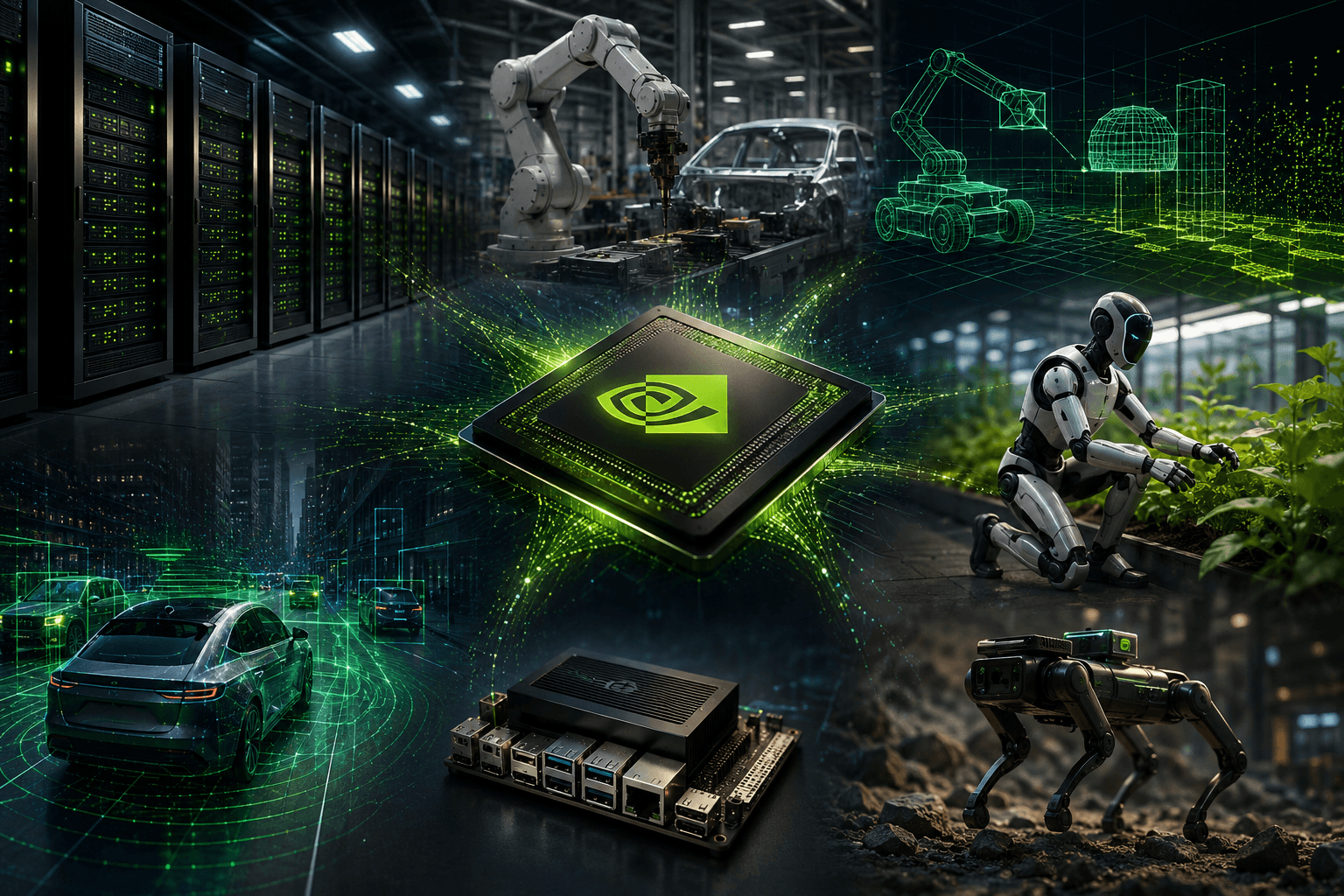
NVIDIA is the easiest physical AI company to recognize and one of the hardest to size correctly. Calling it a GPU company is accurate in the same way that calling Amazon a retailer is accurate. It describes the entry point, not the system that has formed around it.
This deep dive is part of Black Scarab's Top 15 Physical AI Infrastructure Companies series, which maps the infrastructure layers behind physical AI: compute, robot intelligence, perception, safety, deployment software, and field data.
The closest companion reads are Hailo's edge AI acceleration layer, Edge Impulse's embedded AI deployment layer, and Viam's robotics software platform because they show how NVIDIA's data-center and robotics platform can connect to edge acceleration, embedded deployment, and fleet software.
Physical AI needs training infrastructure, simulation, synthetic data, robot learning, vision models, sensor processing, edge inference, safety workflows, developer tools, and deployment partners. NVIDIA already touches most of that chain. Its advantage is not that every piece is finished. Its advantage is that builders can begin almost anywhere in the chain and still find themselves inside an NVIDIA orbit.
That is why NVIDIA remains the gravitational center of physical AI. It can talk about massive data centers and embedded robots without switching categories. A world model trained in a cloud cluster, tested in simulation, optimized for inference, and deployed on an edge module can all pass through NVIDIA hardware, software, libraries, and developer communities.
For investors and operators, the important question is no longer whether NVIDIA benefits from AI. That is obvious. The sharper question is whether physical AI becomes the next durable demand layer after language models: one that pulls compute into factories, fleets, warehouses, vehicles, hospitals, farms, energy sites, construction projects, and machines that have to understand the world before they act in it.
Executive Summary
NVIDIA is positioned as the infrastructure company behind physical AI, not simply a supplier to robotics companies. Its data center GPUs train and serve large models. Its Cosmos work targets world foundation models and synthetic data. Isaac gives robotics teams simulation, robot learning, ROS acceleration, and humanoid development tooling. Omniverse provides digital twin and simulation infrastructure. Jetson and AGX systems move inference closer to the physical environment.
The company now has a clearer financial vocabulary for the split. In its May 20, 2026 Q1 fiscal 2027 release, NVIDIA reported record revenue of $81.6 billion and Data Center revenue of $75.2 billion. It also introduced a reporting framework with Data Center and Edge Computing as market platforms, describing Edge Computing as including data processing devices for agentic and physical AI such as robotics and automotive.
That matters because physical AI is both a cloud problem and an edge problem. The cloud trains, simulates, generates, and coordinates. The edge senses, reacts, controls, and survives local constraints. If NVIDIA can keep both sides connected, physical AI may become less of a robotics market and more of a compute migration: AI leaves the screen and starts demanding infrastructure wherever physical work happens.
NVIDIA's Physical AI Stack
Training and AI factories
NVIDIA Position
GPU systems, networking, CUDA, data center platforms, and accelerated inference software.
Why It Matters
World models, robot policies, synthetic data pipelines, and multimodal systems all increase demand for accelerated compute.
World models
NVIDIA Position
Cosmos for physical AI model development, synthetic data, reasoning over real-world scenarios, and robot policy learning.
Why It Matters
Physical AI needs models that understand motion, cause, space, uncertainty, and possible futures, not only text prediction.
Simulation and digital twins
NVIDIA Position
Omniverse, OpenUSD workflows, physics, rendering, sensor simulation, and industrial digital twin tooling.
Why It Matters
Robots and autonomous systems are too expensive and risky to train only in the real world.
Robotics development
NVIDIA Position
Isaac Sim, Isaac Lab, Isaac ROS, Isaac GR00T, robotics middleware, and CUDA-accelerated robot perception.
Why It Matters
Robotics teams need a development environment that connects training, testing, deployment, and runtime performance.
Edge deployment
NVIDIA Position
Jetson, AGX, IGX, Thor-class systems, partner devices, and optimized AI runtimes.
Why It Matters
Real deployments need local inference for latency, bandwidth, safety, privacy, and uptime.
| Layer | NVIDIA Position | Why It Matters |
|---|---|---|
| Training and AI factories | GPU systems, networking, CUDA, data center platforms, and accelerated inference software. | World models, robot policies, synthetic data pipelines, and multimodal systems all increase demand for accelerated compute. |
| World models | Cosmos for physical AI model development, synthetic data, reasoning over real-world scenarios, and robot policy learning. | Physical AI needs models that understand motion, cause, space, uncertainty, and possible futures, not only text prediction. |
| Simulation and digital twins | Omniverse, OpenUSD workflows, physics, rendering, sensor simulation, and industrial digital twin tooling. | Robots and autonomous systems are too expensive and risky to train only in the real world. |
| Robotics development | Isaac Sim, Isaac Lab, Isaac ROS, Isaac GR00T, robotics middleware, and CUDA-accelerated robot perception. | Robotics teams need a development environment that connects training, testing, deployment, and runtime performance. |
| Edge deployment | Jetson, AGX, IGX, Thor-class systems, partner devices, and optimized AI runtimes. | Real deployments need local inference for latency, bandwidth, safety, privacy, and uptime. |
Black Scarab Weekly
Get the next Black Scarab deep dive
Keep reading now, then get every new deep dive and news report in Thursday's briefing.
Why NVIDIA Starts the Map
Most physical AI companies own a slice of the stack. A camera company owns sensing. A robot company owns embodiment. A software company owns fleet management. A model company owns intelligence. A vertical platform owns workflow and data. NVIDIA is unusual because it has credible claims across the connective tissue between all of those slices.
The company does not need every robot to be branded by NVIDIA. It needs every serious robot builder, simulation provider, industrial AI team, perception startup, autonomous vehicle company, and edge AI integrator to find NVIDIA useful enough that leaving the ecosystem feels expensive. That is a much stronger position than selling one end product.
Physical AI also has a harder coordination problem than pure software. A chatbot can fail inside a browser window. A robot can fail inside a factory aisle. A warehouse vision system can slow a line. A vehicle can make a safety-critical mistake. A construction model can misread site progress. That means buyers tend to prefer known platforms, supportable hardware, mature developer tools, and integration partners that reduce operational risk.
NVIDIA benefits from that buyer psychology. The more physical AI becomes mission-critical, the more buyers care about toolchain maturity, documentation, partner ecosystems, reference architectures, long-term support, and developer familiarity. The fastest chip is important. The trusted path from prototype to deployment may be more important.
Cosmos: World Models for Machines
Cosmos is the clearest sign that NVIDIA sees physical AI as a model category, not only a hardware category. Language models learned patterns in text. Vision models learned patterns in images and video. Physical AI needs models that can reason about environments, objects, motion, interaction, risk, and possible outcomes.
That is why world foundation models matter. A robot, vehicle, drone, inspection system, or industrial vision agent has to do more than classify pixels. It needs to anticipate what could happen next. It needs to understand that a pallet may shift, a pedestrian may step into a path, lighting may change, a tool may occlude a part, a surface may be reflective, or a process may drift outside its expected state.
NVIDIA describes Cosmos as a foundation-model effort for physical AI with open data processing, training, and evaluation frameworks. Its public positioning around Cosmos 3 emphasizes reasoning, world and action generation, robot policy learning, simulation, and synthetic video data. The exact model leaderboard matters less than the direction: NVIDIA is trying to make synthetic worlds and real-world policies part of one development loop.
The business implication is subtle but large. If physical AI progress depends on more real-world data than companies can safely or affordably collect, synthetic data becomes infrastructure. The companies that control the synthetic data pipeline can influence what gets trained, which environments are tested, which edge cases are represented, and how quickly a physical AI system moves from prototype to field deployment.
Where Cosmos Could Matter
Robot learning
Strategic Role
Generate and evaluate scenarios before policies are tested on real machines.
What to Watch
Whether robotics teams use Cosmos to reduce real-world data collection and shorten iteration cycles.
Autonomous vehicles
Strategic Role
Create diverse driving scenes, sensor conditions, and rare events for training and validation.
What to Watch
Whether AV developers trust synthetic outputs enough to make them part of safety-critical validation.
Industrial vision
Strategic Role
Improve inspection and video analytics when real defect data is rare or expensive to label.
What to Watch
Whether synthetic data closes accuracy gaps in messy factories, warehouses, and infrastructure sites.
Humanoid robots
Strategic Role
Support policy learning across manipulation, mobility, perception, and human-scale environments.
What to Watch
Whether foundation models become reusable across robot bodies or stay highly embodiment-specific.
| Use Case | Strategic Role | What to Watch |
|---|---|---|
| Robot learning | Generate and evaluate scenarios before policies are tested on real machines. | Whether robotics teams use Cosmos to reduce real-world data collection and shorten iteration cycles. |
| Autonomous vehicles | Create diverse driving scenes, sensor conditions, and rare events for training and validation. | Whether AV developers trust synthetic outputs enough to make them part of safety-critical validation. |
| Industrial vision | Improve inspection and video analytics when real defect data is rare or expensive to label. | Whether synthetic data closes accuracy gaps in messy factories, warehouses, and infrastructure sites. |
| Humanoid robots | Support policy learning across manipulation, mobility, perception, and human-scale environments. | Whether foundation models become reusable across robot bodies or stay highly embodiment-specific. |
Isaac: Robotics Becomes a Platform Problem
Isaac is NVIDIA's attempt to make robotics development feel less like a pile of disconnected experiments. A serious robot stack has perception, localization, mapping, motion planning, simulation, training, deployment, runtime optimization, middleware, and increasingly foundation models. Every one of those pieces can become a bottleneck.
Isaac matters because many robotics companies do not want to rebuild the same plumbing. They need fast visual SLAM, ROS acceleration, simulation, robot learning workflows, synthetic data, and deployment paths to Jetson or larger edge systems. NVIDIA's Isaac page now connects Isaac Sim, Isaac Lab, Isaac ROS, Cosmos, Jetson Orin, Thor, and Isaac GR00T in a way that makes robotics look like a full-stack workflow instead of a single software kit.
GR00T is particularly important for the investor narrative because humanoid robots are becoming a front door for physical AI. Humanoids are not guaranteed to win the market, but they expose the hardest problems: whole-body control, dexterous manipulation, language-conditioned action, fleet learning, safety, simulation transfer, and real-time inference. If NVIDIA becomes a standard development layer for humanoid teams, the company gains influence even when it does not build the robot body.
The risk is that robotics is brutally specific. A warehouse AMR, a quadruped inspector, a cobot arm, an autonomous tractor, and a humanoid assistant do not share every requirement. NVIDIA can provide the base layer, but the value still has to be finished by robot makers, integrators, sensor vendors, safety systems, and vertical operators. Isaac wins if it reduces that repeated engineering burden. It struggles if each deployment still feels like custom machinery.
Omniverse: The Simulation Layer
Omniverse is often described through graphics and digital twins, but the more important physical AI question is whether simulated environments become part of the normal operating system for building machines. If robots and autonomous systems need to be tested against thousands or millions of scenarios, the simulation layer becomes a strategic control point.
NVIDIA positions Omniverse as accelerated libraries and microservices for physical AI simulation applications and agentic workflows. The site emphasizes OpenUSD, data interoperability, physics, rendering, sensor simulation, runtime services, industrial facility digital twins, robot simulation, autonomous vehicle simulation, synthetic data, and robot learning.
That mix is telling. A factory digital twin is not only a pretty model of a factory. It can become a place to test robot routes, line changes, collision risks, camera placement, worker interaction, equipment layout, and edge cases that would be expensive to test live. A warehouse twin can help evaluate autonomous movement before equipment touches inventory. A construction site model can connect progress data to planning. A vehicle simulation environment can test rare and dangerous scenarios.
The long-term opportunity is that simulation stops being a design artifact and becomes a continuous workflow. Machines learn in simulation, deploy in the field, collect new data, update the model of the environment, and return to simulation for validation. Omniverse is NVIDIA's attempt to sit inside that loop.
Jetson and the Edge
Physical AI cannot live entirely in the cloud. Cloud compute is powerful, but a robot cannot wait on a round trip to decide whether to stop. A factory camera may need local inference because bandwidth is expensive, uptime matters, and video cannot always leave the site. A medical or industrial system may need predictable latency and privacy. A vehicle, drone, or mobile robot needs compute that moves with it.
That is where Jetson and NVIDIA's broader edge systems matter. Jetson gives developers compact modules and developer kits for robotics and edge AI, with software that connects to the rest of the NVIDIA stack. For startups, Jetson is often the first serious embedded AI platform they prototype on. For integrators, it is a familiar option when a customer needs local AI but not a full server rack.
The edge story is not just small hardware. It is a deployment pattern. Models trained in the data center need to be compressed, optimized, monitored, updated, and run under thermal, power, and reliability limits. A model that performs beautifully on a data center GPU may be useless if it cannot meet latency or power budgets in a sealed industrial computer.
This is where NVIDIA's platform advantage becomes practical. CUDA, TensorRT, JetPack, Isaac, Metropolis, partner hardware, and Jetson developer communities make the edge feel less isolated from the data center. That bridge is difficult for competitors to copy quickly because it depends on years of developer habit, not only chip specs.
The Data Center Flywheel
The physical AI story begins at the edge, but the revenue center begins in the data center. World models, synthetic data, multimodal perception, robot policy training, reinforcement learning, simulation, and large-scale inference all require serious accelerated compute. Even when the final system runs locally, much of the learning and validation happens upstream.
NVIDIA's May 2026 financial release makes the scale visible. Q1 fiscal 2027 revenue reached $81.6 billion, up 85% from the prior year. Data Center revenue reached $75.2 billion, up 92% from the prior year. Edge Computing was much smaller at $6.4 billion, but the language around Edge Computing explicitly includes robotics, automotive, PCs, workstations, game consoles, AI-RAN base stations, and data processing devices for agentic and physical AI.
That reporting shift matters. It gives investors a cleaner way to watch whether physical AI becomes a second growth surface rather than a footnote inside automotive or embedded devices. Data Center may fund the model-training boom. Edge Computing may reveal how much AI demand escapes the server room and becomes attached to machines, vehicles, factories, and infrastructure.
The strongest version of the NVIDIA thesis is not that every robot ships with the highest-margin NVIDIA component. It is that physical AI creates demand at both ends: more data center compute to build and improve models, and more edge compute to deploy those models into the world.
The Ecosystem Advantage
NVIDIA's deepest moat may be developer behavior. Hardware competitors can build accelerators. Cloud providers can design custom silicon. Startups can optimize inference chips. But developer habits compound slowly. CUDA familiarity, documentation, tutorials, sample projects, startup programs, university exposure, robotics kits, and partner integrations create a path of least resistance.
In physical AI, that matters because teams are already fighting enough complexity. A founder building an inspection robot does not want to invent a perception pipeline, simulation workflow, deployment runtime, camera compatibility layer, and hardware optimization strategy before getting to the actual customer problem. A plant engineering team does not want a research project when the line is down. A hospital technology team does not want unsupported edge hardware sitting inside a regulated workflow.
NVIDIA does not need perfect lock-in to benefit. It only needs to be the default first choice. Once a prototype is built on Jetson, a simulation workflow is built in Isaac or Omniverse, models are optimized through NVIDIA tooling, and engineers are trained on the stack, replacement becomes a business decision rather than a spec-sheet decision.
That default status can create a quiet toll road through the physical AI economy. Even when the visible product is a robot, camera system, autonomous vehicle, inspection platform, warehouse workflow, or digital twin, NVIDIA may still participate through training, simulation, optimization, edge deployment, or developer infrastructure.
Where NVIDIA Is Vulnerable
The strongest companies create the clearest backlash. NVIDIA's physical AI position is powerful precisely because customers can become uncomfortable with how much depends on one vendor. Cost, supply availability, power draw, thermal design, procurement leverage, software dependency, and strategic control all become real concerns as deployments scale.
At the data center level, hyperscalers and large enterprises will keep looking for custom silicon, internal accelerators, alternative networking, and software layers that reduce dependence on NVIDIA. At the edge, many workloads do not need the biggest GPU. A camera that runs a small model, a sensor that performs local preprocessing, or a microcontroller-class AI task may be better served by lower-cost, lower-power alternatives.
There is also a difference between development standard and production standard. A robotics team may prototype on NVIDIA because it is convenient, then optimize cost later if the product ships at scale. Automotive companies, defense buyers, industrial OEMs, and large manufacturers often want supplier diversity and long-term control over their bill of materials.
Open-source ecosystems can also pressure the stack. ROS, MuJoCo, OpenUSD, PyTorch, ONNX, OpenVLA research, open robotics datasets, and non-NVIDIA inference frameworks can reduce total lock-in. NVIDIA participates in some open ecosystems, but the more physical AI matures, the more customers will ask where openness ends and platform dependency begins.
Key Risks to Watch
Cost pressure
Why It Matters
Large deployments make per-unit edge compute and data center training bills visible.
Signal
Robotics and industrial buyers shift production systems to cheaper accelerators after prototyping.
Power and thermal constraints
Why It Matters
Robots, cameras, vehicles, and rugged computers have tighter limits than server racks.
Signal
Competitors win specific edge niches on watts, size, or passive cooling.
Platform concentration
Why It Matters
Customers may resist being locked into one hardware and software ecosystem.
Signal
Large buyers demand multi-vendor support, open runtimes, or abstraction layers.
Vertical specificity
Why It Matters
Physical AI value often depends on industry workflow, not only compute performance.
Signal
Vertical software companies capture more margin than infrastructure suppliers.
Simulation trust gap
Why It Matters
Synthetic worlds only matter if they transfer to real-world performance and safety.
Signal
Customers require stronger validation before relying on simulated training or testing.
| Risk | Why It Matters | Signal |
|---|---|---|
| Cost pressure | Large deployments make per-unit edge compute and data center training bills visible. | Robotics and industrial buyers shift production systems to cheaper accelerators after prototyping. |
| Power and thermal constraints | Robots, cameras, vehicles, and rugged computers have tighter limits than server racks. | Competitors win specific edge niches on watts, size, or passive cooling. |
| Platform concentration | Customers may resist being locked into one hardware and software ecosystem. | Large buyers demand multi-vendor support, open runtimes, or abstraction layers. |
| Vertical specificity | Physical AI value often depends on industry workflow, not only compute performance. | Vertical software companies capture more margin than infrastructure suppliers. |
| Simulation trust gap | Synthetic worlds only matter if they transfer to real-world performance and safety. | Customers require stronger validation before relying on simulated training or testing. |
What Investors Should Watch
The first signal is whether Cosmos becomes part of real development workflows, not only a launch story. Watch for robotics companies, autonomous vehicle teams, industrial vision providers, and simulation platforms using Cosmos to reduce data bottlenecks, generate edge cases, or improve policy learning.
The second signal is Isaac adoption. If Isaac becomes the standard development environment for humanoids, AMRs, industrial robots, and autonomous machines, NVIDIA gains leverage before hardware selection even begins. GR00T adoption by humanoid developers is especially important because humanoids are likely to attract capital, talent, and public attention even before the market fully matures.
The third signal is Omniverse's industrial pull. Digital twins have been promised for years, but physical AI could make them more necessary. If factories, warehouses, construction sites, and autonomous vehicle programs begin treating simulation as an operational requirement, Omniverse becomes more than a 3D collaboration platform.
The fourth signal is edge revenue visibility. NVIDIA's new reporting framework gives investors a cleaner lens into Edge Computing. Physical AI will not show up neatly as one line item, but growth in robotics, automotive, workstations, industrial edge, and AI-RAN can indicate whether AI is moving from data centers into physical systems.
The fifth signal is margin migration. If the physical AI market rewards only the hardware layer, NVIDIA still wins. If it rewards software, simulation, developer workflows, support, and reference architectures, NVIDIA could participate in more durable platform economics. If vertical platforms capture most of the value, NVIDIA remains essential but less vertically dominant.
How Operators Should Think About NVIDIA
For operators, NVIDIA is usually the right default place to begin, but not always the right place to end. If a company is testing robotics, industrial vision, autonomous inspection, video analytics, digital twins, or edge inference, the NVIDIA ecosystem provides a practical starting path. It reduces early technical uncertainty and expands the pool of developers who can help.
That does not mean every deployment should standardize blindly. A serious physical AI stack should be evaluated at the workload level. What latency is required? How much video leaves the site? How much power is available? Is the device passively cooled? Does the model need to update frequently? What happens when connectivity fails? Who supports the system after installation? What is the cost at ten units, one hundred units, and ten thousand units?
The best operators will treat NVIDIA as a platform option, not a religion. Use the ecosystem where it accelerates development, improves reliability, and lowers integration risk. Challenge it where a narrower workload can run cheaper, cooler, or more openly somewhere else. Physical AI will reward teams that understand the whole stack rather than teams that buy the most impressive component.
The Bottom Line
NVIDIA is the first deep dive because so much of physical AI currently bends around it. The company has the data center scale, developer ecosystem, simulation tooling, robotics software, embedded compute, and partner network to shape how physical AI gets built. It is not simply selling picks and shovels. It is trying to define the mine, the rail system, the refinery, and the marketplace where the output is sold.
The bullish case is that physical AI becomes the next major accelerated computing cycle. Robots, vehicles, cameras, factories, warehouses, hospitals, farms, and infrastructure sites generate demand for training, synthetic data, simulation, inference, and edge deployment. NVIDIA benefits because the stack is already built around its strengths.
The cautious case is that physical AI becomes fragmented, vertical, cost-sensitive, and slower than the investor narrative wants. In that world, NVIDIA still remains important, but value may leak toward vertical software, robot OEMs, sensor companies, integrators, or cheaper edge chips. The company begins the race ahead, but physical AI will test whether an infrastructure giant can stay central when intelligence has to leave the data center and survive the real world.
Sourcing & Verification
This guide was compiled using NVIDIA's official Cosmos, Isaac, Jetson, and Omniverse materials, plus NVIDIA's May 20, 2026 Q1 fiscal 2027 financial results. Product availability, model capabilities, partner adoption, edge hardware roadmaps, and financial segmentation should be rechecked against current NVIDIA releases before investment or procurement decisions.
Black Scarab Weekly
Catch up on physical AI in one email
Every new Black Scarab deep dive and news report, collected into one clear Thursday briefing.
Related Insights
Cross-Industry
The Best Way to Source GPU Compute in 2026
Compute Exchange Deep Dive: How its marketplace helps organizations source reserved GPU capacity and future commitments, and how it compares with hyperscalers, specialist GPU clouds, and direct deals.
Read related insight
Cross-Industry
Ouster Deep Dive: Digital LiDAR, Spatial Perception, and the 3D Sensing Layer of Physical AI
A business and investor deep dive on Ouster, the digital LiDAR company building 3D sensing hardware and software for autonomy, robotics, smart infrastructure, mapping, security, warehouses, ports, and industrial intelligence.
Read related insight
Cross-Industry
Hailo Deep Dive: Edge AI Acceleration, Low-Power Inference, and the Physical AI Compute Layer
A business and investor deep dive on Hailo, the edge AI processor company behind Hailo-8, Hailo-8L, Hailo-10H, Hailo-15, and the Hailo AI Software Suite, showing why efficient local inference is becoming a core deployment layer for physical AI.
Read related insight
Next Step
Explore a commercial opportunity in Mexico
If you are exploring how a physical AI technology could fit the Mexican market, Black Scarab can help assess the opportunity, map relevant stakeholders, and define a credible commercial next step.