
Case Study · Retail
Case Study #4: Walmart's Intelligent Retail Lab – Edge AI for Real-Time Inventory
A real-world look at how Walmart's Intelligent Retail Lab used store-edge AI to detect stockouts, improve forecast accuracy, and turn in-store inventory into a real-time operational signal.
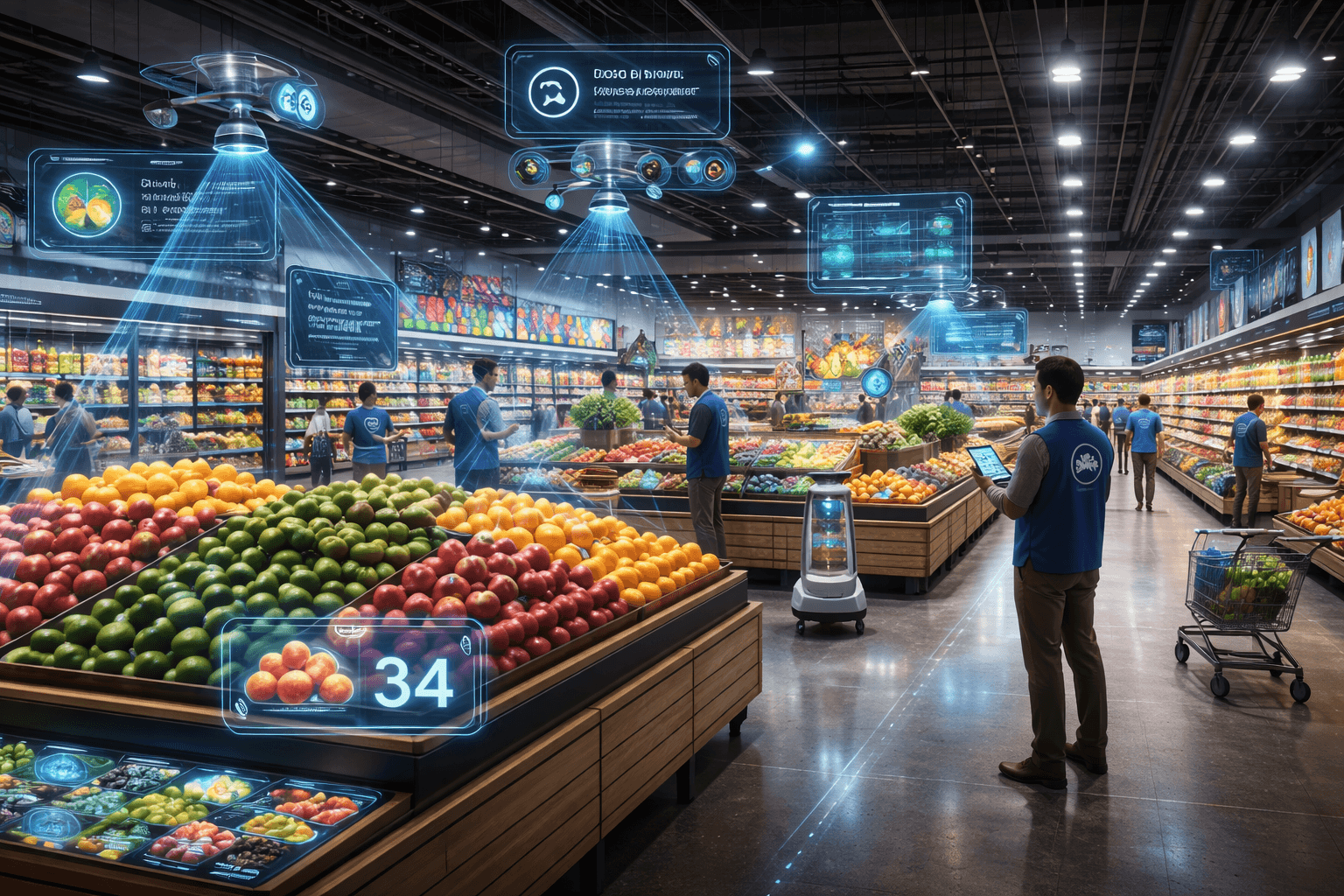
In this case study, we examine how Walmart deployed its Intelligent Retail Lab to solve the stockout problem, where products are missing from shelves despite being in the backroom. By processing data at the store edge, Walmart transformed one of its busiest Neighborhood Markets in Levittown, New York, into a real-time artificial intelligence factory.
1. The Challenge: The $1 Trillion Stockout Problem
For a retailer of Walmart's scale, the biggest threat to revenue is not just competition, it is empty shelves.
The latency barrier: Manually scanning more than 30,000 items across 50,000 square feet is too slow. Traditional cloud-based AI struggles to process the massive data volumes generated by thousands of in-store cameras without significant lag.
Real-time need: Associates need to know the moment a product like ground beef or bananas runs low, not hours later after a cloud batch process completes.
Black Scarab Weekly
Follow the physical AI economy
Get Black Scarab news, deep research, and practical analysis in one clear Thursday briefing.
2. The Solution: A Decentralized Data Center
Walmart retrofitted the IRL store with an array of 1,500 ceiling-mounted cameras and shelf sensors, all connected to a glass-encased, on-site data center.
Localized computer vision: The system uses Edge AI to identify specific products, distinguishing between different weights of meat or the ripeness of bananas.
Instant associate alerts: Instead of employees combing the aisles, the edge processors trigger out-of-stock notifications directly to internal mobile apps. This tells associates exactly what to bring from the backroom before a customer even notices the gap.
Operational edge sensing: Beyond inventory, the local AI tracks shopping cart availability and identifies spills on the floor, allowing for immediate cleanup and hazard prevention.
3. Key Outcomes and Impact
The shift to edge-based intelligence has fundamentally improved store efficiency and the customer experience.
30% increase in forecast accuracy: By combining real-time shelf data with localized demand signals, Walmart improved its inventory predictions and reduced stockouts by 20%.
Labor optimization: Associates spend less time on rote visual audits and more time interacting with customers, as the AI handles the mundane task of shelf-watching.
Privacy-first design: By processing data locally and focusing on products rather than people, Walmart ensures that raw video does not need to be stored or transmitted to a central cloud, maintaining a higher standard of shopper privacy.
4. The Edge Advantage
The IRL project proves that for high-volume retail, the edge is the only place where data can be converted into action at the speed of thought. By keeping the processing power inside the store, Walmart ensures that its inventory systems remain resilient, fast, and highly accurate across its 4,700 U.S. locations.
Sourcing & Verification
This article was compiled using data from Walmart's Corporate Newsroom on the Intelligent Retail Lab, technical blogs from Walmart Global Tech, and operational reports on AI-driven supply chain optimization.
Black Scarab Weekly
Follow the physical AI economy
Get Black Scarab news, deep research, and practical analysis in one clear Thursday briefing.
Related Case Studies
Industrial Robotics
Top Robotic Welding Systems in 2026: Eight Options Compared
Compare eight robotic welding systems for fabrication, repeat production and pipework, with public pricing, an interactive payback calculator and a look at adaptive AI and humanoids.
Read related insight
Robotics
How to Build a Robot With NVIDIA
From a virtual warehouse to onboard inference, a practical guide to the tools, data, and engineering decisions behind a working humanoid.
Read related insight
Physical AI Infrastructure
Encord Deep Dive: Founders, Funding and the Robot Data Market
From image labeling to robot data services, Encord is building a business around the experience machines need to learn useful work.
Read related insight