
Case Study · Transportation & Logistics
Case Study #10: Coca-Cola HBC Warehouse Logistics with AR Picking and Edge AI
A real-world look at how Coca-Cola HBC used AR smart glasses, edge-enabled picking workflows, and TeamViewer Frontline to improve warehouse picking accuracy, reduce training time, and support hands-free logistics operations.
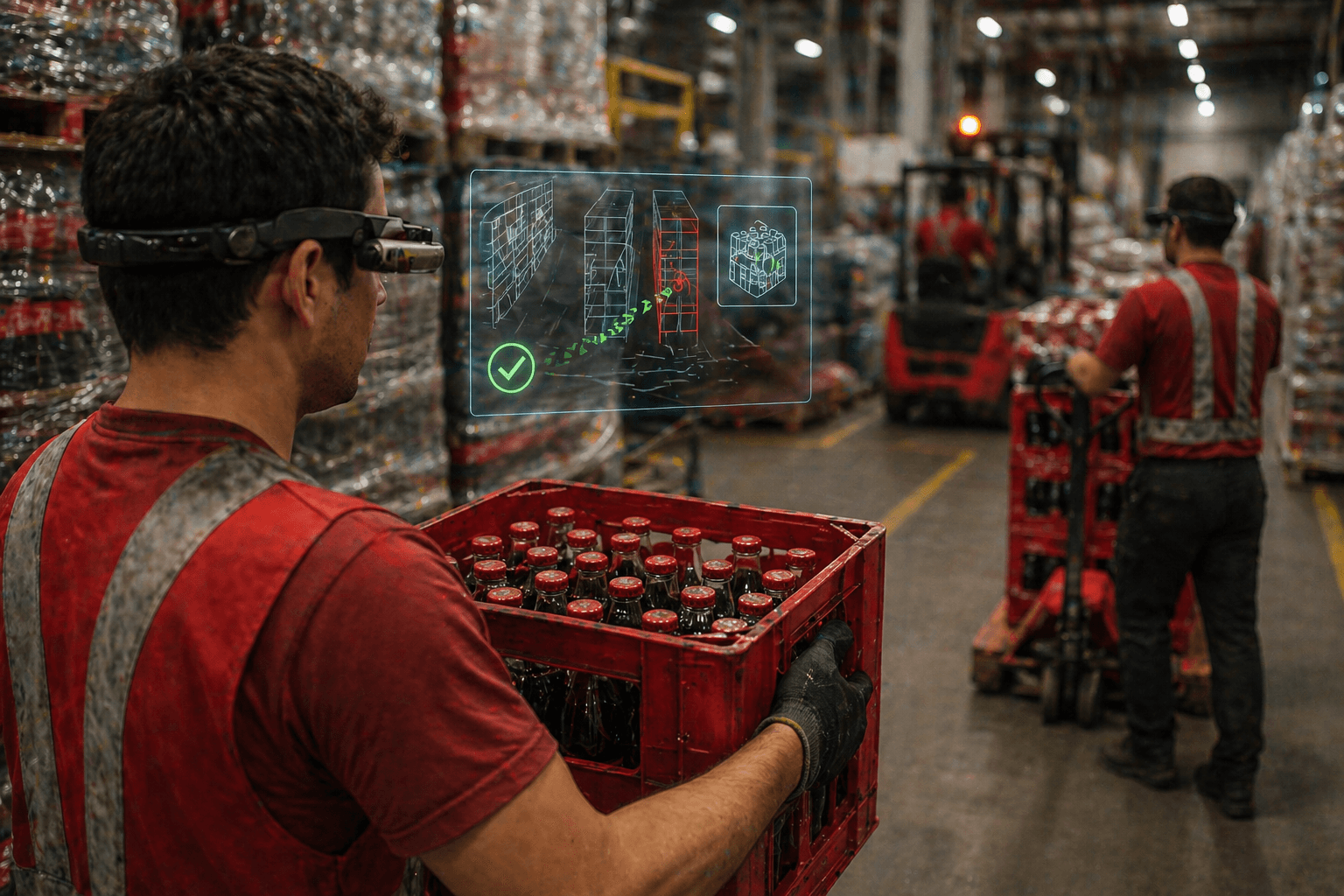
In this case study, we examine how Coca-Cola HBC modernized warehouse logistics by replacing paper-based and handheld picking workflows with augmented reality and edge-enabled wearable systems. By combining smart glasses, local device logic, and TeamViewer Frontline vision picking, the bottler created a hands-free process that improves speed, accuracy, and worker ergonomics in high-volume beverage operations.
1. What It Solved
Coca-Cola HBC's warehouse teams were dealing with the familiar limitations of pick-by-paper and handheld RF scanner workflows in mixed pallet environments.
Accuracy Bottlenecks: Manual picking methods increased the risk of quantity and product errors, leading to returns, rework, and customer dissatisfaction.
Safety and Ergonomics: Handheld scanners and paper lists forced workers to dedicate a hand and part of their attention to the device instead of the physical movement of heavy crates and packs.
Training Time: New workers had to learn warehouse routes, SKUs, and pick logic the hard way. The AR interface reduced training time by 30% by showing step-by-step visual instructions in context.
Black Scarab Weekly
Get the next Black Scarab deep dive
Keep reading now, then get every new deep dive and news report in Thursday's briefing.
2. Process Improvements
The shift to AR-supported picking changed both the accuracy profile and the pace of warehouse execution.
Accuracy Peak: TeamViewer reports that Coca-Cola HBC reached 99.99% picking accuracy after roughly two months of deployment.
Productivity Boost: TeamViewer also says picking performance increased by 6% to 10% because workers located items faster and no longer depended on paper workflows.
Real-Time Inventory Flow: Because the AR workflow is integrated with warehouse systems, confirmation data can flow back immediately as items are picked, improving inventory visibility and reducing fulfillment friction.
CAPEX Efficiency: TeamViewer's case study notes that the solution was cost-effective relative to maintaining or renewing traditional rugged handheld hardware fleets.
3. Hardware and Software Used
The deployment depends on specialized wearable hardware and a warehouse software layer that keeps instructions with the worker instead of on a distant terminal.
Hardware: Smart Glasses: Coca-Cola HBC used industrial AR smart glasses for vision picking workflows, giving warehouse staff a hands-free interface directly in their field of view.
On-Device Scanning and Guidance: The wearable setup supports immediate confirmation and visual navigation without forcing the operator back to separate paper or handheld tools.
Software: TeamViewer Frontline Pick: The vision picking application delivers the AR picking interface and workflow logic used in the warehouse.
Enterprise Integration: TeamViewer states the system integrates with warehouse management systems so task data flows to the glasses and confirmations flow back into logistics operations in real time.
4. The Edge Advantage
For Coca-Cola HBC, the edge is the worker's line of sight on the warehouse floor. By putting instructions, confirmations, and navigation cues directly into a wearable interface, the company reduced friction at the exact moment a picker needs to act. That creates a practical "hands-free logistics" model where speed, ergonomics, and accuracy reinforce each other.
Sourcing & Verification
This article was compiled using TeamViewer's official Coca-Cola HBC customer success material, TeamViewer Frontline platform pages describing warehouse picking performance, and Coca-Cola HBC's 2022 Hungary logistics announcement about AI-supported warehouse operations.
Black Scarab Weekly
Catch up on physical AI in one email
Every new Black Scarab deep dive and news report, collected into one clear Thursday briefing.
Related Case Studies
Transportation & Logistics
Plus One Robotics Deep Dive: The Economics of Supervised Warehouse Autonomy
Inside Plus One Robotics and its supervised autonomy model: how PickOne sees parcels, how Yonder resolves exceptions, what InductOne and DepalOne sell, what the evidence establishes, and how buyers should calculate value.
Read related insight
Transportation & Logistics
Amazon Proteus Deep Dive: Autonomous Mobile Warehouse Robots, Computer Vision, Logistics ROI, Safety, and Deployment Strategy
A business-focused deep dive on Amazon Proteus, covering autonomous mobile warehouse robots, computer vision, human-filled logistics facilities, cart movement, safety, operational ROI, natural-language tasking, and what leaders should learn from Amazon's robotics strategy.
Read related insight
Transportation & Logistics
Case Study #5: FedEx's Smart Sorting Hubs – Edge AI for High-Velocity Logistics
A real-world look at how FedEx integrated edge AI, robotics, and six-sided scanning into major sorting hubs to sustain high package throughput without sacrificing reliability.
Read related insight
Next Step
Explore a commercial opportunity in Mexico
If you are exploring how a physical AI technology could fit the Mexican market, Black Scarab can help assess the opportunity, map relevant stakeholders, and define a credible commercial next step.