
Robotics Series · Cross-Industry
ANYbotics ANYmal Deep Dive: Industrial Inspection Robots for Energy, Mining, Chemicals, and Heavy Industry
A business-focused deep dive on ANYbotics ANYmal, covering autonomous industrial inspection, ANYmal X for Ex-zones, pricing context, ROI logic, sensors, onboarding, enterprise integration, and where quadruped robots make operational sense.
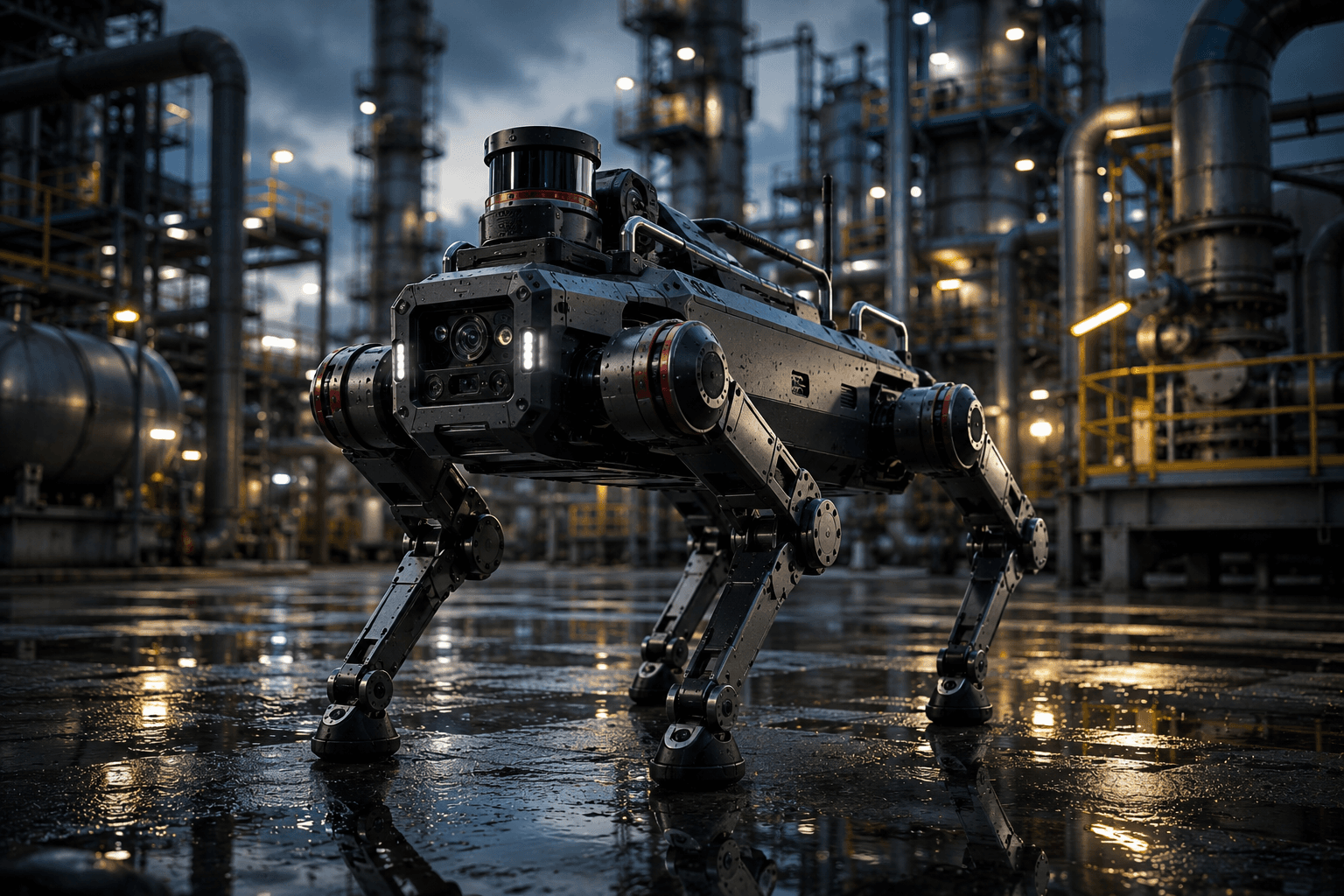
ANYbotics ANYmal is a four-legged industrial inspection robot built for the places where routine inspection is still expensive, hazardous, inconsistent, or trapped in paper-based workflows. It is not a consumer robot and it is not trying to be a general humanoid worker. It is a rugged mobile inspection system for complex plants.
This is the second deep dive in Black Scarab's robotics series. The goal is to help industry leaders understand what is actually available, what the robot does, where it fits, and whether it can help a business. ANYmal matters because it is designed around one of the clearest robotics use cases: autonomous inspection in energy, mining, chemicals, power, utilities, transport, and heavy industry.
This article belongs to the Top 10 Robots Transforming the World in 2026 series. Read it beside Boston Dynamics Spot, Gecko Robotics' asset-health data layer, FORT Robotics' safety and control layer, and Ouster's LiDAR and 3D sensing layer to compare inspection robots, asset-health intelligence, trusted control, and 3D sensing in harsh environments.
The core question is not whether ANYmal can walk. The core question is whether a robot can collect better inspection data, more often, in places where people are exposed to heat, gas, stairs, weather, noise, height, remote access, or explosive-atmosphere restrictions.
Executive Summary
ANYmal is best understood as a recurring inspection coworker. It travels through brownfield industrial facilities, carries a standard sensor suite, captures visual, thermal, acoustic, LiDAR, and optional gas data, and sends that data into software systems where teams can identify anomalies and take action.
ANYbotics offers two main inspection platforms. ANYmal is the rugged industrial-grade robot for demanding facilities. ANYmal X is the Ex-certified variant built for explosive atmospheres, including Zone 1 environments under ATEX and IECEx standards. That distinction matters for chemicals, oil and gas, and other facilities where ordinary electronics cannot simply walk into classified areas.
For executives, ANYmal should be evaluated as an inspection program, not a robot purchase. The robot only creates value when inspection routes, data models, alerts, maintenance workflows, and site operations are designed around it.
ANYmal at a Glance
What is it?
Practical Answer
A rugged autonomous quadruped robot for industrial inspection and data collection.
What is ANYmal X?
Practical Answer
An Ex-certified version for explosive atmospheres, including Zone 1 IIB use cases.
Who is it for?
Practical Answer
Chemicals, oil and gas, power and utilities, mining, metals, minerals, transport, and complex industrial sites.
What does it collect?
Practical Answer
Visual, thermal, acoustic, LiDAR, and optional gas or acoustic-imaging data.
What does it need to succeed?
Practical Answer
Defined inspection routes, docking, onboarding, integration, safety process, and maintenance-system ownership.
| Question | Practical Answer |
|---|---|
| What is it? | A rugged autonomous quadruped robot for industrial inspection and data collection. |
| What is ANYmal X? | An Ex-certified version for explosive atmospheres, including Zone 1 IIB use cases. |
| Who is it for? | Chemicals, oil and gas, power and utilities, mining, metals, minerals, transport, and complex industrial sites. |
| What does it collect? | Visual, thermal, acoustic, LiDAR, and optional gas or acoustic-imaging data. |
| What does it need to succeed? | Defined inspection routes, docking, onboarding, integration, safety process, and maintenance-system ownership. |
Black Scarab Weekly
Follow the physical AI economy
Get Black Scarab news, deep research, and practical analysis in one clear Thursday briefing.
What ANYmal Actually Does
ANYmal's job is to automate recurring inspection rounds in complex industrial facilities. It can navigate multi-floor plants, stairs, wet or bumpy terrain, cramped positions, and low-light environments while carrying sensors that collect information operators normally gather manually.
The standard ANYmal payload includes visual and thermal cameras, a pan-tilt unit, spotlight, ultrasonic microphone, and LiDAR. ANYbotics also describes custom sensor options for gas sensing and acoustic imaging. This makes the robot useful for more than video: it can monitor temperature, detect acoustic anomalies, help localize leaks, document reality, and support predictive maintenance.
The hardware specs are business-relevant because they describe operational rhythm. ANYbotics lists roughly 90 minutes of battery run time, 100 minutes for a 70 percent quick charge, three hours for a full charge, a 2 km walking range, 0.75 m/s normal walking speed, built-in Wi-Fi and 4G/LTE, IP67 ruggedization, 360-degree LiDAR, six depth cameras, and onboard edge compute powered by dual Intel i7 processors.
Where ANYmal Is Being Used
ANYmal is strongest in industries where routine inspection intersects with safety risk and asset uptime. ANYbotics explicitly positions the platform for oil and gas, chemicals, power and utilities, mining, metals and minerals, railway, transportation, construction, and other heavy industrial environments.
In chemicals, ANYmal can monitor assets, identify thermal anomalies, detect gas presence, create 3D reality capture, and reduce operator exposure in corrosive, gaseous, high-temperature, and ATEX-classified areas. The ANYmal X version is especially important because many chemical and oil and gas facilities have Zone 1 areas where certified equipment is required.
In power and utilities, the robot can inspect substations and equipment without requiring a human to walk every route. In mining and metals, the value is visibility in environments that can be remote, uneven, dusty, wet, or difficult to access. In transport and rail, the logic is similar: recurring inspection points, safety concerns, asset continuity, and the need to turn visual checks into operational data.
Industries Where ANYmal Fits Best
Chemicals
Likely Use Case
Thermal inspection, gas presence, anomaly detection, ATEX and non-ATEX inspection rounds.
Why It Matters
Reduces exposure in hazardous areas and helps teams detect avoidable failures earlier.
Oil and gas
Likely Use Case
Offshore and onshore inspection, gas sensing, acoustic monitoring, remote site checks.
Why It Matters
Supports inspection in dangerous, remote, or explosive-atmosphere environments.
Power and utilities
Likely Use Case
Substation monitoring, thermal checks, asset inspection, remote facility patrols.
Why It Matters
Improves inspection consistency while reducing unnecessary human exposure.
Mining, metals, and minerals
Likely Use Case
Tunnel and plant inspection, harsh-terrain mobility, environmental sensing.
Why It Matters
Provides routine visibility in sites where access can be difficult or risky.
Transportation and rail
Likely Use Case
Infrastructure inspection, facility monitoring, recurring condition checks.
Why It Matters
Turns repeated walkdowns into structured digital inspection data.
Data centers and large facilities
Likely Use Case
Thermal monitoring, equipment checks, remote operations support.
Why It Matters
Helps operators monitor critical assets with repeatable routes and sensor data.
| Industry | Likely Use Case | Why It Matters |
|---|---|---|
| Chemicals | Thermal inspection, gas presence, anomaly detection, ATEX and non-ATEX inspection rounds. | Reduces exposure in hazardous areas and helps teams detect avoidable failures earlier. |
| Oil and gas | Offshore and onshore inspection, gas sensing, acoustic monitoring, remote site checks. | Supports inspection in dangerous, remote, or explosive-atmosphere environments. |
| Power and utilities | Substation monitoring, thermal checks, asset inspection, remote facility patrols. | Improves inspection consistency while reducing unnecessary human exposure. |
| Mining, metals, and minerals | Tunnel and plant inspection, harsh-terrain mobility, environmental sensing. | Provides routine visibility in sites where access can be difficult or risky. |
| Transportation and rail | Infrastructure inspection, facility monitoring, recurring condition checks. | Turns repeated walkdowns into structured digital inspection data. |
| Data centers and large facilities | Thermal monitoring, equipment checks, remote operations support. | Helps operators monitor critical assets with repeatable routes and sensor data. |
Pricing and Total Cost
ANYbotics does not publish a simple retail price for ANYmal or ANYmal X. That is normal for enterprise inspection robotics. The robot is usually sold as part of a configured deployment that depends on site requirements, safety classification, payloads, docking, software, onboarding, support, and integration scope.
Business leaders should avoid asking only, 'How much does the robot cost?' A better question is, 'What does it cost to turn inspection rounds into reliable operational data?' The total program can include the robot, docking stations, sensor configuration, Data Navigator, mission design, CAD or digital-twin setup, site validation, training, support, cloud or enterprise integration, and internal maintenance-process changes.
ANYmal X can also change the cost discussion because Ex-certified deployments are more specialized. If the alternative is sending people into Zone 1 environments, issuing permits, limiting inspection frequency, or missing early signs of failure, the economics are not comparable to buying a generic robot for a clean warehouse.
ANYmal Cost Areas to Budget For
Robot platform
What It Covers
ANYmal or ANYmal X, base mobility, onboard compute, batteries, tablet, charger, and core autonomy.
Buyer Note
Current pricing should be quoted directly through ANYbotics or partners.
Inspection payloads
What It Covers
Visual, thermal, acoustic, LiDAR, gas sensing, acoustic imaging, or specialized sensors.
Buyer Note
Sensor selection determines whether the robot produces useful data or only media.
Docking and route coverage
What It Covers
Docking station, charging strategy, range extension, multi-floor route planning.
Buyer Note
Important for repeat autonomous inspection rather than occasional manual operation.
Software and data layer
What It Covers
Data Navigator, cloud services, dashboards, APIs, enterprise integrations.
Buyer Note
The value comes from turning robot observations into maintenance actions.
Onboarding and support
What It Covers
Virtual setup, CAD/BIM route validation, field engineering, operator training, safety process.
Buyer Note
ANYbotics emphasizes onboarding because plant deployment is an operational change, not a plug-in gadget.
| Cost Area | What It Covers | Buyer Note |
|---|---|---|
| Robot platform | ANYmal or ANYmal X, base mobility, onboard compute, batteries, tablet, charger, and core autonomy. | Current pricing should be quoted directly through ANYbotics or partners. |
| Inspection payloads | Visual, thermal, acoustic, LiDAR, gas sensing, acoustic imaging, or specialized sensors. | Sensor selection determines whether the robot produces useful data or only media. |
| Docking and route coverage | Docking station, charging strategy, range extension, multi-floor route planning. | Important for repeat autonomous inspection rather than occasional manual operation. |
| Software and data layer | Data Navigator, cloud services, dashboards, APIs, enterprise integrations. | The value comes from turning robot observations into maintenance actions. |
| Onboarding and support | Virtual setup, CAD/BIM route validation, field engineering, operator training, safety process. | ANYbotics emphasizes onboarding because plant deployment is an operational change, not a plug-in gadget. |
For procurement, treat ANYmal as an inspection solution quote rather than a retail hardware SKU.
Why Companies Integrate ANYmal
The strongest reason to integrate ANYmal is to make inspection more frequent, safer, and more digital. In many industrial plants, inspection still depends on humans walking routes, reading gauges, listening for abnormal sounds, taking thermal readings, writing notes, and deciding what to escalate.
ANYmal changes the inspection model by giving facilities a repeatable mobile data collector. It can follow planned routes, collect the same categories of data over time, and support trend analysis. The value is not just remote walking. The value is repeatable condition monitoring.
ANYbotics highlights chemical-industry examples where thermal, visual, and acoustic data helped identify avoidable failures. On its chemicals page, ANYbotics quotes Grace's automation and robotics team saying extrapolated savings showed about a 1.5 percent increase in production uptime for one plant directly attributable to ANYmal. That is the kind of business signal leaders should look for: not robot novelty, but measurable uptime impact.
The ROI Logic
ANYmal's ROI does not come from replacing every human inspector. It comes from improving inspection frequency, safety, data quality, early anomaly detection, and the ability to document plant conditions consistently.
The best ROI cases are facilities where downtime is expensive, environments are hazardous, inspection routes are repetitive, and there are many assets that do not justify fixed sensors at every point. A robot can move between assets and bring the sensor package to the inspection point.
The wrong ROI case is vague curiosity. If leadership cannot name the route, the asset class, the anomaly, the safety exposure, or the action that follows detection, the project is not ready. Robots do not create value just by existing in a plant.
ANYmal ROI Checklist
Is the inspection route repetitive?
Why It Matters
Repeatability lets the business compare conditions over time.
Is the environment hazardous, remote, or hard to access?
Why It Matters
Safety and access constraints make mobile robotics more valuable.
Are fixed sensors too expensive or incomplete?
Why It Matters
A mobile robot can inspect multiple assets with one sensor suite.
Can the robot data trigger action?
Why It Matters
Alerts, work orders, and maintenance review are where data becomes ROI.
Does the site need Ex certification?
Why It Matters
For Zone 1 and explosive atmospheres, ANYmal X may matter more than generic quadruped capability.
| Question | Why It Matters |
|---|---|
| Is the inspection route repetitive? | Repeatability lets the business compare conditions over time. |
| Is the environment hazardous, remote, or hard to access? | Safety and access constraints make mobile robotics more valuable. |
| Are fixed sensors too expensive or incomplete? | A mobile robot can inspect multiple assets with one sensor suite. |
| Can the robot data trigger action? | Alerts, work orders, and maintenance review are where data becomes ROI. |
| Does the site need Ex certification? | For Zone 1 and explosive atmospheres, ANYmal X may matter more than generic quadruped capability. |
The Edge AI Stack Behind ANYmal
ANYmal is useful for Black Scarab's audience because it makes the edge AI stack visible. The robot is not only a walking machine. It is a package of locomotion, sensing, onboard compute, autonomy, connectivity, docking, software, cloud services, enterprise integration, and safety design.
At the sensing layer, ANYmal can collect visual, thermal, acoustic, ultrasonic, LiDAR, and gas data. At the autonomy layer, it can navigate complex multi-floor environments, including industrial stairs, wet terrain, and low-light areas. At the software layer, Data Navigator turns inspection data into actionable insights, while ANYbotics' AWS-backed infrastructure supports fleet data, telemetry, mission control, and customer access.
For a buyer, this means the robot should be specified around the data product. A route that needs thermal anomaly detection requires a different payload and alert workflow than a route focused on gas presence, acoustic leak detection, gauge reading, or 3D reality capture.
What an ANYmal Deployment Really Includes
Robot platform
Examples
ANYmal or ANYmal X, legs, onboard compute, batteries, rugged tablet, docking.
Business Question
Can the robot physically and safely operate in our site conditions?
Sensing
Examples
Visual camera, thermal camera, ultrasonic microphone, LiDAR, gas sensors, acoustic imaging.
Business Question
What condition data do we need to collect?
Autonomy
Examples
Route execution, stair navigation, low-light operation, docking, connectivity fallback.
Business Question
Can the inspection be repeated without constant manual driving?
Software
Examples
Data Navigator, cloud data, telemetry, mission management, enterprise integrations.
Business Question
Will the data reach the teams and systems that act on it?
Operations
Examples
Onboarding, route validation, field engineering, safety rules, training, support.
Business Question
Who owns the robot program after the first demo?
| Layer | Examples | Business Question |
|---|---|---|
| Robot platform | ANYmal or ANYmal X, legs, onboard compute, batteries, rugged tablet, docking. | Can the robot physically and safely operate in our site conditions? |
| Sensing | Visual camera, thermal camera, ultrasonic microphone, LiDAR, gas sensors, acoustic imaging. | What condition data do we need to collect? |
| Autonomy | Route execution, stair navigation, low-light operation, docking, connectivity fallback. | Can the inspection be repeated without constant manual driving? |
| Software | Data Navigator, cloud data, telemetry, mission management, enterprise integrations. | Will the data reach the teams and systems that act on it? |
| Operations | Onboarding, route validation, field engineering, safety rules, training, support. | Who owns the robot program after the first demo? |
Deployment Pattern: Why Onboarding Matters
ANYbotics' onboarding process is worth paying attention to because it reveals the reality of industrial robotics. Deployment is not only about shipping a robot. It requires task selection, route definition, virtual setup, site validation, integration, training, safety process, and continuing support.
ANYbotics describes using CAD, BIM, or site data to virtually set up and validate inspection missions before deployment. That matters for brownfield plants because robots need to work around existing stairs, equipment, routes, lighting, surfaces, and safety zones.
This is where many robotics projects succeed or fail. A good pilot has a specific route and a clear operational owner. A weak pilot asks the robot to wander around and impress people. The first version might look more exciting, but the second version is the one that can become a business system.
When ANYmal Is a Bad Fit
ANYmal is not the right answer for every site. If the environment is clean, flat, predictable, and mostly about moving goods, an autonomous mobile robot may be cheaper. If the job is a fixed manipulation task, a cobot arm may be better. If the inspection point can be covered by one fixed sensor, a walking robot may be unnecessary.
It is also a bad fit when the company does not have a maintenance workflow ready to receive the data. If thermal readings, gas alerts, or acoustic anomalies do not create review, escalation, or work orders, the robot is only producing another stream of files.
ANYmal is strongest where mobility, ruggedness, repeatability, safety, and multi-sensor inspection are all required. If only one of those matters, there may be a simpler answer.
Implementation Roadmap for a First Pilot
A first ANYmal pilot should be designed around one inspection program, not broad robotics excitement. The goal is to prove that the robot can capture useful data repeatedly, safely, and in a way that operations teams can act on.
The best starting point is usually a route with clear pain: recurring manual inspection, safety exposure, hard-to-reach equipment, thermal or acoustic anomaly risk, gas concerns, or downtime history. Once that route is understood, the robot, payloads, docking, and software can be specified around it.
First ANYmal Pilot Plan
1
Action
Select one high-value inspection route.
Success Signal
The route has safety, downtime, labor, or compliance relevance.
2
Action
Define the inspection data product.
Success Signal
The team knows whether it needs thermal, acoustic, visual, LiDAR, gas, or gauge data.
3
Action
Validate the route virtually and on site.
Success Signal
Stairs, lighting, surfaces, connectivity, doors, and safety zones are understood.
4
Action
Run supervised missions.
Success Signal
Operators can complete the route safely and collect consistent data.
5
Action
Automate and integrate.
Success Signal
Robot data flows into dashboards, maintenance review, or work-order logic.
6
Action
Scale only after proving the workflow.
Success Signal
The pilot shows enough value to justify docks, more routes, or multi-site rollout.
| Step | Action | Success Signal |
|---|---|---|
| 1 | Select one high-value inspection route. | The route has safety, downtime, labor, or compliance relevance. |
| 2 | Define the inspection data product. | The team knows whether it needs thermal, acoustic, visual, LiDAR, gas, or gauge data. |
| 3 | Validate the route virtually and on site. | Stairs, lighting, surfaces, connectivity, doors, and safety zones are understood. |
| 4 | Run supervised missions. | Operators can complete the route safely and collect consistent data. |
| 5 | Automate and integrate. | Robot data flows into dashboards, maintenance review, or work-order logic. |
| 6 | Scale only after proving the workflow. | The pilot shows enough value to justify docks, more routes, or multi-site rollout. |
Black Scarab Takeaway
ANYbotics ANYmal is one of the clearest examples of robotics becoming an industrial data strategy. The robot is valuable because it carries sensors through hard environments and makes inspection repeatable.
For industry leaders, the right lesson is not that every facility needs a quadruped robot. The lesson is that inspection is becoming mobile, autonomous, and software-connected. The winning deployments will be the ones where the robot is tied to asset performance, safety, maintenance planning, and plant uptime.
For Black Scarab's catalog vision, ANYmal reinforces the same pattern we saw with Spot: the robot body is only one part of the basket. A real deployment needs cameras, thermal sensing, acoustic sensing, gas detection, LiDAR, edge compute, wireless connectivity, docking, dashboards, integrations, and support.
Sourcing & Verification
This guide was compiled using ANYbotics product pages for ANYmal and ANYmal X, ANYbotics industry materials for chemicals and industrial inspection, onboarding documentation, AWS's ANYbotics robotics infrastructure case study, SAP's 2026 coverage of ANYbotics industrial inspection integration, and public ANYbotics customer materials related to BASF, PETRONAS, RTE, Grace, and Digital Realty. Current pricing and deployment configuration should be verified directly with ANYbotics or an authorized partner before procurement.
Black Scarab Weekly
Follow the physical AI economy
Get Black Scarab news, deep research, and practical analysis in one clear Thursday briefing.
Related Insights
Cross-Industry
The Best Way to Source GPU Compute in 2026
Compute Exchange Deep Dive: How its marketplace helps organizations source reserved GPU capacity and future commitments, and how it compares with hyperscalers, specialist GPU clouds, and direct deals.
Read related insight
Cross-Industry
Ouster Deep Dive: Digital LiDAR, Spatial Perception, and the 3D Sensing Layer of Physical AI
A business and investor deep dive on Ouster, the digital LiDAR company building 3D sensing hardware and software for autonomy, robotics, smart infrastructure, mapping, security, warehouses, ports, and industrial intelligence.
Read related insight
Cross-Industry
Hailo Deep Dive: Edge AI Acceleration, Low-Power Inference, and the Physical AI Compute Layer
A business and investor deep dive on Hailo, the edge AI processor company behind Hailo-8, Hailo-8L, Hailo-10H, Hailo-15, and the Hailo AI Software Suite, showing why efficient local inference is becoming a core deployment layer for physical AI.
Read related insight